Does Every Pipeline Joint Need Sealing? Evidence for a Repair Scope
Use NASSCO guidance, EPA rehabilitation criteria and inspection research to scope joint sealing, separate leakage from wall damage and prepare measured records.
By Reliance Trenchless Technology7 min read
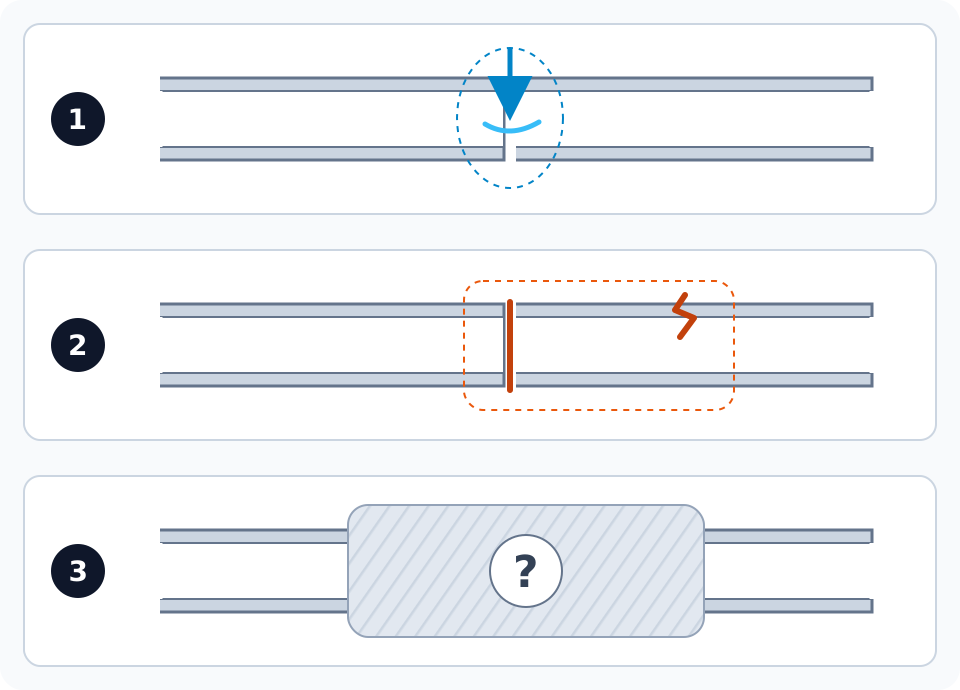
Short answer: no, not automatically. The repair scope should follow the condition of the whole pipe section, the results of any required tests, and the owner's acceptance requirements. Some joints may need sealing; others may need further investigation or no intervention. A clear CCTV image alone does not establish watertightness, and joint sealing does not automatically address damage between joints.
A useful distinction comes from NASSCO's mainline grouting overview: it calls for testing all joints and sealing those that fail. Testing every joint and installing a seal at every joint are different scopes. That example concerns injection grouting; it is not an installation or test procedure for Reliance mechanical joint seals.
What the authorities say about repair scope
The US EPA's 2005 CMOM guide, section 2.5, describes non-structural repairs as typically sealing leaking joints in otherwise sound pipe. Structural repairs involve replacement of all or part of a line, or lining. It says method selection depends on pipe size, type, location, dimensional changes, flow, surface conditions and the severity of infiltration and inflow.
NASSCO also explains that a pipeline can appear structurally sound while its joints have lost watertightness. In its mainline grouting example, joints are air-tested, failed joints are injected, and a further test confirms the seal. This is evidence for checking joint performance rather than deciding from appearance alone. The relevant project specification must define the appropriate test, acceptance criteria and records; this article supplies no test pressure or operating procedure.
For an owner, the practical question is therefore: which locations need leakage control, which need a structural repair, and what evidence is still missing? A project may require systematic testing or a broader rehabilitation programme. The answer should not be reduced to either "seal everything" or "repair only the joint visibly leaking today".
What inspection data can and cannot tell you
NASSCO's assessment guidance describes CCTV as a way to identify structural and maintenance defects, infiltration, obstructions and connections. Lighting, camera centring and focus affect inspection quality. Its PACP programme provides consistent condition coding so owners can identify and prioritise work from recorded observations.
There is also research on how reliably those observations are interpreted. In The consistency of visual sewer inspection data, Dirksen and colleagues (2013) studied reproducibility using inspector examination results, routine inspection data and repeated interpretation of reports. The publicly available author-manuscript abstract reports a false-positive probability of a few percent and a false-negative probability of approximately 25% for recognising defects. These are approximate findings from that study, not a leakage rate, a seal-failure rate or a current industry-wide CCTV accuracy figure. The accessible extract does not provide the full sample and methods, so the number should be read as a reported research finding with that limitation.
Measurement needs similar care. Under "Laser and Sonar", NASSCO describes laser-profiling systems for 6–72 inch pipelines and reports accuracy up to 1 mm, while stressing calibration and operator training. Those figures describe the technology in that overview. They do not make an ordinary CCTV screenshot a millimetre measurement or establish the accuracy of the equipment used on your project.
The EPA guide, sections 2.4.2–2.4.3, distinguishes system testing from visual inspection and calls for identifiable, standardised inspection records. A useful joint record includes:
The asset reference, survey date, survey direction and inspected length.
The joint's distance from a known reference, plus the original video timestamp.
The observed condition: infiltration, an open joint, offset, roots, deposits or adjacent cracking.
Flow and visibility conditions, and anything hidden by standing water, debris or obstruction.
Measured bore, joint opening and offset, with the method, units and measurement location; keep visual estimates separate.
Any required test result, its acceptance basis, and the joints or areas still awaiting investigation.
Do not label exfiltration as confirmed simply because a joint looks open in a video. Keep observed conditions, measured dimensions and leakage-test results distinct. The CCTV information guide helps organise the records for review.
Sort the evidence before selecting a product
The groups below translate the EPA distinction between leakage control and structural rehabilitation into a review checklist. They organise information; they are not engineering acceptance criteria.
| Recorded condition | What needs review | Related information |
|---|---|---|
| A leaking joint or failed joint test, with adjacent pipe assessed as sound | Whether the proposed joint-sealing method suits the measured bore, joint geometry, seating surfaces and access | Joint seal measurement guide |
| A joint defect with cracking or damage in the adjacent wall | Whether leakage control, a repair covering the damaged length, or both are required | Joint seals vs repair sleeves |
| Joint and wall defects distributed along a section | Whether repeated local repairs or a longer rehabilitation scope best meets the project's requirements | Sectional repair vs full-length CIPP |
| No visible defect at a joint | Record the observation; check whether specified testing or further investigation is still required before treating the joint as accepted | CCTV information guide |
| An obscured joint, missing dimensions or conflicting records | Resolve the evidence gap through suitable cleaning, re-inspection, measurement or testing before selecting a configuration | CCTV information guide |
Keep the joint seal and the damaged pipe length distinct
The EPA's distinction matters when comparing products: sealing a joint in otherwise sound pipe and rehabilitating damaged pipe wall are different design tasks. Do not assume that selecting a component called a "seal" resolves both.
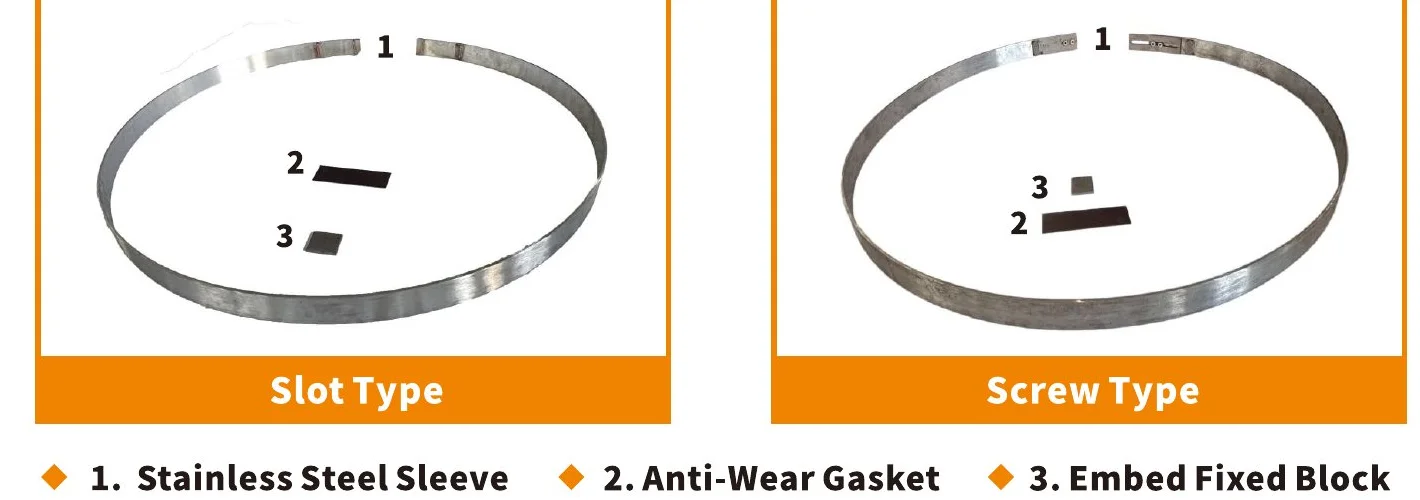
The Reliance Internal Pipe Seal brochure, page 2, shows slot-type and screw-type stainless steel ring assemblies, a rubber sealing element and installation accessories. It lists rubber widths of 270, 350 and 500 mm. These are published product options, not allowable joint openings or structural repair lengths.
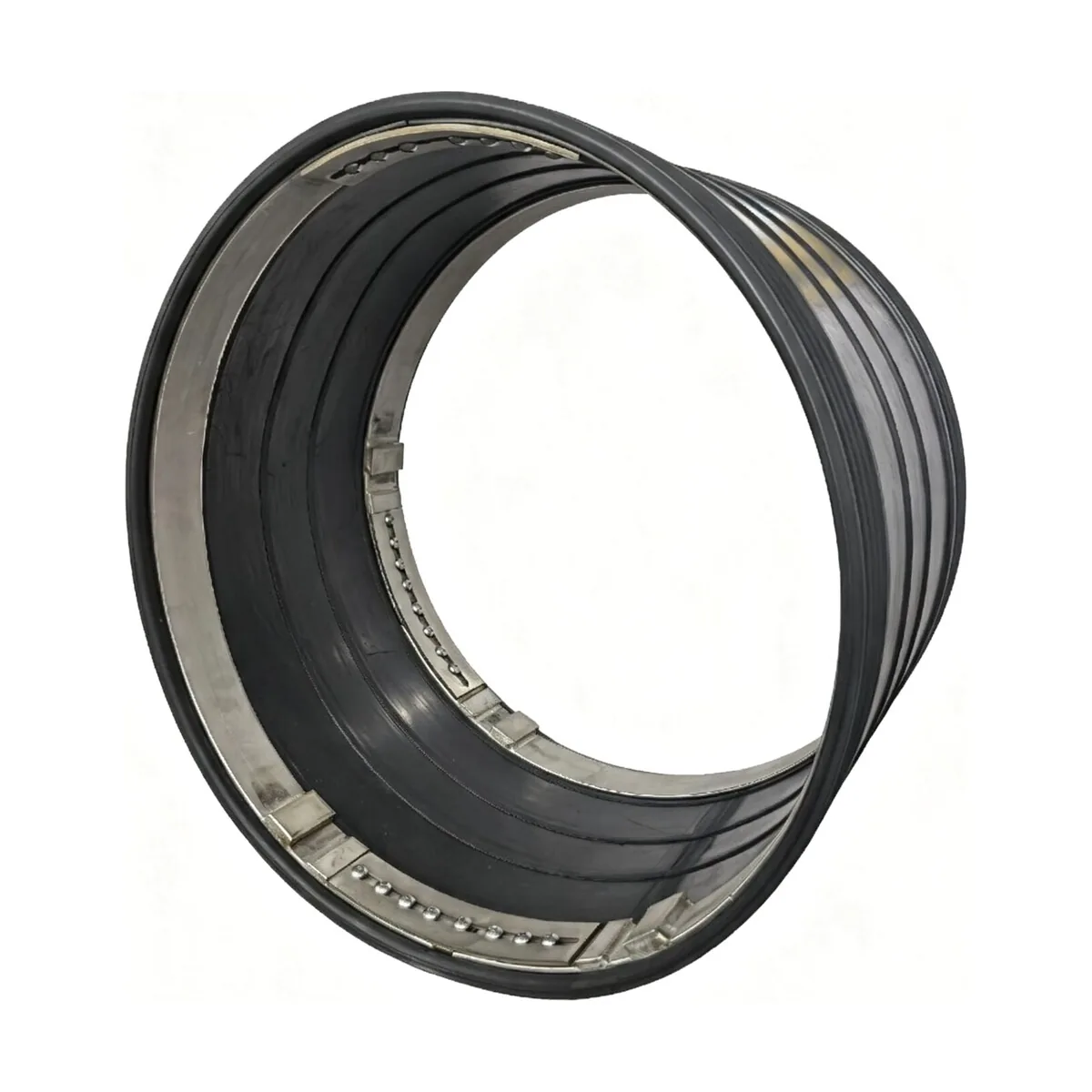
The brochure lists DN200–3000 and customised sizes. The website dimensions table provides geometry rows from DN200 to DN1800; separate WW and DW model tables include other sizes. The dimensions table is not the complete product range. Request the dimensions for the particular model: nominal DN alone does not confirm the measured bore, usable seating area or an approved configuration.
The Instant-Lock small and large ranges are separate internal repair-sleeve options. Use the joint seals vs repair sleeves guide to compare the tasks and documents required, then obtain a project-specific review of the proposed system.
When the whole section needs a wider review
The EPA guide connects rehabilitation to structural integrity, control of infiltration and inflow, and control of exfiltration. Its section 2.5 also asks owners to consider service laterals and manholes. A joint-only repair list may therefore be incomplete when the evidence points to leakage elsewhere in the system.
Review the wider scope when defects are distributed, joint damage is mixed with wall damage, dimensions conflict, or flow and access constrain individual installations. There is no universal number of defective joints in the sources cited here that determines when local sealing must give way to lining or replacement. Compare the actual condition, required outcome, practical access and acceptance plan.
Materials also need evidence. The public summary of ASTM D471-16a, sections 4.1–4.3, explains that liquid exposure can affect rubber properties and that controlled comparative tests may not correlate directly with actual part performance. Confirm the conveyed medium, concentration where relevant, temperature and service conditions for the proposed rubber and metal grades. This standard reference does not mean that a Reliance seal has been tested or approved to it.
What to send for a joint-sealing review
Prepare a joint schedule that includes both the proposed repairs and the unresolved locations:
The asset reference, original inspection video and report, survey date and inspected direction.
Each joint location, timestamp, observed defect and any test result with its acceptance requirement.
The measured internal bore on both sides, joint opening, offset and available seating area, including the measurement method and units.
The condition of the adjacent pipe wall and the extent of other defects along the section.
Installation access, flow-control requirements and practical constraints.
The conveyed medium and known service conditions, with the source of each value.
The joints not proposed for repair, the evidence supporting that choice, and any remaining investigation or testing.
For dimension and assembly questions, use the internal pipe joint seal measurement guide. Then send a project enquiry with the schedule and supporting records.
References and source documents
NASSCO — Pipe Rehabilitation: injection and mainline grouting, testing and sealing failed joints
US EPA — CMOM guide, EPA 305-B-05-002 (January 2005), sections 2.4.2–2.5, printed pages 2-38–2-42
NASSCO — Assessment: CCTV, laser and sonar, calibration and inspection records
NASSCO — PACP / LACP / MACP: consistent condition coding and asset prioritisation
ASTM D471-16a — Rubber exposed to liquids: public Significance and Use, sections 4.1–4.3
Reliance Internal Pipe Seal brochure — assemblies, rubber widths and size range, page 2
Reliance internal pipe seal — dimensions table DN200–DN1800; separate WW/DW model tables
Further reading
Article
Pipe Plug vs Repair Packer: What Is the Difference?
Buyer guide
Internal Pipe Joint Seals: What to Measure Before Ordering
Buyer guide
Internal Pipe Joint Seals vs Repair Sleeves: What Is the Difference?
Buyer guide
Sectional Point Repair vs Full-Length CIPP Lining
Buyer guide
What CCTV Inspection Information Is Needed Before Pipe Point Repair?