
Reading P60/120 and P90/160 Mortar Pump Tables
Technical guide to reading P60/120 and P90/160 mortar pump tables. Compare flow rate, line pressure, vertical head loss, and jobsite power requirements.
By Reliance Trenchless Technology4 min read
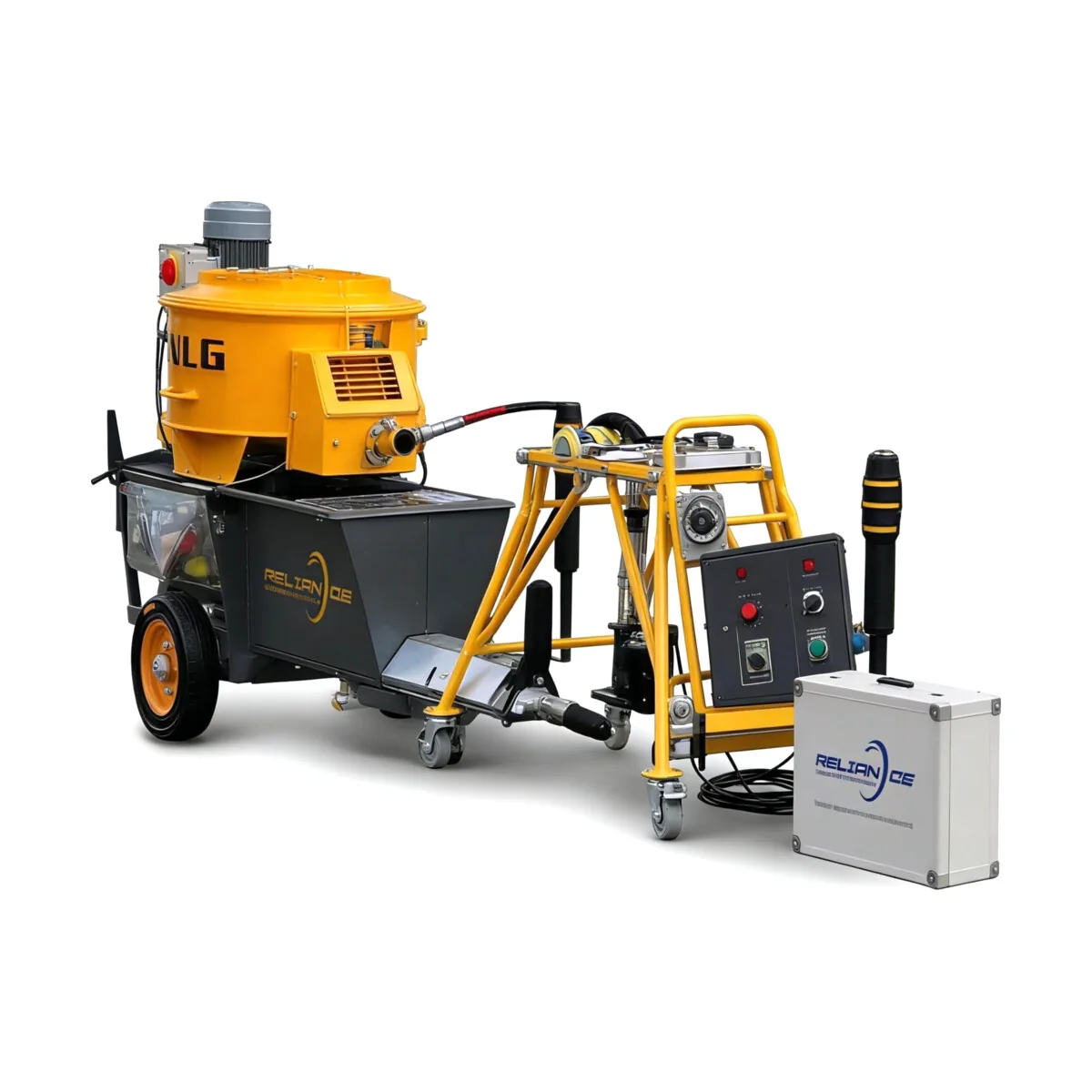
When evaluating equipment specifications for trenchless manhole rehabilitation, contractors frequently encounter product tables displaying designations like "P60/120" and "P90/160". Misinterpreting these numbers often leads to project failures on site: selecting an under-powered pump causes line blockages and stalled rotors in deep drop shafts, while selecting an oversized rig can overload jobsite generators and cause excessive mortar rebound.
The Reliance Mortar Sprayer System incorporates heavy-duty progressive cavity pumps engineered specifically to transfer high-density, fiber-reinforced thixotropic mortars from surface mixing skids down into underground access chambers. As highlighted in our field video on the Reliance Manhole Mortar Sprayer YouTube Feature, this automated system relines circular and square manholes from 600 mm up to 1800 mm across without manned entry. Understanding how to read the P60/120 and P90/160 specification tables ensures that pump displacement, delivery pressure, and generator sizing match your actual vertical depth and material rheology.
Decoding the designation: P60/120 vs P90/160
In professional mortar pumping terminology, the model designations represent two fundamental mechanical parameters:

First Number (Nominal Flow Rate in L/min):
- P60: Delivers up to 60 litres per minute (3.6 m³/h) of mixed mortar under zero-head bench test conditions. - P90: Delivers up to 90 litres per minute (5.4 m³/h), providing 50% greater volumetric output for large-diameter chambers or thick multi-pass structural coats.
Second Number (Pressure Rating in bar):
- 120: Denotes a maximum burst/operating pressure rating of 120 bar for the progressive cavity rotor/stator and manifold assembly. - 160: Denotes a heavy-duty 160 bar pressure rating with reinforced stator vulcanization, designed to overcome substantial vertical head and viscous wall shear.
Separating pump and mixer specifications
A common error when reviewing equipment datasheets is conflating mixer drive requirements with progressive cavity pump power:
Continuous Forced-Action Batch Mixer: Operates with high-torque planetary blades to break down polymer additives and achieve a lump-free, homogenous thixotropic paste. Motor ratings typically range from 4.0 kW to 5.5 kW.
Progressive Cavity Rotor/Stator Drive: Uses a variable-speed frequency inverter to regulate volumetric output. The P60/120 utilizes a 5.5 kW to 7.5 kW main motor, whereas the P90/160 requires a heavy-duty 11.0 kW motor to push dense slurries against high back pressure.
Combined Generator Sizing: Under guidelines from the American Concrete Institute ACI 506R, electric motor starting currents (inductive inrush) require sizing mobile jobsite generators to at least 2.5× the continuous running kVA rating. A complete P60 rig requires a minimum 25–30 kVA generator, while a P90 rig demands a 40–50 kVA 3-phase power source.
Hydraulic friction loss vs vertical manhole depth
The usable output at the spray head is never identical to the nameplate pump displacement. Mortar density (~2.0 to 2.2 kg/L) and shear-thinning viscosity introduce severe flow resistance as depth increases.
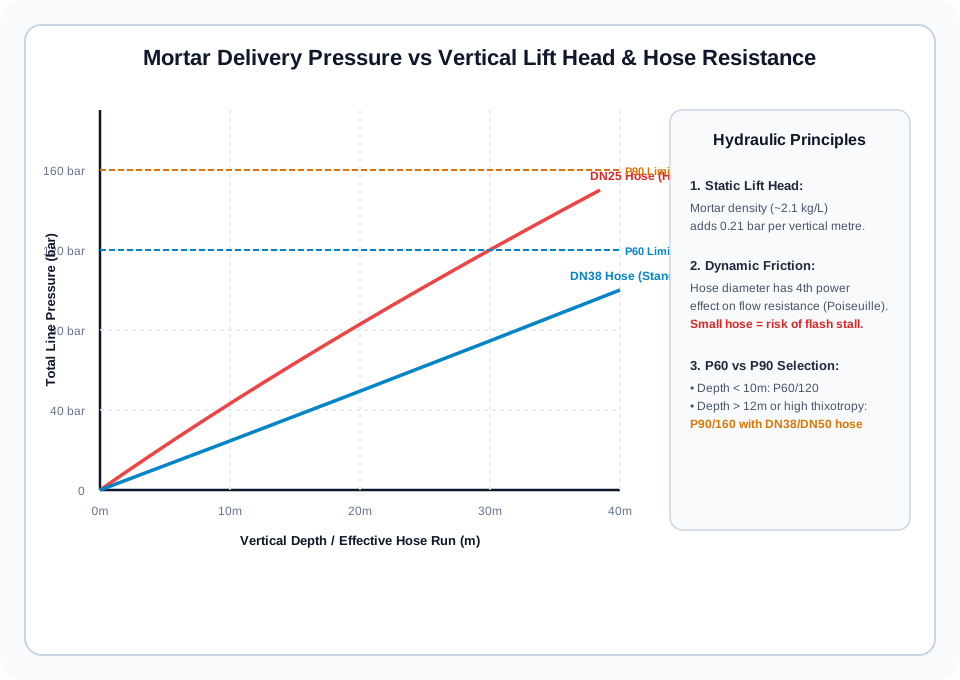
According to technical standards published by NASSCO for Manhole Rehabilitation, total delivery pressure is calculated by combining two resistance components:
ΔP_total = ρ · g · H + ΔP_friction
Static Hydrostatic Lift Head: For dense structural mortar (ρ ≈ 2,150 kg/m³), every 10 meters of vertical depth adds 2.11 bar of pure static back pressure.
Dynamic Wall Friction: Frictional resistance inside flexible delivery hoses is inversely proportional to the internal diameter. As shown in the hydraulic curves:
- DN25 (1-inch) Hose: Creates rapid pressure escalation (> 1.2 bar/m of hose run). A 20-meter vertical drop combined with 15 meters of surface layout can exceed 45 bar of friction alone, placing the P60 pump near its continuous operational limit and risking line flash-setting. - DN38 or DN50 (1.5 to 2-inch) Hose: Drastically reduces frictional pressure drop (< 0.35 bar/m), allowing the P90/160 system to pump structural mortars down 30-meter drop shafts effortlessly.
Application decision matrix: Which pump configuration to specify?
Before finalizing equipment procurement or mobilization, consult the following selection boundaries:
| Project Parameter | P60 / 120 Configuration | P90 / 160 Configuration |
|---|---|---|
| Typical Chamber Depth | Up to 10–12 metres | 12 to 35+ metres |
| Manhole Internal Diameter | Ø 600 mm to 1,200 mm | Ø 1,000 mm to 2,500 mm |
| Typical Coat Thickness | 10 mm to 25 mm per pass | 25 mm to 50+ mm structural lining |
| Pumping Hose Diameter | DN25 / DN32 mm | DN38 / DN50 mm |
| Site Power Requirement | 3-Phase 380V/400V, ~25 kVA | 3-Phase 380V/400V, ~45 kVA |
| System Mobility | Compact skid / trailer friendly | Heavy industrial truck mount |
Under the UK HSE PUWER Regulations, high-pressure slurry systems must be equipped with certified burst-disc manifolds or electronic overpressure cutoff transducers to prevent hose ruptures during accidental nozzle clogging.
Information to confirm before ordering
To ensure your mortar pump and spray head package are matched to your local materials and chamber configurations, prepare the following technical data:
Mortar Manufacturer TDS: Technical data sheet specifying aggregate grain size (must be ≤ 2.0 mm for P60 and ≤ 4.0 mm for P90), water-cement ratio, and initial set time.
Maximum Vertical Depth: Depth from ground surface to manhole benching across your deepest structures.
Available Jobsite Utilities: Whether power is supplied via municipal 3-phase grid connections or portable diesel generator sets.
Explore technical details in the Reliance Mortar Sprayer System Brochure, read our Manhole Rehabilitation Pumps, Mixers & Spray Heads Guide, or submit your rehabilitation requirements via our Mortar Sprayer System Enquiry Form.
References and source documents
Reliance YouTube — Manhole Mortar Sprayer: Reline 600–1800 mm Manholes from Inside, No Digging
NASSCO — Specification Guidelines for Manhole Rehabilitation by Centrifugally Cast Concrete
ACI 506R-16: Guide to Shotcrete and Progressive Cavity Pumping of Cementitious Mortars
UK HSE — PUWER Machinery and Safety Guidelines for High-Pressure Slurry Pumping
Further reading
Article
Disadvantages of Trenchless Pipe Lining: Limits, Failures, and DIY Risks
Article
Sewer Line Replacement: Permits, Insurance Coverage, and Lifespan
Article
Trenchless Sewer Repair Cost per Foot: CIPP, Epoxy, and Point Repairs
Buyer guide
Manhole Rehabilitation Equipment: Pumps, Mixers and Spray Heads