Trenchless Point Repair: Stainless Steel Sleeves vs CIPP Patching
Compare stainless steel mechanical sleeves vs CIPP resin patches across cure time, active infiltration, ambient heat, and site footprint for trenchless repairs.
By Reliance Trenchless Technology9 min read
Continue with AI
Bring this article into your own conversation.
Preferred Sources
Keep up with Reliance Trenchless on Google.
Availability depends on your account and region.
When municipal pipeline engineers and trenchless rehabilitation contractors encounter localized sewer defects—such as circumferential cracks, displaced joint gaskets, root intrusion, or isolated puncture holes—they face a foundational methodological decision: should the defect be sealed with a chemical cured-in-place pipe (CIPP) composite patch, or restored using a mechanical stainless steel repair sleeve?
Both approaches fall under the umbrella of sectional point repair. Both avoid the disruptive surface excavation, traffic detours, and utility relocation associated with traditional open-trench replacement. However, their underlying mechanical principles, site footprints, environmental sensitivities, and curing kinetics differ fundamentally.
Choosing the wrong technology can lead to catastrophic project failures: chemical resin wash-out under active hydrostatic infiltration, premature flash-curing during scorching Middle East summer operations, or sleeve sealing compromises caused by excessive host pipe ovality. This guide examines the engineering performance, operational trade-offs, and site constraints of Instant-Lock mechanical repair sleeves versus CIPP fiberglass and resin spot patches deployed via inflatable repair packers.
Engineering and operational comparison matrix
The fundamental distinction lies between in-situ chemical polymerization and permanent mechanical elastomeric compression. The table below summarizes the key engineering, logistical, and environmental parameters governing both technologies.
| Engineering Parameter | Mechanical Repair Sleeves (Instant-Lock) | CIPP Point Patches (Fiberglass & Resin) |
|---|---|---|
| Primary Material Architecture | 316L (1.4404) stainless steel shell + molded EN 681-1 EPDM gasket | Multiaxial E-CR or Advantex fiberglass mat + silicate or epoxy resin |
| Curing / Setting Mechanism | Physical expansion via packer; mechanical ratchet/spring latch locks under radial force | Exothermic chemical polycondensation or polyaddition polymerization |
| Installation & Curing Time | 0 minutes (immediate mechanical lock; 25–30 min total packer cycle) | 60 to 240 minutes (continuous pressurized cure cycle) |
| Tolerance to Active Infiltration | High; seals immediately against active groundwater ingress (>1.5 bar) | Very Low; running water washes out unpolymerized resin matrix |
| Ambient Temperature Sensitivity | None; operable from -20°C to +120°C with identical mechanical behavior | Extreme; pot life drops below 8 min at >35°C (risk of flash cure on packer) |
| Pipe Ovality & Deformation Tolerance | Low (<2–3% ovality); requires circular cylindrical landing zone | High; flexible textile mat conforms to irregular cross-sections and bends |
| Surface Equipment Footprint | Small: compressor, air control unit, packer winch/push rods | Large: resin mixing station, power mixers, wet-out table, chemical PPE |
| Environmental & Chemical Hazards | Zero VOCs, zero styrene, zero chemical leaching into wastewater stream | Chemical handling risks, exothermic temperature spikes, hazardous waste |
| Structural Re-rounding Capability | High; rigid steel shell forces fractured segments back into alignment | Low; flexible mat bridges fractures without exerting radial reforming force |
Installation timeline and mainline downtime
In municipal sewer operations, the cost of equipment and materials is frequently eclipsed by the cost of traffic management, sewer bypass pumping, and confined-space manhole crews. Downtime per repair reach directly governs total project expenditure.
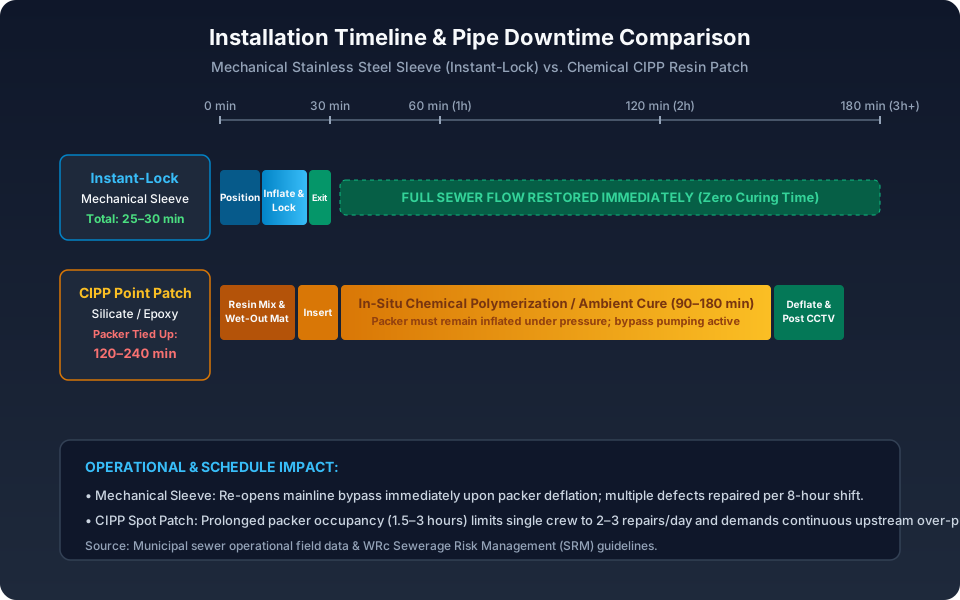
With an Instant-Lock mechanical repair sleeve, the repair packer serves solely as an expansion jack. Once the packer positions the pre-rolled sleeve over the defect, compressed air (typically 1.5–2.5 bar) drives the shell outward until the EPDM gasket compresses against the host pipe and the toothed locking mechanism engages. The packer is immediately deflated and withdrawn. The entire cycle takes 25 to 35 minutes, and full gravity sewage flow can be restored immediately without risk of damage.
In contrast, a CIPP point patch requires on-site chemical resin batching, mechanical impregnation (wet-out) of the multiaxial glass mat, wrapping onto the packer with protective film, winch positioning, and sustained pneumatic inflation throughout the resin's entire cure cycle. Depending on whether a silicate, epoxy, or vinylester system is deployed and whether ambient or steam curing is used, the packer must hold uninterrupted pressure for 1.5 to 4 hours. During this entire window, upstream sewage must be continuously over-pumped or blocked using inflatable pipe plugs.
Performance under active groundwater infiltration
A pervasive challenge in aging municipal gravity networks is groundwater infiltration. When the local water table rises above the pipe invert—especially in coastal, delta, or reclaimed areas across the Gulf Cooperation Council (GCC) and European waterways—water enters cracks under active hydrostatic head ().
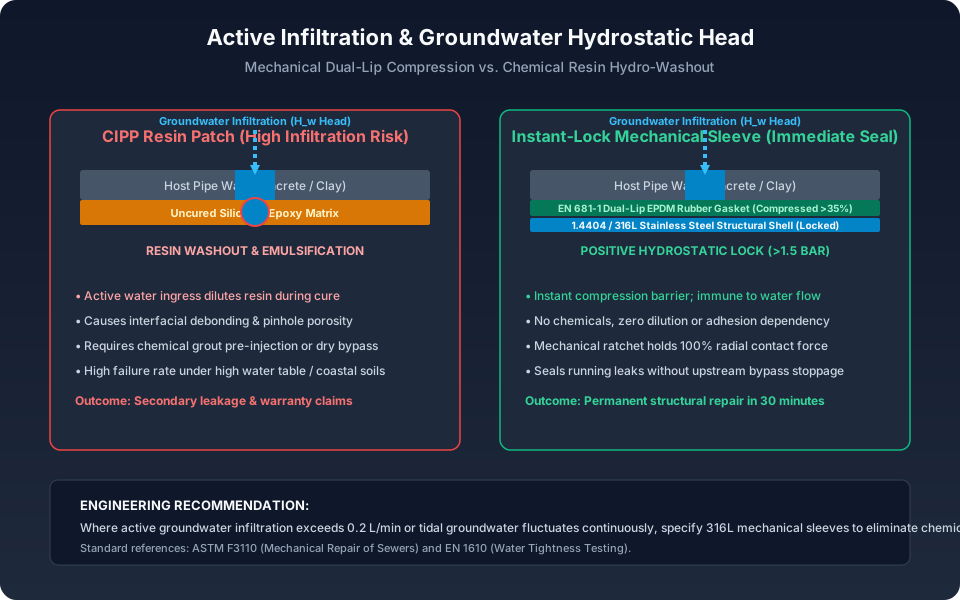
Under active infiltration, installing a resin-impregnated CIPP patch carries severe operational vulnerability:
Resin Washout: Flowing water emulsifies uncured resin components (particularly silicate and water-miscible epoxy resins), stripping the matrix from the glass fibers before cross-linking completes.
Interfacial Porosity & Blistering: Water pressure forces micro-channels through the curing laminate, causing pinhole leaks and structural debonding from the host pipe.
Pre-Grouting Costs: Preventing washout typically demands separate pre-injection of polyurethane chemical grouts, adding significant labor, chemical material costs, and scheduling delays.
Instant-Lock mechanical sleeves eliminate this failure mode entirely. The sleeve's continuous molded EPDM gasket features integrated dual-lip sealing profiles compliant with EN 681-1. When the internal locking mechanism latches under pneumatic packer expansion, the gasket is compressed by 35% to 45% against the host pipe perimeter, creating a positive mechanical hydraulic seal capable of withstanding internal and external pressures up to 1.5 to 2.5 bar immediately. Running water is blocked the instant the ratchet latches.
Thermal operational constraints: Middle East and hot-climate operations
Ambient temperature governs resin reaction kinetics. In laboratory conditions (20°C to 23°C), standard silicate point repair resins offer a comfortable working pot life of 25 to 35 minutes, allowing ample time for wet-out, packer wrapping, insertion, and CCTV positioning.
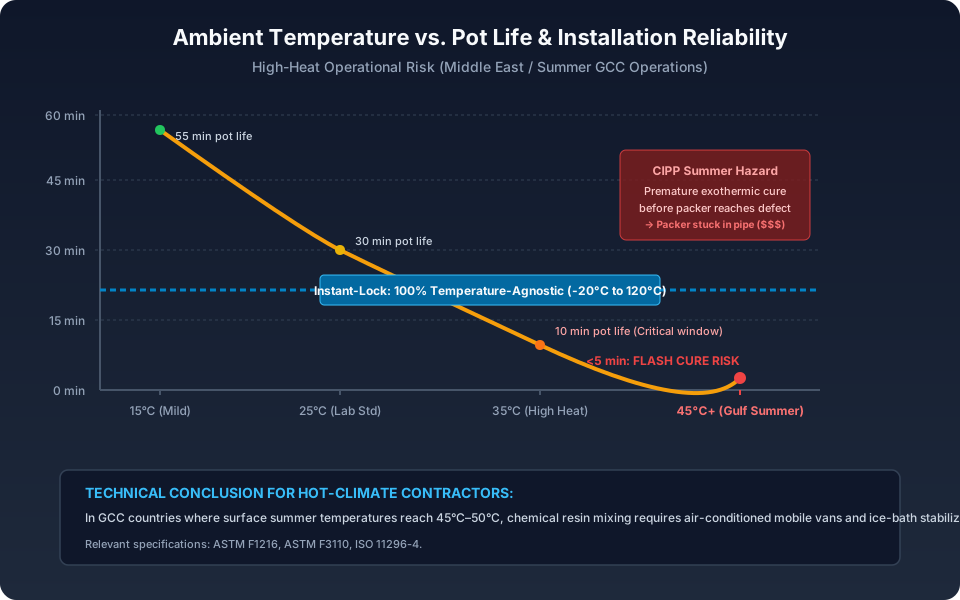
However, for contractors operating in high-ambient-heat regions—such as Saudi Arabia, UAE, Qatar, or southern European summer work sites—surface asphalt and manhole temperatures routinely reach 40°C to 50°C. Under these conditions, chemical reaction rates accelerate according to Arrhenius kinetics:
At 35°C, resin pot life contracts to approximately 10–12 minutes.
At 45°C, pot life collapses to under 5–6 minutes.
This drastic shrinkage creates a dangerous operational failure mode known as packer freeze: the resin begins its exothermic chain reaction while the packer is still being winched through the pipeline, locking the packer irreversibly against the pipe wall and necessitating expensive robotic milling or open-cut excavation to retrieve the tool.
To safely install CIPP patches in hot climates, contractors must invest in climate-controlled mobile trailers, insulated resin containers, and chilled ice-baths for resin mixing. By contrast, Instant-Lock mechanical repair sleeves are 100% temperature-agnostic. Fabricated entirely from cold-worked austenitic 316L stainless steel and vulcanized EPDM rubber, their installation mechanics, expansion forces, and sealing longevity remain unchanged whether deployed at -10°C or +50°C.
When to select sleeves vs CIPP patches: decision matrix
Neither technology is a universal panacea. Choosing the optimal method requires evaluating pipe geometry, defect classification, and site operational constraints.
Specify Instant-Lock Mechanical Sleeves when:
Active groundwater infiltration is present: High water ingress cannot be easily stopped or bypassed during installation.
Rapid flow restoration is critical: High-density urban corridors, trunk lines, or industrial discharge pipelines where prolonged bypass pumping is prohibitively costly or disruptive.
High ambient or variable temperatures prevail: Summer work in GCC or arid climates where chemical resin handling introduces severe pot-life risks.
Structural re-rounding is advantageous: Longitudinal fractures where the host pipe walls have displaced inwards and require radial mechanical jacking back into alignment.
Chemical-free environmental regulations apply: Potable water protection zones, sensitive stormwater discharge basins, or confined urban areas where styrene odors and VOC emissions trigger public complaints.
Specify CIPP Point Patches when:
Cross-sectional pipe ovality exceeds 3%: The host pipe has deformed into an ellipse, egg shape, or localized bulge where rigid cylindrical stainless steel shells cannot achieve uniform radial gasket compression.
Defects span pipe bends or non-standard joint offsets: Flexible fiberglass mats readily conform to slight directional changes (up to 15°–30° bends depending on packer type) where rigid sleeves cannot pass or seat.
Minor surface corrosion without structural displacement: The defect is purely superficial chemical etching or surface honeycombing requiring thin composite re-lining rather than heavy-duty mechanical bridging.
Non-standard pipe cross-sections: Elliptical, horseshoe, or arched masonry culverts where standard cylindrical mechanical sleeves cannot be expanded.
Site equipment, quality verification and procurement
A streamlined point repair workflow depends on matching certified repair hardware with compatible deployment tooling. When preparing a point repair project:
Verify Host Pipe Internal Bore: Conduct high-resolution CCTV inspection and laser profilometry to measure exact inner diameter and ovality before ordering sleeves or packers. Review the sectional point repair selection guide.
Confirm Packer Compatibility: Verify that the inflatable repair packer has sufficient effective contact length to support the entire sleeve or patch assembly with at least 50 mm clearance on either end. Consult the how to choose a pipe repair packer guide.
Inspect Sealing Margins: Ensure sound host pipe landing zones () exist on both sides of the fracture. If the defect sits adjacent to a lateral connection, follow the repair sleeves near lateral connections engineering rules.
Direct Factory Support: When procuring mechanical repair sleeves or CIPP equipment for municipal tenders, sourcing directly from specialized manufacturers provides mill test certificates (EN 10204 3.1 for 316L stainless steel) and direct engineering sizing advice.
Frequently Asked Questions
Can Instant-Lock mechanical sleeves be installed while water is actively leaking into the pipe?
Yes. Unlike CIPP resin patches that require a dry host pipe surface or pre-injection chemical grouting to prevent resin washout and emulsification, mechanical sleeves rely entirely on physical radial compression of an EN 681-1 EPDM rubber seal against the host wall, sealing active leaks immediately upon expansion.
How do extreme summer temperatures affect CIPP point repair vs mechanical repair sleeves?
At ambient temperatures exceeding 35°C to 45°C—common in Middle East summers—chemical resin pot life drops to under 8–10 minutes, creating severe risk of premature exothermic curing before the packer reaches the defect. Mechanical sleeves contain no chemical components and install identically regardless of ambient temperature.
When is a CIPP resin patch preferred over a mechanical stainless steel sleeve?
CIPP fiberglass patches are preferred when the host pipe has significant circular deformities, cross-sectional ovality exceeding 3%, or localized longitudinal angle bends, because the flexible impregnated glass mat conforms to irregular pipe profiles where rigid cylindrical stainless shells cannot seat evenly.
What equipment is required on-site for mechanical sleeve installation vs CIPP patching?
Mechanical sleeve installation requires only a standard inflatable repair packer, air control box, compressor, and push rods or winches. CIPP patching additionally requires resin mixing stations, electric drill mixers, vacuum or manual wet-out tables, chemical PPE, hazardous material handling, and temperature-conditioned resin storage.
References and source documents
Reliance Instant-Lock Small & Big Specification Brochure (Pages 1–2)
ASTM F3110-14(2024) — Standard Practice for Mechanical Trenchless Point Repair Sleeves
EN 681-1:1996/A3:2005 — Elastomeric Seals: Material Requirements for Pipe Joints
WRc — Sewerage Risk Management (SRM) Manual Point Repair Criteria
Reliance Repair Packers Product Catalog & Operating Pressure Instructions
Further reading
Article
Manhole Rehabilitation: Spin-Cast Spraying vs Manual Patching
Article
Direct Specialist Manufacturers vs Trading Middlemen for Trenchless Supplies
Article
European Quality at Factory Prices: Evaluating Reliance for Middle East Projects