管路の部分補修工法:非開削の適用条件と工法選定
下水道管路の孤立欠陥に対する部分補修工法の適用条件、CIPP樹脂パッチとInstant-Lockスリーブの比較、および余裕長の計算方法を解説。
著者:Reliance Trenchless Technology読了目安:7 分
この記事を共有
優先ソース
Google で Reliance Trenchless をフォロー。
利用できるかはアカウントと地域によって異なります。
Sectional point repair (commonly referred to as spot repair or CIPP short lining) is a trenchless rehabilitation method designed to seal isolated pipeline defects without excavating the street or relining an entire manhole-to-manhole sewer reach. According to NASSCO pipe rehabilitation guidelines, sectional repair installs a localized structural sleeve or resin-impregnated composite patch directly over a structural flaw, restoring hydraulic smoothness and eliminating groundwater infiltration.
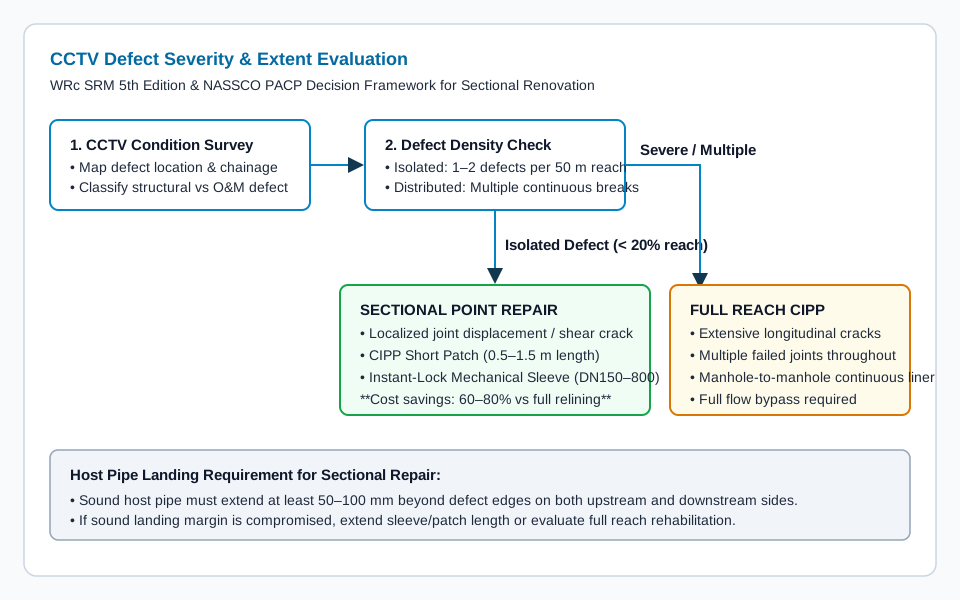
Choosing sectional point repair over full-length CIPP lining depends primarily on defect frequency and the structural integrity of the surrounding host pipe. When a closed-circuit television (CCTV) survey reveals only one or two isolated defects—such as an offset joint, localized circumferential crack, or localized root penetration—in an otherwise sound 50-meter sewer reach, sectional point repair delivers the required structural barrier at 20% to 40% of the cost of full reach relining. Furthermore, it eliminates the expensive surface bypass pumping setups required by full-length inversions.
When does a sewer defect qualify for sectional point repair?
A pipeline qualifies for sectional trenchless point repair when the host pipe retains sufficient structural geometry to support the localized repair sleeve or resin patch. The Water Research Centre WRc Sewerage Risk Management (SRM) manual defines clear condition thresholds where localized renovation is technically sound:
Isolated joint defects: Offset joints with shear displacement under 30 mm, open joints with missing gasket material, and leaking joints exhibiting active infiltration.
Localized structural fractures: Circumferential cracks, longitudinal cracks shorter than 1.0 meter, and localized puncture holes where surrounding pipe bedding remains stable.
Root intrusion points: Joints penetrated by tree roots where mechanical or high-pressure water jet root-cutting restores circular clearance without collapsing pipe crowns.
Abandoned lateral seals: Intrusive or blind lateral tap openings that require permanent internal sealing to stop soil ingress.
Conversely, sectional point repair is contraindicated when CCTV logs show systemic pipe degradation. If structural defects occur across more than 20% of the reach length, if host pipe ovality exceeds 10% (indicating active structural buckling), or if severe line sags (bellies) trap heavy silt, sectional repairs will not correct hydraulic grade defects. In such circumstances, full-length CIPP lining or pipe bursting is the correct engineering intervention, as outlined in our sectional point repair vs full-length CIPP guide.
How do you measure defect length and host pipe landing margins?
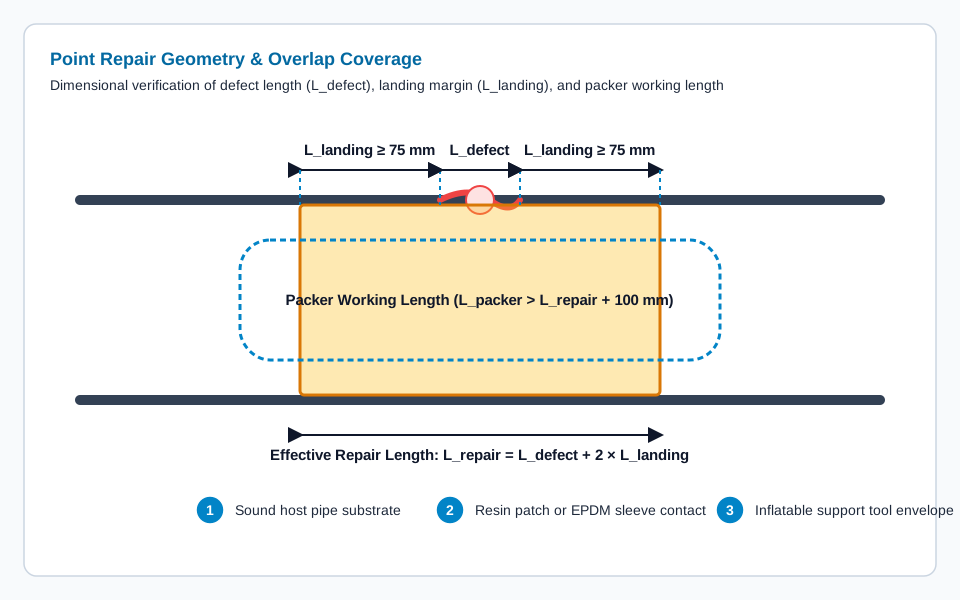
The most critical calculation in sectional point repair specification is determining the minimum repair length (). A sectional repair must never simply match the visible defect boundary; it must extend onto sound host pipe on both sides to establish an impermeable seal and bridge shear forces.
In this geometric relationship:
represents the axial defect length measured accurately from calibrated CCTV tractor footage.
represents the minimum sound landing margin on undisturbed pipe wall. For gravity sewers under ambient hydrostatic groundwater pressure, industry practice mandates (3 inches) on each side. In pressurized lines or high-water-table zones ( head), specify (4 inches).
The total working length of the inflatable repair packer must exceed by at least 100 mm to ensure full radial compression across both landing collars without ballooning out the ends.
When reviewing CCTV records before procurement, also measure the host pipe internal diameter () across multiple clock positions. Never rely on nominal pipe diameter (NPS) alone, as vitrified clay and reinforced concrete pipes frequently deviate from nominal dimensions by 5% to 10%.
CIPP resin-fiberglass patch vs mechanical repair sleeve: what changes?
Contractors and municipal engineers have two primary sectional repair technologies available: resin-impregnated fiberglass patches and mechanical stainless steel sleeves. Selecting between them depends on jobsite flow conditions, curing temperature constraints, and installation access.
| Engineering Parameter | CIPP Resin-Fiberglass Patch | Instant-Lock Mechanical Sleeve |
|---|---|---|
| Structural Material | Multi-axial E-CR fiberglass mat + silicate or epoxy | AISI 304 or 316L stainless steel shell |
| Sealing Mechanism | Thermoset chemical resin adhesion to pipe wall | EPDM continuous compression gasket (DIN EN 681-1) |
| Installation / Cure Time | 60–180 minutes under maintained packer inflation | 5–10 minutes mechanical lock; 0 minutes cure wait |
| Resistance to Active Flow | Requires dewatering; running flow washes uncured resin | High; rubber gasket seals immediately under flow |
| Tolerance to Ovality | High; flexible fabric conforms to minor pipe deformation | Moderate; requires circular bore (ovality < 2%) |
| Applicable Diameters | DN100 to DN1200 (using flexible / wheeled packers) | DN150 to DN800 (standard pre-curved sleeve sizes) |
| Equipment Required | Repair Packers + wet-out table | Installation packer + pneumatic lock tool |
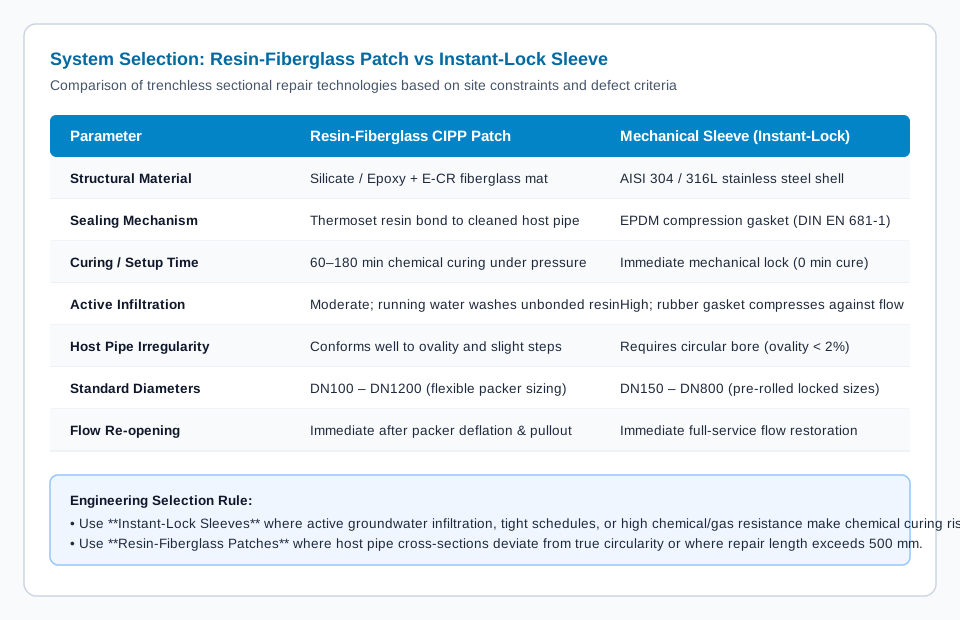
For pipelines with persistent running infiltration where total flow bypass is unfeasible, Instant-Lock small mechanical sleeves provide immediate structural integrity. Because the stainless steel sleeve locks mechanically via internal toothed ratchets, the repair is watertight the second the installation packer is vented. Conversely, where pipes have minor cross-sectional irregularities or where long patches () are required, the fiberglass & resin repair system provides continuous composite relining conforming to ASTM F1216 standards.
What technical data must an engineering requisition contain?
To obtain an accurate quotation and avoid jobsite installation delays, project submittals and RFQs should contain confirmed physical parameters rather than generalized descriptions:
Host pipe material and measured bore: State whether the host line is vitrified clay (VCP), ductile iron (DIP), concrete (RCP), or PVC, including the exact measured internal diameter at the defect.
Defect axial length and CCTV chainage: Distance from the launch manhole to the upstream and downstream defect boundaries.
Groundwater hydrostatic head: Water table elevation relative to the pipe invert, confirming whether mechanical EPDM seals or high-strength silicate resins are indicated.
Access opening envelope: Manhole frame clear diameter and invert depth, ensuring the selected wheeled repair packer can be rigged into the sewer pit.
Consult our detailed guide on choosing pipe repair packers and sleeves vs fiberglass patches. When you are ready to configure equipment or place an order, submit your pipe measurements through our contact page for immediate technical review.
FAQ: よくある質問
How long does a sectional point repair last compared to full CIPP lining?
When properly installed onto sound host pipe with verified landing margins, both ASTM F1216-compliant resin-fiberglass composite patches and AISI 316L stainless steel mechanical sleeves provide a design service life exceeding 50 years. The structural longevity matches full-length CIPP lining because the repair materials use identical corrosion-resistant silicate/epoxy polymers and high-grade stainless alloys.
Can a sectional point repair be installed in a pipe with active groundwater infiltration?
Yes, but the technology choice is critical. Active running water can dilute or wash out unpolymerized epoxy or silicate resin during patch placement, resulting in localized voids. In lines with high infiltration, mechanical stainless steel sleeves with EPDM rubber gaskets are preferred because the mechanical expansion locks the gasket against the pipe wall immediately, achieving seal integrity without chemical cure time.
What is the maximum pipe diameter for sectional trenchless point repairs?
Reliance manufactures sectional repair packers and Instant-Lock mechanical sleeves for pipelines up to DN800 in standard configurations, with custom large-diameter packers engineered up to DN1200 and beyond. For man-entry pipelines exceeding DN800, internal joint seals and segmented stainless expansion bands are commonly specified.
Is sewer bypass pumping always required during sectional spot repairs?
Flow-through repair packers feature a hollow central bypass tube that allows normal wastewater base flows to pass through the tool during the 60–120 minute patch curing cycle. Full surface bypass pumping is only necessary if sewer flows exceed the hydraulic capacity of the packer bypass conduit or if mechanical sleeve installation requires zero water level for visual camera alignment.
参考文献・出典資料
あわせて読みたい資料
記事
非開削管路部分補修設備:作業車両搭載機器リストと選定指針
記事
取付管接続部付近の補修スリーブ選定:確認すべき項目
記事
1 台の補修パッカーで複数の管径に対応できますか?
購入ガイド
管修理用パッカーの選び方
購入ガイド
ステンレス製修理スリーブと樹脂・ガラス繊維パッチの比較
購入ガイド
部分修理と全長 CIPP ライニングの比較