Equipamentos de reparação pontual não destrutiva: Checklist para veículos móveis
Equipamentos essenciais para furgões de reparo pontual sem vala: packers com rodas, painel de controle pneumático, varetas de empuxo e controle de qualidade.
Por Reliance Trenchless Technology6 min de leitura
Partilhar este artigo
Continuar com IA
Leve este artigo para a sua própria conversa.
Fontes preferidas
Acompanhe a Reliance Trenchless no Google.
A disponibilidade depende da sua conta e da região.
Outfitting a mobile trenchless pipe repair rig requires a carefully balanced equipment package. Point repairs—whether installing silicate resin-impregnated fiberglass patches or expanding mechanical stainless steel sleeves—depend on four interdependent systems: pneumatic air delivery, mechanical insertion and winching, downhole positioning, and quality-controlled chemical impregnation.
Missing a single component on site—such as an uncalibrated pressure regulator, improper push rod connections, or missing safety relief valves—can cause catastrophic downtime, incomplete patch expansion, or bladder rupture inside the sewer line. Following NASSCO assessment and equipment guidelines and OSHA compressed gas regulations, this guide details the essential equipment checklist for professional trenchless pipe repair contractors.
What core equipment belongs on a mobile point-repair rig?
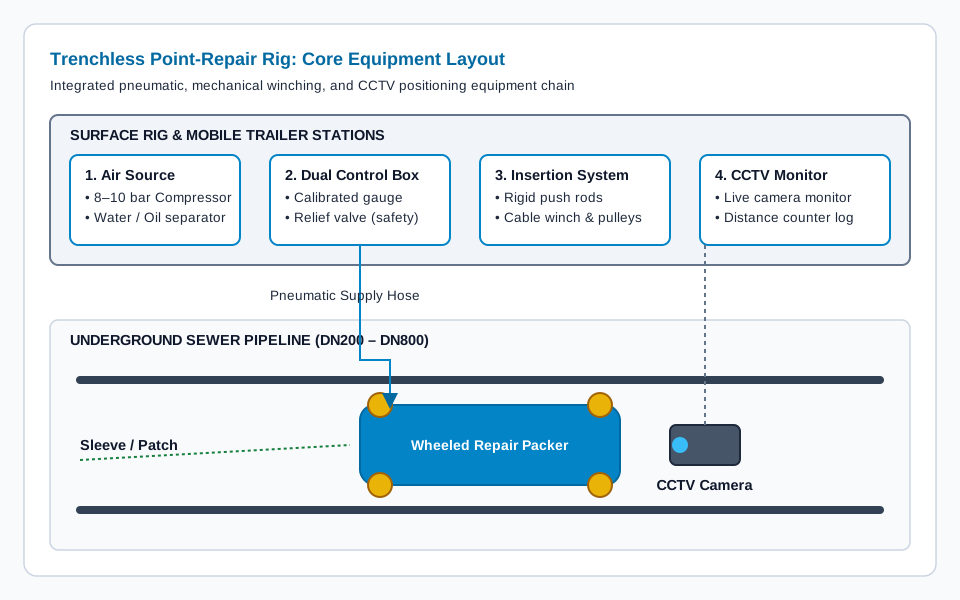
A self-contained mobile point-repair trailer or van should be configured with five dedicated hardware groups:
Pneumatic air supply: An oil-free air compressor capable of delivering 8 to 10 bar (115–145 psi) at a minimum flow rate of 150 L/min. The compressor must be paired with an inline particulate filter and moisture water trap to prevent condensation from fouling downhole packer valves.
Pneumatic control console: A dedicated dual-stage regulator control unit featuring a glycerine-filled pressure gauge (0–4 bar / 0–60 psi scale), a pressure-relief safety valve calibrated to 0.2 bar above the packer rated working pressure, and an emergency three-way exhaust ball valve.
High-pressure deployment hoses: Steel-wire reinforced or heavy-duty polyurethane air hoses rated to at least 20 bar burst pressure. Hose couplings must feature safety locking sleeve pins and integrated wire cable restraints to prevent whipping in the manhole.
Insertion rods and winch line: Heavy-duty continuous fiberglass push-pull rods (9 mm to 11 mm diameter) for small diameter lines (DN100–DN250), and portable electric or manual cable winches equipped with manhole rim rollers for larger diameter pipelines (DN300–DN800).
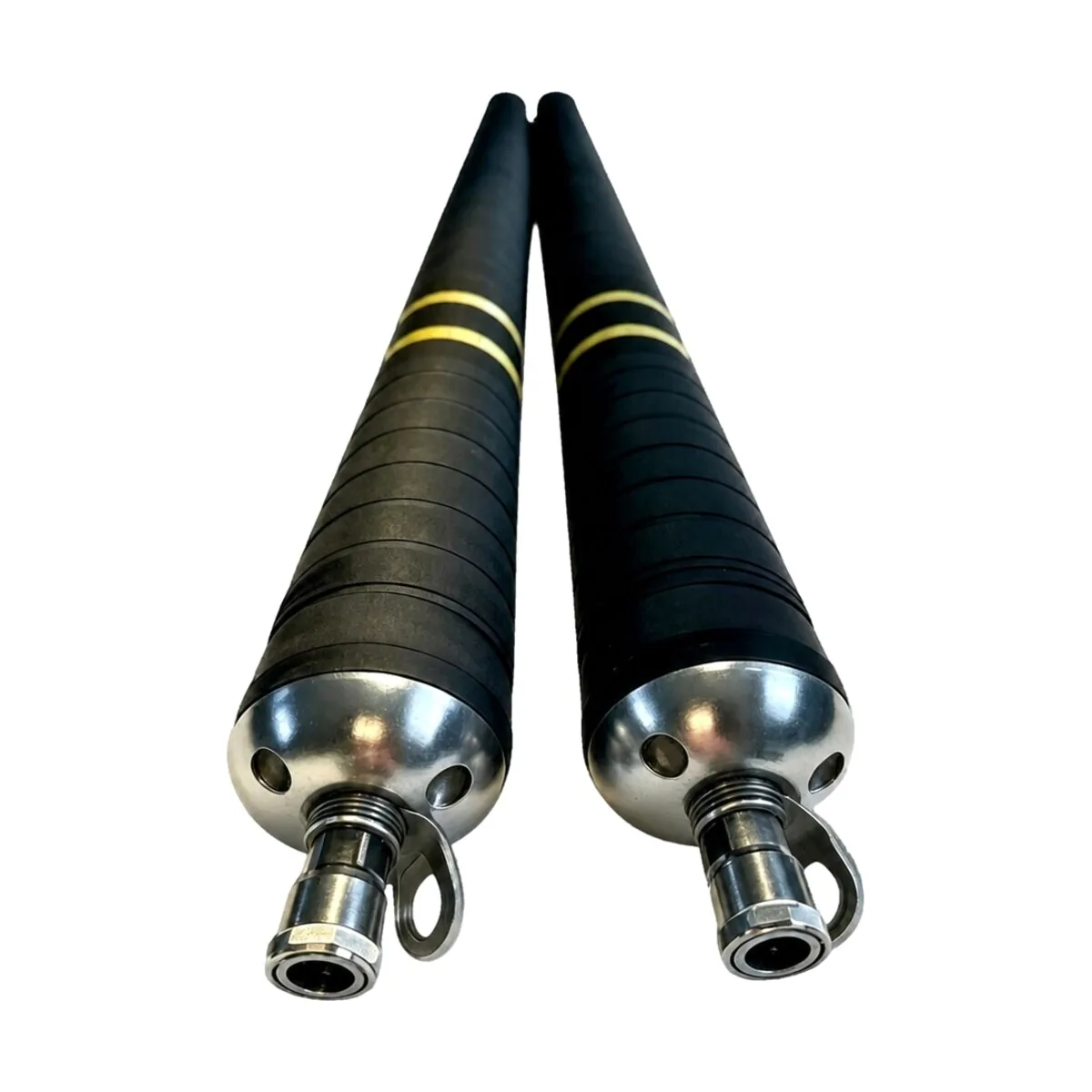
Downhole inflatable packers: A calibrated fleet of Repair Packers matching the contract diameter range.
Wheeled mainline packers vs flexible lateral packers: sizing for access
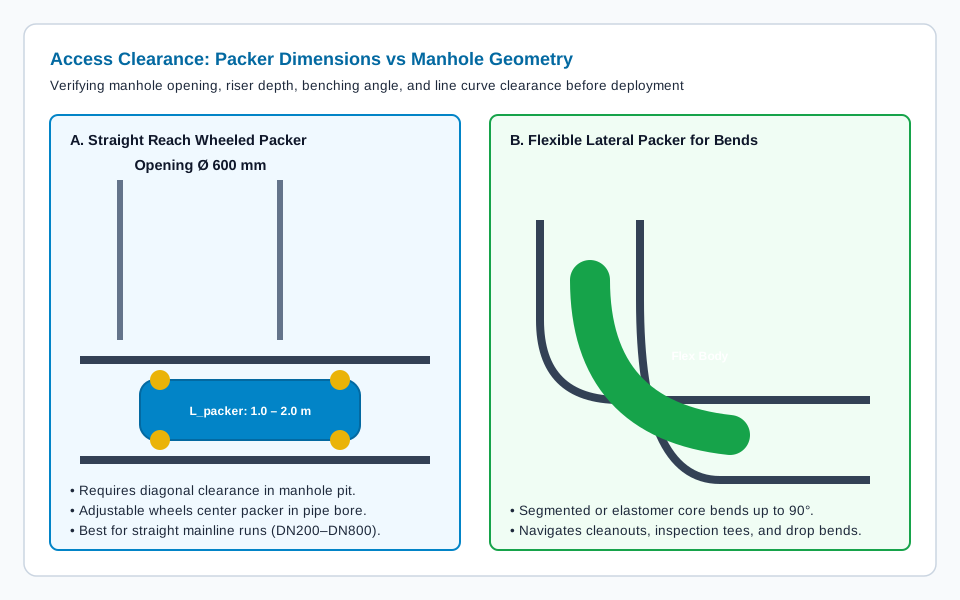
Selecting the right packer architecture is vital to ensure downhole tools can enter through restricted manhole openings and navigate sewer geometries without getting stuck.
| Equipment Category | Wheeled Mainline Repair Packer | Flexible Lateral Repair Packer |
|---|---|---|
| Target Pipe Diameters | DN200 to DN800 (8" to 32") | DN100 to DN250 (4" to 10") |
| Structural Architecture | Rigid central aluminum / steel tube with flow bypass | High-elongation elastomer bladder, flexible core |
| Wheel & Centering System | 3-roller or 4-roller adjustable spring-loaded wheels | Smooth low-friction runner ribs or caster guides |
| Bend Navigation | Straight sewer reaches; maximum 5° joint deflection | Navigates 45° and 90° bends from cleanouts |
| In-Pipe Alignment | Self-centering; centers patch evenly on pipe crown | Hand-guided / pushed through lateral riser pipes |
| Flow-Through Capacity | Integrated bypass pipe maintains continuous sewage flow | Solid core or minimal bypass; requires line throttling |
Wheeled mainline packers center the repair patch evenly around the full 360° internal circumference. Without centering wheels, heavy resin patches tend to sag toward the pipe invert, creating an uneven resin pool at the bottom and an under-thickness laminate at the pipe crown. For lateral pipelines with sharp bends, flexible lateral packers provide the articulation necessary to launch repairs from small 150 mm cleanout stacks.
Field quality control stations: resin mixing, wet-out, and pressure holding
High-quality trenchless point repairs demand rigorous adherence to chemical mixing and structural impregnation standards. A properly organized rig separates field operations into four quality-control stations:
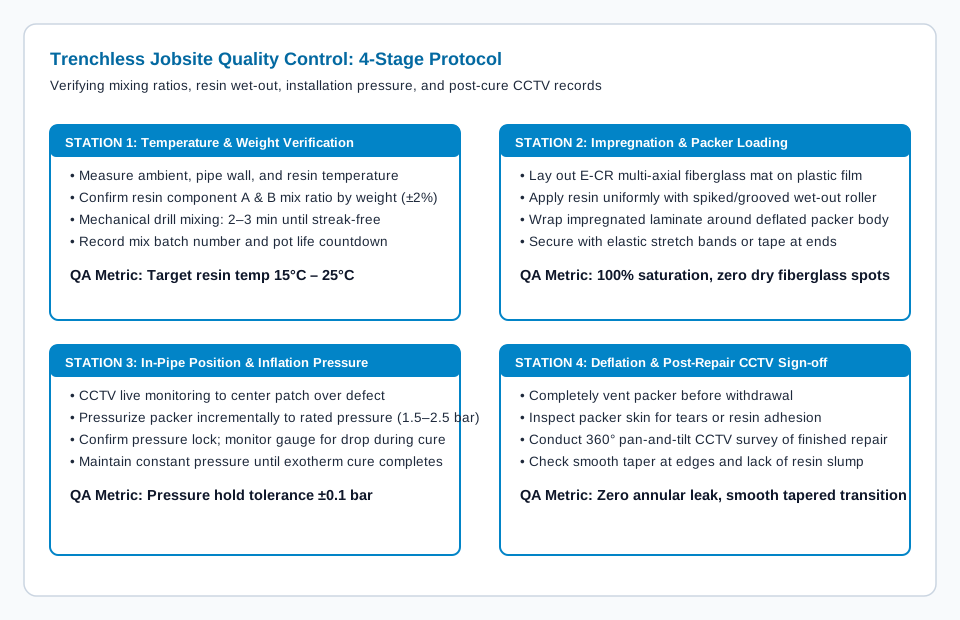
Station 1: Temperature and weight logging: Ambient temperature, resin component temperatures, and sewer pipe wall temperature must be logged before opening resin pails. Both silicate and epoxy resins have pot lives that drop by roughly 50% for every 10°C temperature rise. Weigh component A and component B using a calibrated digital balance ($pm 2%$ accuracy) rather than volumetric estimation. Mix with a mechanical drill paddle for 2 to 3 minutes until the batch is completely homogeneous.
Station 2: Fiberglass wet-out table: Lay the multi-axial E-CR fiberglass reinforcement mat onto a heavy-duty plastic film. Pour the catalyzed resin evenly across the fabric and work it in using grooved aluminum or spiked bubble-buster rollers until 100% resin wet-out is achieved with zero dry white glass fibers remaining.
Station 3: In-pipe inflation and pressure holding: After pushing the wrapped packer to the defect under live CCTV guidance, inflate the packer to the manufacturer's rated pressure (typically 1.5 to 2.5 bar, as specified on the tool data plate). Monitor the pressure gauge continuously throughout the exothermic cure cycle.
Station 4: Post-cure deflation and CCTV inspection: Once the resin has hardened (verified by checking the retained cup test sample on the truck), completely deflate the packer before towing it back. Perform a 360° pan-and-tilt CCTV survey to verify smooth tapered transition edges and zero annular voids.
What should be confirmed before ordering a point-repair equipment package?
When investing in trenchless pipe repair equipment or submitting an equipment tender, confirm these five operational variables:
Working diameter span: Determine whether your mobile rig will specialize in residential lateral lines (DN100–DN200) or municipal mainline sewers (DN200–DN800).
Packer working length: Match the packer effective cylinder length to defect profiles. Standard working lengths range from 1000 mm to 2000 mm.
Sleeve installation compatibility: If installing mechanical stainless sleeves, confirm that your installation packer includes mechanical end plates and push fittings compatible with Instant-Lock Small sleeves.
Site safety and isolation tooling: Equip your crew with multi-size pipe plugs for temporary upstream flow stopping, 4-gas confined space monitors, and certified manhole fall-protection tripods.
Review our sewer point repair equipment checklist and trenchless installation guide for comprehensive jobsite templates. For tailored equipment packages, factory calibration data, and packer specifications, submit your technical requirements via our contact page.
FAQ: Perguntas frequentes
What air pressure is required to operate sectional pipe repair packers?
Most Reliance mainline wheeled repair packers operate at an inflation pressure between 1.5 bar and 2.5 bar (22 to 36 psi), depending on diameter and pipe material. Always refer to the stamped metal data plate on the packer end collar; never exceed the maximum operating pressure, and always use a control console with an integrated safety pressure relief valve.
Can one repair packer be used for both resin patches and mechanical sleeves?
Standard CIPP repair packers can install resin-fiberglass patches across their rated diameter range. However, expanding mechanical stainless steel sleeves requires specialized installation packers equipped with heavy-duty end bumpers, hardened radial expanders, and sleeve positioning clamps that match the mechanical locking mechanism of the sleeve.
How do contractors move repair packers into position without snagging?
Mainline packers are maneuvered using a combination of rigid fiberglass push rods (pushed from the upstream manhole) and a tag line or winch cable pulled from the downstream manhole. The integrated guide wheels prevent the packer body and wet-out resin fabric from dragging against the dirty pipe invert during transit.
What daily maintenance does trenchless repair packer equipment require?
After every shift, thoroughly wash the packer rubber sleeve with water to remove wet resin before polymerization occurs. Check the rubber bladder for surface cuts or embedded debris, lubricate wheel bearings with waterproof grease, inspect pneumatic quick-connect couplings, and verify that the control console pressure gauge returns precisely to zero.
Referências e documentos de origem
Leituras complementares
Artigo
Reparação pontual de tubulações: Quando aplicar métodos não destrutivos
Artigo
Luvas de reparo próximas a ramais: o que avaliar?
Artigo
Um packer de reparação pode servir vários diâmetros?
Guia de compra
Como escolher um packer para reparação de tubagens
Guia de compra
Lista de verificação do equipamento para reparação pontual de esgotos
Guia de compra
Guia de instalação sem vala para Instant-Lock