
CIPP Liner Ends: What to Measure Before Specifying an End Seal
Measure CIPP liner termination dimensions before specifying mechanical end seals: host pipe bore, liner step height, bare landing width, and ovality.
By Reliance Trenchless Technology5 min read
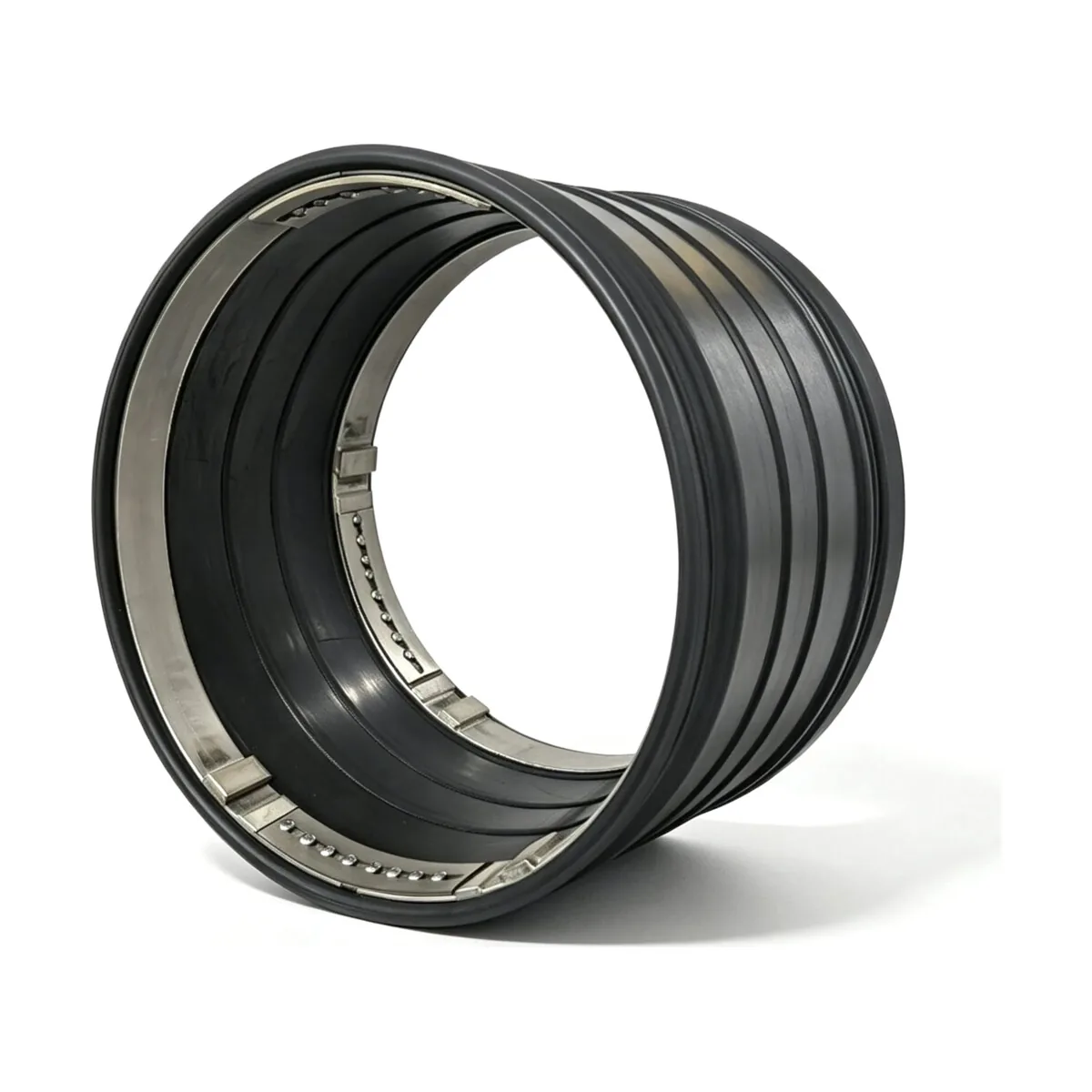
Following the installation of a Cured-in-Place Pipe (CIPP) lining, contractors and municipal inspectors often discover water weeping continuously into manholes around the trimmed liner circumference. When planning a permanent mechanical repair, engineers confront a vital field specification question: _"What should I measure at a CIPP liner termination before ordering an end seal?"_
Specifying an end seal is not a matter of simply ordering a generic pipe-diameter band. Because CIPP liners introduce an abrupt internal wall step and do not molecularly bond to the host pipe, selecting a Reliance Internal Pipe End Seal requires capturing four specific field dimensions: bare host pipe inner diameter, trimmed liner inner diameter, liner wall thickness step, and the available axial landing distance before the manhole benching.
As highlighted in our engineering overview on Internal Pipe Joint Seals DN150–DN4000, an internal mechanical end seal utilizes a profiled, stepped EPDM rubber sleeve compressed by dual 316L stainless steel expansion bands. Accurate measurement ensures the rubber sleeve seats flush across the transition step, eliminating infiltration tracking under external hydrostatic pressures up to 1.5 bar (15 meters of water head).
The physics of annular space: Why CIPP liner terminations leak
Even a textbook CIPP installation meeting ASTM F1216 standards experiences thermosetting resin shrinkage during exothermic cross-linking (typically 1.0% to 2.5% volumetric shrinkage for polyester and vinyl ester systems):

The Non-Bonded Micro-Annulus: CIPP relies on close mechanical fit against the host conduit. It does not form a chemical weld with damp, biofilm-coated vitrified clay, concrete, or corroded cast iron.
Hydrostatic Tracking: Groundwater surrounding the buried pipeline enters through cracks or open joints upstream in the host pipe. Once inside, this pressurized water tracks effortlessly along the microscopic annular gap between the host pipe and the outer liner skin, discharging into the manhole chamber.
Why Hydrophilic Rings Alone Can Fall Short: While hydrophilic rubber cords placed prior to inversion offer swelling protection, heavy debris or wrinkled liners can pinch or wash out the seal. A mechanical internal end seal provides a verifiable, positive elastomeric compression barrier compliant with BS EN 681-1 and ASTM C923.
4 Critical dimensions to measure before specifying an end seal
To configure the correct stepped rubber profile and expansion band diameters, technicians must enter the manhole and record the following parameters:
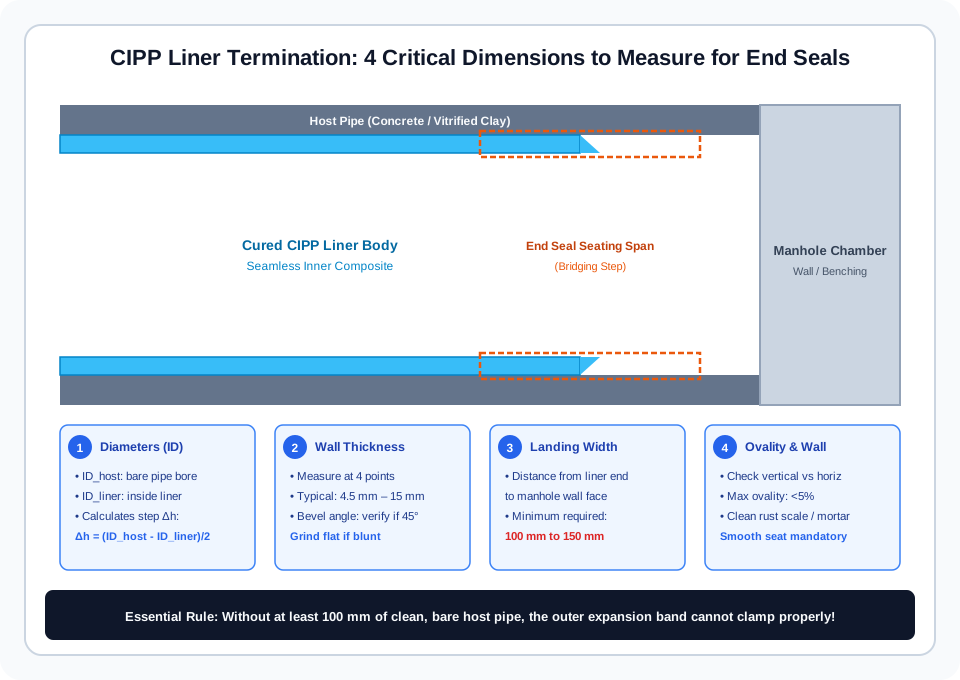
1. Host pipe inner diameter ($ID_{host}$) and liner inner diameter ($ID_{liner}$)
Measure both diameters using internal vernier calipers or telescopic gauges at multiple clock orientations (12-6 o'clock and 3-9 o'clock):
Host Pipe Bore ($ID_{host}$): The internal diameter of the original, bare host pipe just outside the liner termination.
Liner Bore ($ID_{liner}$): The true internal bore of the cured composite liner after trimming.
Step Offset ($\Delta h$): Calculated as $\Delta h = (ID_{host} - ID_{liner}) / 2$. This radial height difference dictates whether a standard stepped EPDM profile or a custom dual-thickness transition sleeve is required.
2. Liner wall thickness ($t_{liner}$) and trim profile
Measure the physical thickness of the trimmed CIPP edge at the invert, crown, and springlines:
Thickness Variation: Liners frequently thicken at the invert due to resin migration during thermal cure (e.g., 6 mm at the crown vs 9 mm at the invert).
Edge Preparation: A blunt, 90-degree square-cut liner edge creates severe localized shear stress against the rubber sleeve. Contractors should bevel the trimmed liner edge to an angle of 30 to 45 degrees using an angle grinder before installing the seal.
3. Available bare host pipe landing width ($W_{landing}$)
The distance between the trimmed liner end and the inner face of the manhole wall is often the most overlooked constraint:
Seating Requirement: The outer stainless steel expansion band of the end seal must clamp directly against the bare host pipe wall, not the liner.
Minimum Width: An end seal requires a minimum of 100 mm to 150 mm of clean, unobstructed host pipe barrel between the trimmed liner edge and the manhole benching. If the liner was installed flush with the manhole opening, technicians must trim back the liner by 120 mm to 150 mm using a diamond wheel cutter to create an adequate landing seat.
4. Cross-sectional ovality and surface soundess
According to ASCE MOP 145, host pipes with structural deformation exceeding 5% require custom-rolled expansion bands:
Ovality Verification: If vertical and horizontal diameters differ by more than 5%, provide individual axis measurements rather than a single nominal diameter.
Host Wall Soundness: The bare host pipe seating area must be wire-brushed to remove loose cement wash, gravel, or dried resin drips to provide an airtight, watertight foundation.
Field measurement protocol checklist
Before submitting an engineering request for internal end seals, ensure your site report contains the following verified records:
| Measurement Parameter | Target Tolerance | Measurement Tool | Notes |
|---|---|---|---|
| Bare Host Pipe ID | $\pm 2\text{ mm}$ | Internal micrometer / telescopic gauge | Measure 100 mm outside liner termination. |
| Trimmed CIPP Liner ID | $\pm 2\text{ mm}$ | Internal caliper | Check for invert thickening. |
| Available Landing Length | $\pm 5\text{ mm}$ | Steel rule | Distance from liner bevel to manhole face. |
| Liner Step Height ($\Delta h$) | $\pm 1\text{ mm}$ | Depth micrometer | Governs rubber transition step thickness. |
| Host Pipe Material | N/A | Visual / CCTV record | Concrete, vitrified clay, or ductile iron. |
Ordering custom vs standard end-seal configurations
Standard end seals accommodate CIPP step offsets up to 10 mm on pipe diameters from DN150 to DN1200. For thicker high-load storm culverts, municipal pressure mains, or heavily deteriorated concrete pipes, our manufacturing team produces custom multi-stepped elastomeric jackets and wide-span retaining bands.
Review our technical measurement guidelines in the Internal Pipe Joint Seals Measurement Guide, compare point repair methods in Sectional Point Repair vs Full-Length CIPP, or submit your manhole landing dimensions through our Internal End Seal Technical Enquiry Form to receive verified production drawings.
References and source documents
Further reading
Article
Disadvantages of Trenchless Pipe Lining: Limits, Failures, and DIY Risks
Article
Packer Overall Length vs Usable Repair Coverage
Article
Sewer Line Replacement: Permits, Insurance Coverage, and Lifespan
Buyer guide
Joint Guide: Measuring Internal Pipe Joint Seals
Buyer guide
Sectional Point Repair vs Full-Length CIPP Lining