
Steam Plugs for FIPP: What Must Be Confirmed Before Selection?
Technical checklist for FIPP steam plugs rated to 150°C. Review elastomer heat degradation, steam inlet flanges, and condensate drainage records.
By Reliance Trenchless Technology3 min read
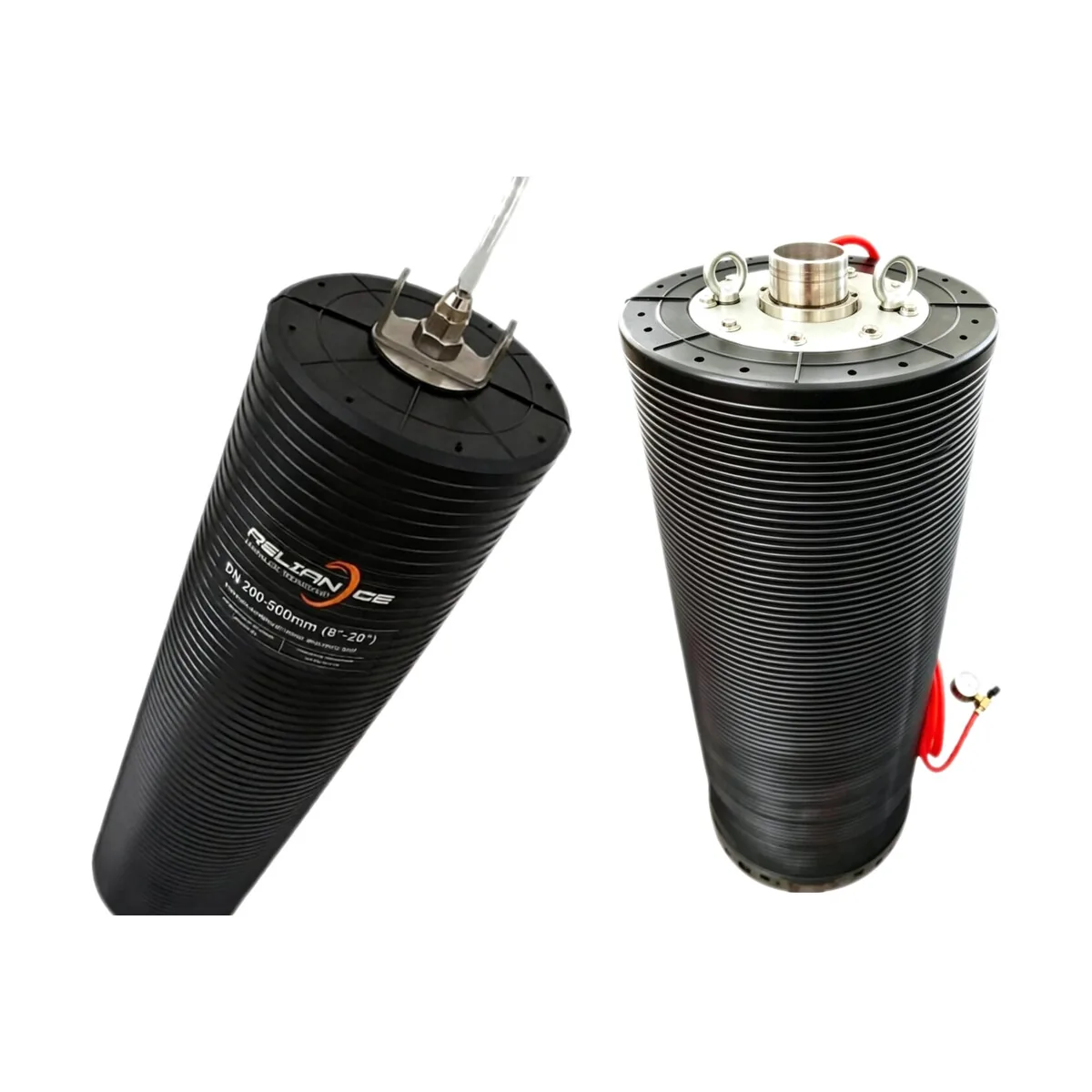
During Formed-In-Place Pipe (FIPP) or steam-cured Cured-In-Place Pipe (CIPP) lining, the terminal ends of the inflated felt or glass liner must be sealed tightly under positive pressure while live pressurized steam is injected to trigger resin cross-linking. Using a standard sewer plug for this task is a severe safety hazard that can cause instant explosive rupture.
In the Reliance FIPP Steam Plugs Video, three essential facts are confirmed: continuous rating for steam up to 150°C (302°F), multi-size coverage from DN70 to DN1200, and dedicated factory testing. Before ordering from our Multi-Size Pipe Plugs range for thermal lining, technical managers must verify specific engineering documents.
Operating demands of FIPP steam curing vs ambient pipe plugging
In ambient gravity pipeline isolation, a plug holds static cold wastewater at temperatures between 10°C and 25°C. In FIPP steam lining, the environment is radically harsher:
Continuous Steam Temperature: Steam injected into the liner operates between 110°C and 140°C for multiple hours to drive the exothermic reaction of vinyl ester, polyester, or epoxy resin matrices.
Internal Operating Pressure: Plugs must maintain an internal inflation seal of 1.0 to 2.5 bar while resisting the internal line pressure required to keep the liner pressed against the host pipe.
Corrosive Steam Condensate: Hot steam combined with styrene or amine condensates forms an aggressive chemical environment at the bottom invert of the plug.
Temperature ratings up to 150°C and elastomer vulcanisation limits
Standard pipe isolation plugs are molded from natural rubber (NR) or styrene-butadiene rubber (SBR). As demonstrated by Kampouris et al. (2020), standard elastomer chains undergo rapid scission, embrittlement, and blistering when exposed to temperatures exceeding 60°C–70°C under mechanical stress.
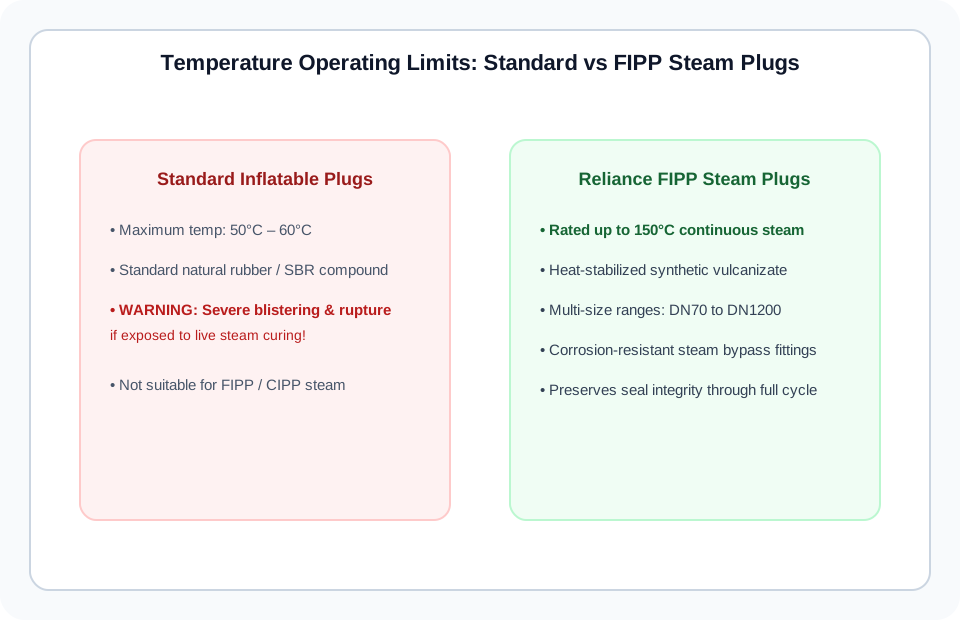
Reliance FIPP steam plugs are manufactured with specially formulated heat-stabilized synthetic elastomers (EPDM / HNBR compounds) vulcanized with aramid reinforcement plies:
Retains tensile modulus and elongation at break even during continuous 150°C exposure.
Resists thermo-oxidative degradation throughout long curing cycles mandated by ASTM F2019.
Multi-size design allows one steam plug model to cover diverse pipe diameters (e.g. DN150–DN300 or DN300–DN600), minimizing contractor capital investment.
Port configurations: steam injection, pressure relief, and condensate drainage
A true FIPP steam plug is not just a heat-resistant rubber cylinder; it is an active thermal distribution head. Every unit must feature three dedicated penetrations:
Upper Steam Injection Port: Positioned at the top or center of the metal endplate, equipped with a high-temperature rotary union or Chicago/Camlock steam fitting to deliver superheated steam directly into the liner crown.
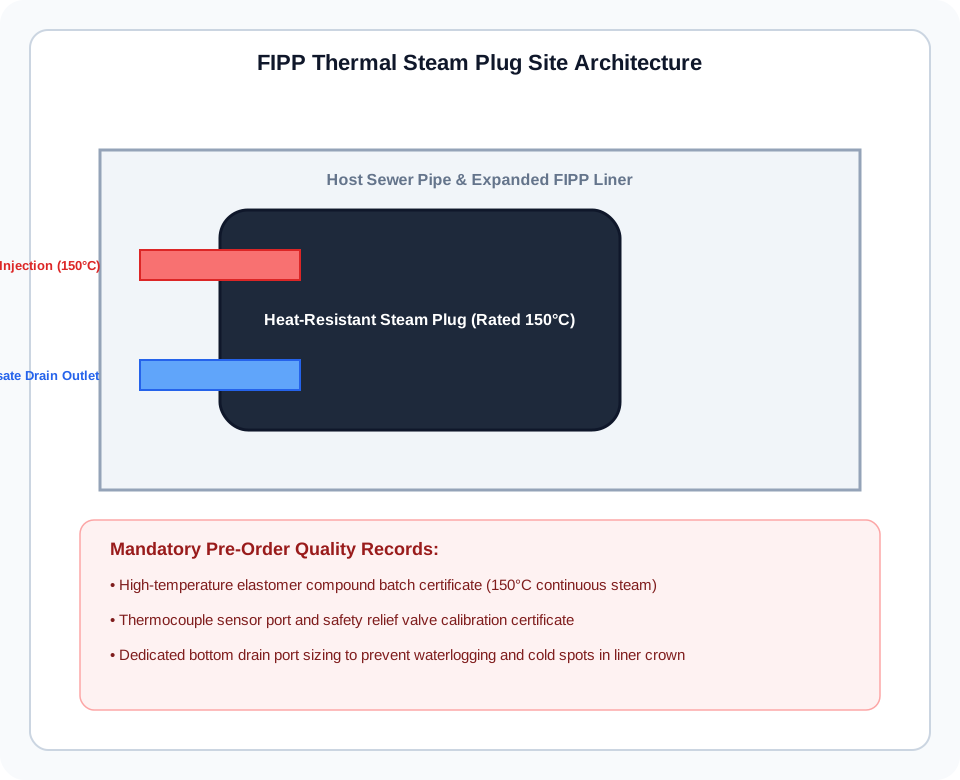
Bottom Condensate Drain Outlet: Condensate is the enemy of thermal curing. Liquid water has a heat capacity over four times that of steam; if condensate pools at the pipe invert, it creates cold spots that leave the liner resin uncured. The bottom drain port allows continuous evacuation through a steam trap or throttling valve.
Thermocouple Sensor Pass-Through: Allows temperature sensor cables from the remote invert and crown to exit to data loggers without breaking the pressure seal.
Essential documentation to review prior to factory dispatch
Before accepting delivery of steam plugs for a thermal lining project, ensure your supplier provides:
150°C High-Temperature Compound Certificate: Batch test record confirming elastomer compound heat aging resistance per ISO 188.
Proof-Test Hydrostatic Certificate: Documented pressure test conducted at 1.5× working pressure inside a heated restraining collar.
Port Layout Drawing: Dimensioned drawing confirming flange connection standards, steam hose thread sizes, and condensate port diameter.
Dimensional Verification Sheet: Multi-size diameter expansion range matched to your specific measured host pipe inner diameters.
Explore our comprehensive range of Multi-Size Inflatable Pipe Plugs or submit your thermal curing parameters through our Technical Consultation Desk.
References and source documents
Further reading
Article
Disadvantages of Trenchless Pipe Lining: Limits, Failures, and DIY Risks
Article
Sewer Line Replacement: Permits, Insurance Coverage, and Lifespan
Article
Trenchless Sewer Repair Cost per Foot: CIPP, Epoxy, and Point Repairs
Buyer guide
How to Choose an Inflatable Pipe Plug