
Sewer Line Replacement: Permits, Insurance Coverage, and Lifespan
Evaluate sewer line replacement frequency (40-60 yrs), municipal permit mandates, homeowners insurance coverage limitations, and cheapest trenchless solutions.
By Reliance Trenchless Technology6 min read
When facing repeated plumbing backups, slow drains, or bad odors, homeowners and commercial facility managers must navigate confusing technical, legal, and financial hurdles: _"How often do residential sewer lines need to be replaced?"_, _"Do I need a permit to replace my sewer line near me?"_, _"Will homeowners insurance cover a sewer line replacement?"_, and _"What is the cheapest way to replace a sewer line?"_
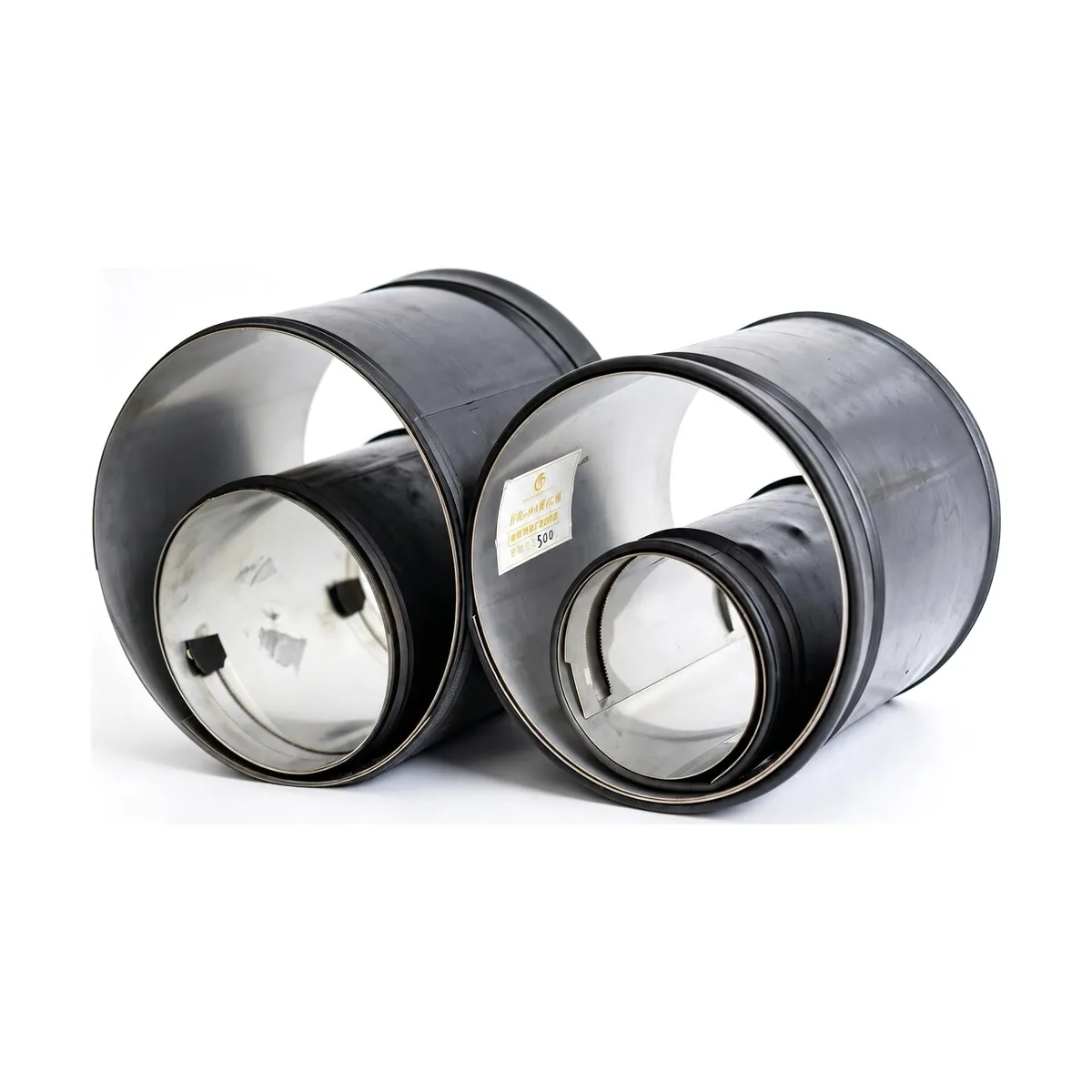
Misunderstanding these rules can result in thousands of dollars in surprise out-of-pocket costs, denied insurance claims, or municipal stop-work fines. While a standard homeowner insurance policy routinely denies claims for aged sewer pipes, modern trenchless rehabilitation—utilizing mechanical stainless steel Instant-Lock Sleeves and elastomeric Internal Pipe Seals—offers a permitted, cost-effective way to restore aging lines to a certified 50-year service life without destroying your landscape.
How often do residential sewer lines need to be replaced?
A sewer lateral does not need replacement based solely on arbitrary calendar years; rather, replacement intervals are governed by pipe material composition, soil chemistry, and joint condition.
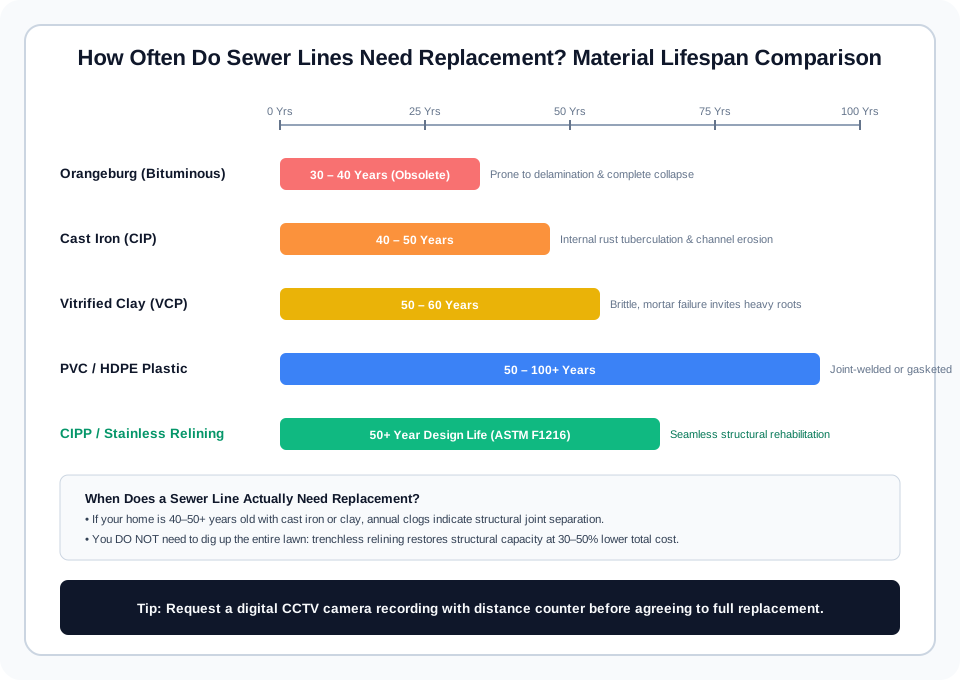
Understanding the realistic engineering lifespans of common sewer pipe materials helps determine when structural rehabilitation is truly required:
| Material | Typical Service Lifespan | Common Failure Mechanism | Recommended Action |
|---|---|---|---|
| Vitrified Clay Pipe (VCP) | 50 – 60 Years | Mortar joint failure, offset bells, heavy root intrusion | Sectional sleeve or full CIPP relining |
| Cast Iron Pipe (CIP) | 40 – 50 Years | Internal $H_2SO_4$ acid tuberculation, bottom channel corrosion | Descaling followed by CIPP or sleeve repair |
| Orangeburg (Bituminized Wood Fiber) | 30 – 40 Years (Obsolete) | Total delamination, ovality, collapse under earth pressure | Full pipe bursting or replacement |
| PVC / HDPE Plastic | 50 – 100+ Years | Rare; joint dislodgement from severe ground seismic shifts | Localized mechanical point repair |
| CIPP / Stainless Steel Relining | 50+ Years (ASTM F1216) | Impervious to roots and sewer gases | Periodic routine CCTV maintenance |
Key warning signs that replacement or relining is urgent
If your home was constructed before 1980 and has not had its sewer rehabilitated, watch for these critical indicators:
Recurring Clogs: Requiring professional snaking or hydro-jetting more than once every 12 to 18 months indicates root ingress through broken joints.
Soggy or Indented Lawn Patches: Wet, lush grass directly above the sewer alignment indicates exfiltrating sewage eroding surrounding structural soil.
Gurgling Fixtures and Sewer Gas Odors: Venting irregularities indicate partial line blockages or missing pipe crowns.
Do I need a permit to replace or reline my sewer line?
Yes. In virtually every municipal jurisdiction across North America, Europe, and Australasia, replacing, modifying, or structurally rehabilitating an underground building sewer requires an official municipal plumbing permit.
Model building codes—including the International Plumbing Code (IPC) and the Uniform Plumbing Code (UPC)—mandate that all building drainage work be inspected and approved:
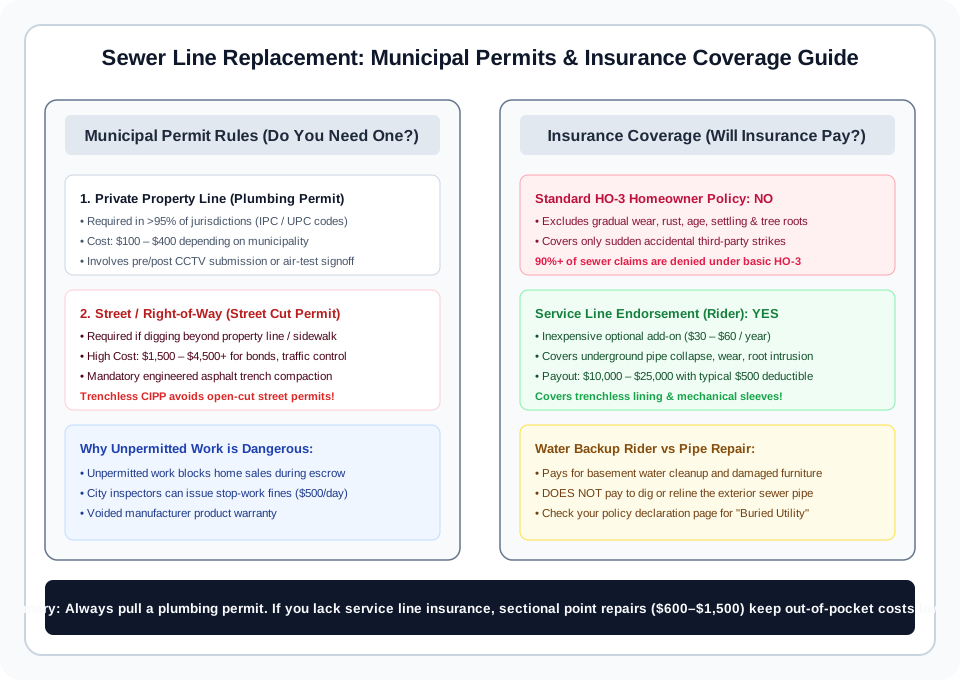
1. Private Property Line (Plumbing Permit)
Scope: Covers work performed between the house exterior wall and the private property boundary.
Cost: Typically ranges from $100 to $400.
Verification: Municipal inspectors require a licensed contractor to submit pre- and post-installation CCTV camera logs or perform an air or hydrostatic water column test verifying that the rehabilitated line holds pressure without leaks.
2. Public Right-of-Way (Street Cut Permit)
Scope: If excavation extends past the sidewalk or property line into the municipal street to connect to the city main.
Cost: $1,500 to $4,500+ due to required municipal surety bonds, engineered asphalt compaction, and certified traffic control setups.
The Trenchless Advantage: CIPP inversion relining pulled from a private cleanout directly to the municipal main connection often eliminates street excavation entirely, saving thousands of dollars in municipal permit fees and street repaving mandates.
Risks of unpermitted sewer work
Never allow a contractor to perform sewer replacement without pulling a permit. Unpermitted work can result in municipal stop-work orders, daily fines exceeding $500, and title encumbrances that can derail the sale or refinancing of your home during escrow inspection.
Will homeowners insurance cover sewer line replacement?
Under a standard HO-3 Homeowners Insurance Policy, the answer is almost always NO.
According to policy guidelines detailed by the Insurance Information Institute (III), standard home insurance is designed solely for "sudden and accidental" occurrences (such as a fire or a tree falling on your roof). Standard policies explicitly exclude:
Normal wear and tear
Gradual age-related deterioration
Rust, tuberculation, and acid corrosion
Tree root intrusion through cracked joints
Ground settling or earth movement
Because over 90% of residential sewer failures result from age, corrosion, or tree roots, standard claims are routinely denied.
How to get coverage: The Service Line Endorsement
Savvy property owners protect themselves by adding an optional Service Line Endorsement (Buried Utility Rider) to their homeowners policy:
Annual Cost: Inexpensive, typically $30 to $60 per year.
Coverage Scope: Covers underground utility piping (sewer, water, gas, electrical) against structural collapse, root invasion, freezing, and mechanical breakdown.
Claim Payout: Typically provides $10,000 to $25,000 in coverage with a manageable $500 deductible.
Applicability: Approved claims reimburse both open-cut replacement and trenchless CIPP or mechanical sleeve installations.
_Note: Distinguish this rider from a "Water Backup Endorsement". A water backup rider pays to clean sewage out of your basement and replace damaged furniture, but pays $0 to repair the cracked sewer pipe in the yard._
What is the cheapest way to replace or repair a sewer line?
If you do not have a service line insurance endorsement and need to pay out-of-pocket, the single cheapest compliant solution is sectional trenchless repair.
Full open-cut replacement across a yard costs $4,500 to $12,000+, while continuous full-run CIPP relining averages $3,000 to $7,000. However, when CCTV video demonstrates that only one or two pipe joints have separated or admitted roots, you do not need to replace the entire 40 to 60-foot line.
Instead, certified contractors deploy localized sectional repairs:
Mechanical Point Sleeves: An Instant-Lock Repair Sleeve manufactured from 316L stainless steel and EPDM elastomer is positioned over the leaking joint using an installation packer and locked into place mechanically. It expands tightly against the pipe interior, restoring complete structural integrity and stopping root ingress in less than 30 minutes with zero curing chemical downtime.
Internal Pipe Seals: For larger diameter storm and sanitary lines, an Internal Pipe Seal utilizes compression expansion bands to seal leaking joints against external hydrostatic pressure.
Cost Savings: A localized sectional point repair costs $600 to $1,400 per patch. If damage is localized, this approach delivers an engineered 50-year repair while preserving 60% to 80% of your budget.
Next steps: Diagnostic verification
Before committing to any excavation or lining contract:
Request a full-length, high-definition CCTV video recording showing exact distance counter meterage.
Check with your insurance carrier to verify whether an optional Service Line Endorsement is active on your policy.
Confirm your contractor holds valid municipal plumbing licenses and pulls all required permits.
Explore our technical comparison on Internal Pipe Joint Seals vs Repair Sleeves, review What Is Trenchless Pipe Repair, or contact our engineering specialists through the Trenchless Sleeve Consultation Portal for product specifications and contractor support.
References and source documents
International Code Council — International Plumbing Code (IPC) Chapter 7: Sanitary Drainage
IAPMO — Uniform Plumbing Code (UPC) Building Sewers & Drainage Systems
Insurance Information Institute — Water Damage, Sump Pumps, and Sewer Backup Coverage Explained
ASCE Manuals and Reports on Engineering Practice No. 145: Cured-In-Place Pipe (CIPP) Design Guide
Further reading
Article
Disadvantages of Trenchless Pipe Lining: Limits, Failures, and DIY Risks
Article
Trenchless Sewer Repair Cost per Foot: CIPP, Epoxy, and Point Repairs
Article
Reading a 40°C Pipe Repair Resin Demonstration
Buyer guide
Internal Pipe Joint Seals vs Repair Sleeves: What Is the Difference?
Buyer guide
What Is Trenchless Pipe Repair? Methods and Limits