Bypass vs Non-Bypass Repair Packers: What Changes?
Compare bypass and non-bypass repair packers for trenchless point repair. Analyze internal flow conduits, weight, bend flexibility, and resin curing times.
By Reliance Trenchless Technology3 min read
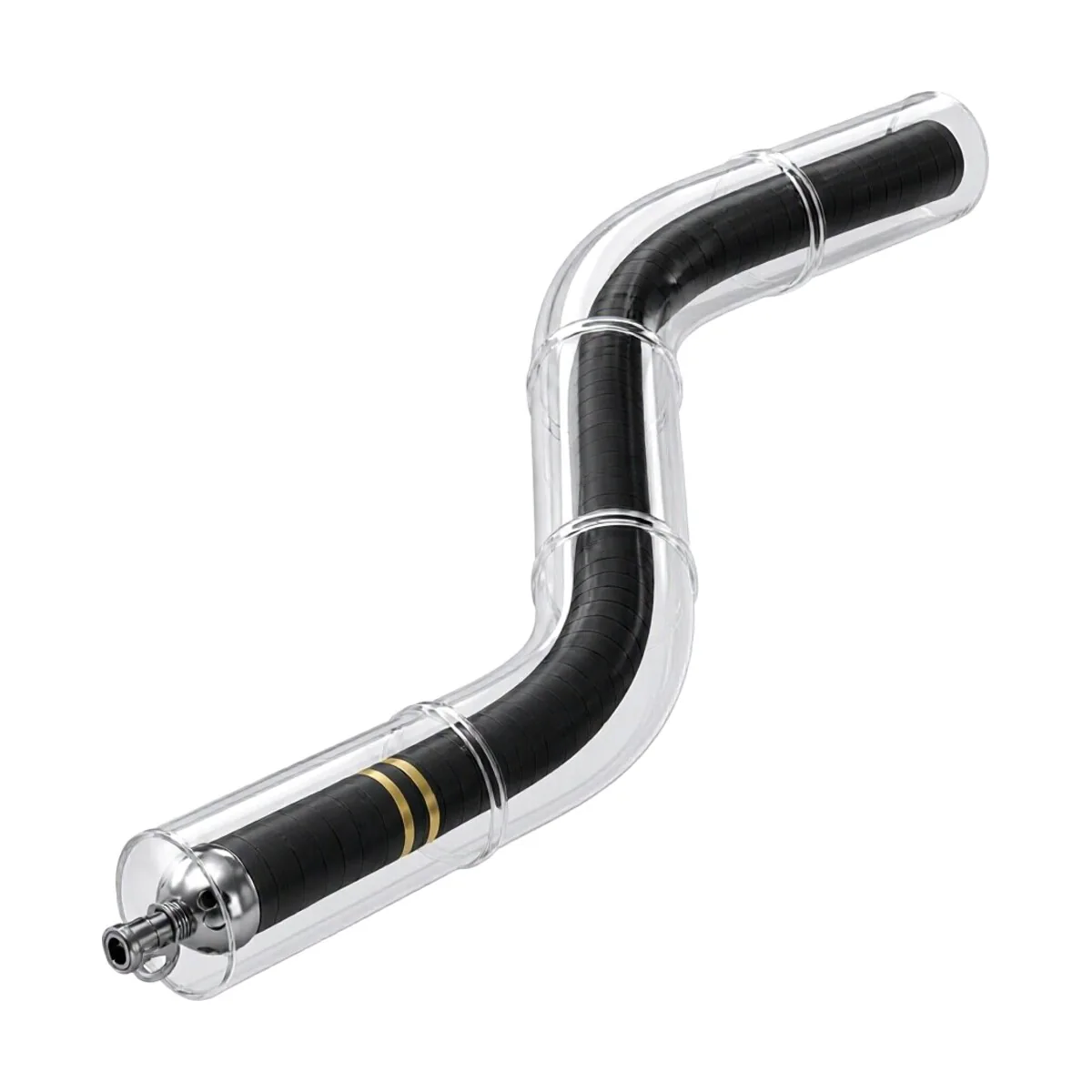
When planning a sectional point repair using resin-impregnated fiberglass matting or mechanical sleeves, selecting between a standard non-bypass packer and a bypass packer is one of the most critical operational choices. Choosing the wrong configuration can lead either to an expensive sewage backup upstream or to an unmaneuverable tool stuck in a tight manhole chamber.
In the Reliance Custom DN250–300 Repair Packer Video, a custom model with end wheels and a central flow bypass is detailed, manufactured with a 5-day lead time. To optimize your fleet of Pipe Rehabilitation Packers, let us analyze the structural, hydraulic, and thermal differences between these two designs.
Mechanical differences: solid core vs central hollow flow conduit
The core distinction between the two packer types lies in their internal structural skeleton:
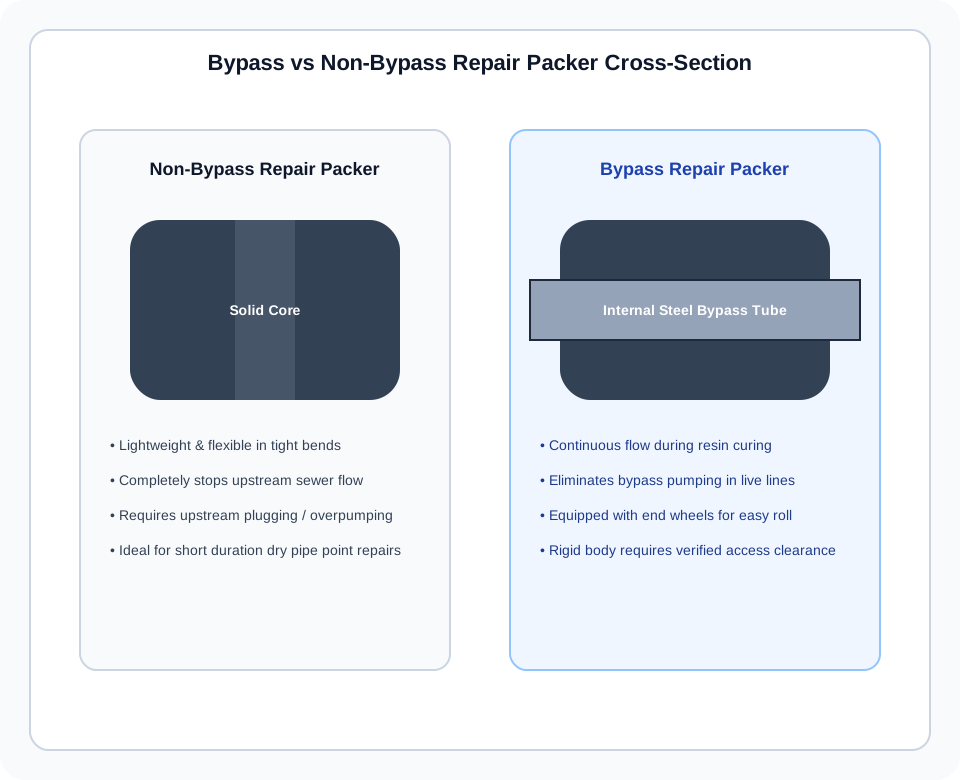
Non-Bypass Repair Packers:
- Feature a flexible or solid core with no flow path. - When inflated, the rubber body completely seals the pipeline cross-section. - _Advantages:_ Extremely lightweight, highly flexible through 45-degree and 90-degree pipe bends, and easy for a two-person crew to lower through standard 600 mm manhole openings. - _Limitation:_ Upstream sewer flow must be completely stopped with an isolation plug or diverted using surface over-pumping.
Bypass Repair Packers:
- Built around a heavy-gauge central steel or aluminum tube passing through the longitudinal axis. - The inflatable rubber bladder surrounds the outside of this metal conduit. - _Advantages:_ Allows continuous effluent conveyance through the core during the entire resin curing cycle. - _Limitation:_ The rigid central metal pipe adds substantial weight and cannot bend around tight elbows or small shaft inverts.
Managing live sewer flow without expensive over-pumping
As highlighted in the WRc Sewerage Risk Management Manual, bypass over-pumping with surface diesel trash pumps, suction hoses, and traffic control is often the single most expensive line item on a trenchless rehabilitation bid.
Deploying a bypass packer eliminates the need for temporary surface pumping in low-to-medium flow conditions:
Sewage enters the upstream end of the packer, travels through the internal steel tube, and discharges harmlessly into the downstream pipe reach.
The resin patch on the exterior remains compressed tightly against the host pipe wall without coming into contact with running water.
To facilitate transport through active sewers without scouring the resin mat against the pipe invert, Reliance equips custom bypass packers with integrated end wheel assemblies.
Weight, turning flexibility, and handling tradeoffs in access shafts
The rigid steel conduit inside a bypass packer introduces real handling constraints that site engineers must account for:
| Engineering Parameter | Standard Non-Bypass Packer | Wheeled Bypass Repair Packer |
|---|---|---|
| Rigid Length ($L$) | Short endplates (~100–150 mm) | Full packer length is rigid metal core |
| Bending Flexibility | Can flex through sweep bends | Zero axial flex; purely rigid cylinder |
| Tool Weight | 8 to 15 kg (DN250 model) | 28 to 45 kg (with bypass tube & wheels) |
| Manhole Access | Easily angled into 600 mm frames | Requires verified diagonal clearance |
As analyzed by Stein (2005), attempting to force a rigid bypass packer through a tight drop manhole or angled benching can jam the tool or scrape off the resin-saturated fiberglass mat before it reaches the defect.
How bypass flow alters resin pot life and exothermic cure temperature
A critical thermodynamic factor that field crews frequently overlook is the heat-sink effect of bypass effluent flow:
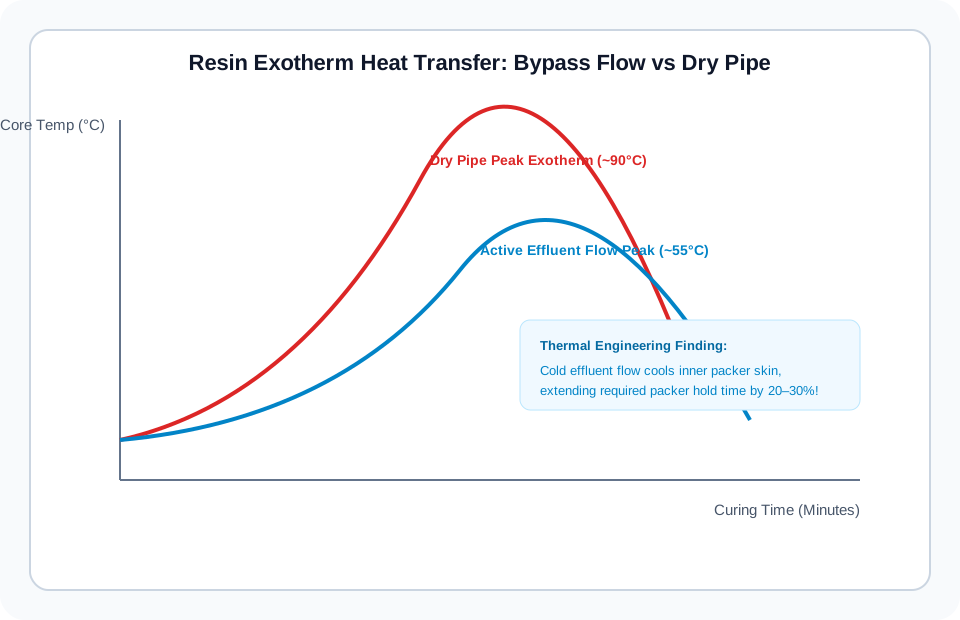
In a dry pipe repaired with a non-bypass packer, the chemical reaction of silicate or epoxy resin generates an exothermic temperature spike (often reaching 80°C–90°C), which accelerates cross-linking.
In a bypass packer, active cold wastewater (typically 12°C–18°C) continuously rushes through the center of the steel tube.
This creates continuous forced convective cooling across the inner wall of the packer, drawing heat away from the curing resin patch.
Field Recommendation: When curing silicate resin on a bypass packer with cold running sewage, extend the in-situ packer hold time by 20% to 30% (e.g. from 45 minutes to 60 minutes) to ensure complete Shore D hardness before deflation.
Explore our comprehensive selection of Pipe Rehabilitation Packers or request a custom bypass configuration tailored to your pipe diameters on our Packer Engineering Inquiry Page.
References and source documents
Reliance YouTube — Custom DN250–300 Repair Packer with Bypass and Wheels, 5-Day Lead Time
Reliance Video Watch Page — Custom DN250-300 Repair Packer Bypass Wheels
Stein, D. (2005), Rehabilitation and Maintenance of Drains and Sewers, Ernst & Sohn
WRc Sewerage Risk Management Manual — Flow management during localized sewer rehabilitation
Reliance Repair Packers Brochure — Technical specifications for standard and bypass models
Further reading
Article
Disadvantages of Trenchless Pipe Lining: Limits, Failures, and DIY Risks
Article
Sewer Line Replacement: Permits, Insurance Coverage, and Lifespan
Article
Trenchless Sewer Repair Cost per Foot: CIPP, Epoxy, and Point Repairs
Buyer guide
How to Choose a Pipe Repair Packer