
Disadvantages of Trenchless Pipe Lining: Limits, Failures, and DIY Risks
Understand disadvantages of trenchless pipe lining: internal diameter loss, host pipe collapse limits, annular shrinkage, 50-year lifespan, and DIY risks.
By Reliance Trenchless Technology6 min read
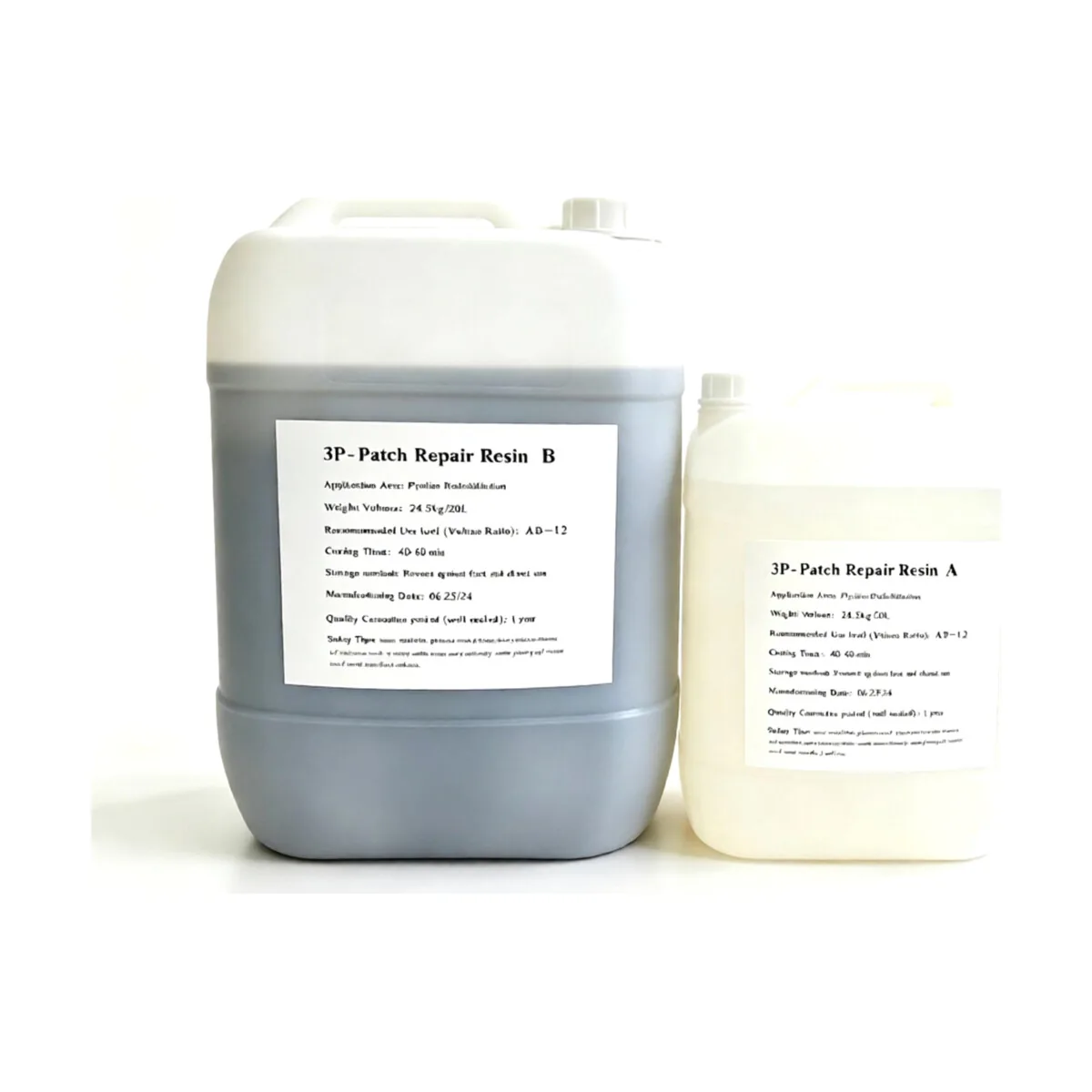
Trenchless pipe lining—specifically Cured-in-Place Pipe (CIPP)—is widely recognized as a non-destructive alternative to digging up sewer mains and residential laterals. However, marketing claims that present relining as an infallible, universal cure-all overlook substantial engineering boundaries. When property owners and facility managers ask _"What are the disadvantages of trenchless pipe lining?"_, _"How long do relined pipes last?"_, or _"Can you do pipe relining yourself?"_, honest engineering answers require separating proven structural capabilities from hard mechanical limitations.
Trenchless lining cannot rebuild a collapsed host pipe that has suffered severe crushing, nor can it correct a back-pitched sewer belly or replace unbonded mechanical joint integrity without proper end seals. While professional systems using our Fiberglass Resin Repair System and inflatable Repair Packers provide an ASTM-compliant 50-year service life, improper diagnosis or attempting DIY installation creates severe risks of permanent blockage and costly emergency excavation.
Primary disadvantages and engineering limitations of CIPP
Understanding where trenchless lining struggles is essential before authorizing any pipeline rehabilitation project. Industry standards codified in ASTM F1216 and ASCE MOP 145 define clear operational boundaries:

1. Inability to correct host pipe sag (bellies) or structural collapse
CIPP is a flexible, resin-saturated fabric tube pulled or inverted into the existing conduit. It conforms intimately to the geometry of the host pipe. If a sewer lateral has lost grade due to ground subsidence, creating a low spot (belly) where water and solids pool, lining simply lines the pool. The sag remains identical. Furthermore, if the host pipe has suffered severe structural collapse with cross-sectional deflection exceeding 10% per NASSCO PACP Defect Assessment, standard inversion liners will wrinkle, choke internal diameter, or buckle under external soil load. Severe deformations require pre-treatment with a hydraulic point jack or localized open excavation.
2. Internal diameter loss
Because a new structural wall is introduced inside the host barrel, internal diameter decreases by approximately 5% to 10% (typically 3 mm to 6 mm wall thickness on a 100 mm to 150 mm residential lateral). While the smoother interior finish (Manning's roughness coefficient $n \approx 0.009$ compared to $n \approx 0.013$–$0.015$ for degraded cast iron or clay) generally compensates for flow velocity, undersized lines carrying high solids concentrations may experience reduced hydraulic surge clearance.
3. Annular shrinkage and infiltration tracking
Thermosetting resins—particularly polyester and vinyl ester systems—experience volumetric resin shrinkage of 1.0% to 2.5% during exothermic curing. Because CIPP does not molecularly weld to contaminated, damp vitrified clay or corroded cast iron, a microscopic annular gap forms between the outer liner surface and the host pipe wall. According to the US EPA CIPP Fact Sheet, groundwater under high hydrostatic pressure can track along this annular space and weep into downstream manholes or cleanouts unless mechanical EPDM rubber end seals or hydrophilic rings are installed at all terminations.
4. Blinded branch laterals requiring robotic reinstatement
When a continuous CIPP liner passes through a mainline or multi-family sewer trunk, it covers every incoming branch connection. Each lateral junction must be precisely reopened from the inside using an expensive robotic cutting tool under CCTV guidance. If a lateral is missed, sewage will back up into the adjoining residence within hours.
5. High initial mobilization threshold for single small defects
Mobilizing a commercial CIPP crew with steam boilers, pressure inversion vessels, and refrigeration trucks entails a substantial flat setup cost. If an inspection reveals only a single cracked joint on an otherwise sound 50-foot lateral, mobilizing full continuous relining is financially disproportionate compared to sectional point repairs.
How long do relined pipes actually last?
A professionally installed CIPP lining has an engineered design life of 50 years or more, supported by the accelerated flexural creep testing mandated in ASTM F1216 and ASTM F2019. The resulting composite tube is chemically inert, resisting root penetration, sulfuric acid ($H_2SO_4$) microbiologically induced corrosion, and caustic industrial cleaning chemicals.
However, premature failures occurring within 3 to 7 years can happen due to three distinct execution errors:
| Failure Cause | Mechanism | Preventative Standard |
|---|---|---|
| Inadequate host wall descaling | Grease, calcification, or rust scale prevents intimate wall contact, causing liner wrinkles or fins that catch solids. | High-pressure water jetting (2,500–4,000 PSI) with chain flail cutters prior to insertion. |
| Incomplete resin polymerization | Ground cold water quenches resin exotherm, leaving unreacted resin paste that dissolves under sewer flow. | Temperature-monitored cure curves using thermocouples or UV sensors verifying glass transition ($T_g$). |
| Over-pressurization blowouts | Excessive inversion air pressure ruptures the liner bladder at unsupported host pipe voids. | Strict pneumatic pressure regulation maintained within 0.5 to 1.5 bar operating envelopes. |
Can you do pipe relining yourself?
The short, emphatic engineering answer is no: you cannot reliably reline a sewer pipe yourself.
While home improvement marketplaces occasionally advertise "DIY pipe lining kits", deploying thermosetting composites inside buried infrastructure without specialized machinery carries catastrophic financial risk.
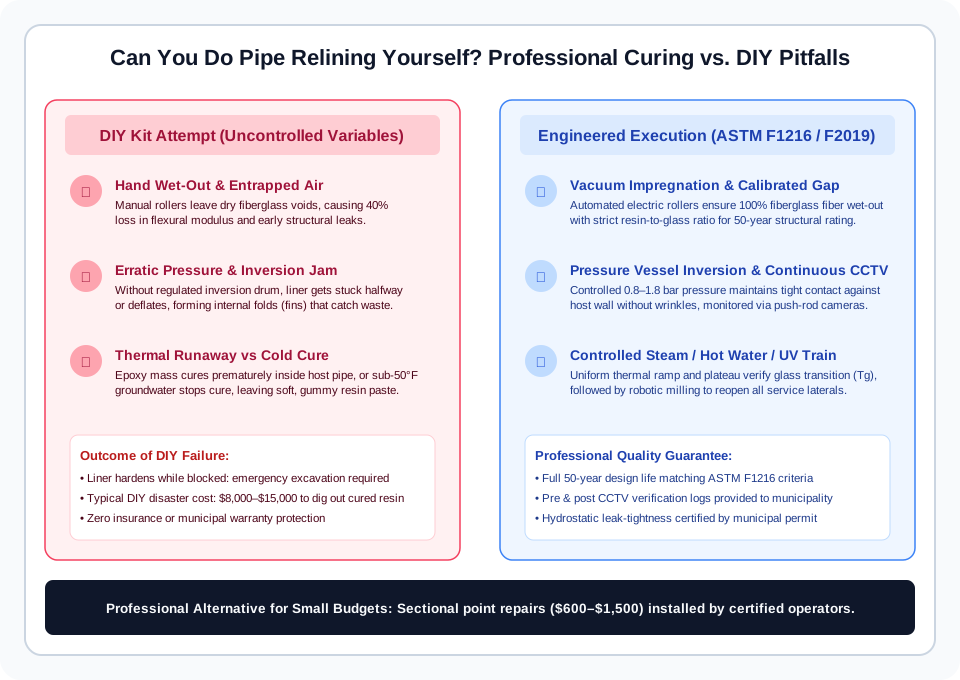
Here is why DIY relining attempts almost invariably fail:
Lack of Calibrated Vacuum Impregnation: Professional liners undergo vacuum-assisted roller saturation to ensure 100% fiber wet-out without trapped air voids. Hand-wetting with a paint roller leaves dry glass fibers that drop structural flexural strength by 30% to 50%.
Inability to Control Inversion Pressure: Commercial installers use pressurized calibration drums or pull-winches connected to pneumatic regulators. If a DIY tube loses pressure during curing, the liner collapses into a wrinkled, partially folded obstruction.
Thermal Runaway and Stuck Liners: Once ambient-cure epoxy or silicate resin is mixed, a strict chemical timer begins. If the liner snags on a rough joint during manual insertion, the resin can begin its exothermic cross-linking while stuck halfway down the pipe. Once hardened, high-pressure water jetting cannot remove it.
Catastrophic Remediation Costs: If a DIY liner cures into an obstruction, the only recourse is an emergency open-trench excavation through concrete driveways or finished floors, escalating a manageable $1,000 repair into a $10,000 to $18,000 demolition bill.
The affordable professional alternative: Sectional point repair
For property owners or site supervisors seeking the most cost-effective path to repair an isolated crack or leaking joint, full-length relining is often unnecessary.
Instead of paying for 50 feet of continuous inversion lining or risking a DIY disaster, contractors can deploy a localized sectional point repair:
An inflatable Point Repair Packer wrapped with a pre-measured Fiberglass Resin Repair System or a mechanical stainless steel Instant-Lock Repair Sleeve is navigated precisely over the defect under push-camera guidance.
The packer is pressurized to 1.5–2.5 bar, pressing the structural patch firmly against the host pipe wall.
Within 90 to 180 minutes at ambient temperature, the patch cures into a seamless structural sleeve spanning 1.0 to 2.0 meters, permanently arresting root ingress and water exfiltration.
Cost Comparison: A sectional point repair costs between $600 and $1,400, delivering the exact same 50-year structural integrity as full CIPP while saving 60% to 75% of total project expenditure.
To determine whether your pipeline condition qualifies for sectional point repair or full-length inversion, consult our guide on Sectional Point Repair vs Full-Length CIPP, review What Is Trenchless Pipe Repair, or contact our technical engineers directly through the Trenchless Engineering Consultation Portal.
References and source documents
Further reading
Article
Sewer Line Replacement: Permits, Insurance Coverage, and Lifespan
Article
Trenchless Sewer Repair Cost per Foot: CIPP, Epoxy, and Point Repairs
Article
Reading a 40°C Pipe Repair Resin Demonstration
Buyer guide
Sectional Point Repair vs Full-Length CIPP Lining
Buyer guide
What Is Trenchless Pipe Repair? Methods and Limits