Trenchless Sewer Repair Cost per Foot: CIPP, Epoxy, and Point Repairs
Compare trenchless sewer repair cost per foot ($80-$250/ft), epoxy lining vs open-cut, 30-foot cost models, surface restoration, and point repair savings.
By Reliance Trenchless Technology5 min read
When sewer pipes crack, deform, or suffer root intrusion, property owners and municipal engineers immediately confront critical financial decisions: _"How much does CIPP cost per foot?"_, _"Is trenchless sewer repair cheaper than replacement?"_, _"How much does an epoxy sewer liner cost?"_, and _"What is the cheapest way to replace a sewer line?"_
On paper, raw replacement materials such as standard Schedule 40 PVC or SDR-35 pipe appear deceptively inexpensive at $15 to $30 per linear foot. However, standard open-cut excavation frequently becomes the most expensive solution once heavy machinery, trench shoring, traffic control, and surface restoration are calculated. In contrast, full-length Cured-in-Place Pipe (CIPP) relining averages $80 to $250 per linear foot, eliminating lawn and pavement demolition. Furthermore, for isolated fractures or offset joints, deploying sectional point repairs with our Repair Packers and Instant-Lock Repair Sleeves delivers an even more cost-effective solution, cutting total project costs by up to 80%.
CIPP cost per foot: The national pricing breakdown
According to industry benchmark studies published in ASCE MOP 145 and WEF Manual of Practice FD-6, trenchless sewer relining costs vary primarily by pipe diameter, line depth, host wall condition, and total footage:
| Pipe Dimension & Type | Typical Linear Foot Range | Typical 30–50 ft Lateral Total | Primary Cost Factors |
|---|---|---|---|
| Residential DN100 (4-inch) Lateral | $80 – $175 / ft | $2,800 – $6,500 | Cleanout access, root descaling, bend transitions |
| Residential DN150 (6-inch) Lateral | $100 – $225 / ft | $3,500 – $8,500 | Increased resin volume, branch lateral reinstatements |
| Commercial DN200–DN300 (8–12 inch) | $140 – $350 / ft | Project-specific bids | Traffic control, high bypass pumping volumes |
| Sectional Point Repair (1–2 m patch) | $600 – $1,400 / patch | $600 – $1,400 total | Localized packer inflation, single-setup mobilization |
For a standard residential lateral, a complete continuous epoxy sewer liner project typically totals $3,000 to $9,000. This turn-key cost encompasses pre-installation high-pressure water jetting, pre-rehabilitation CCTV video inspection, vacuum resin wet-out, inversion and curing, and final CCTV verification.
Is CIPP cheaper than traditional open-cut replacement?
The answer depends entirely on what lies directly above the buried sewer pipe.
A direct linear-foot comparison often confuses buyers because it isolates plumbing labor from civil site restoration:
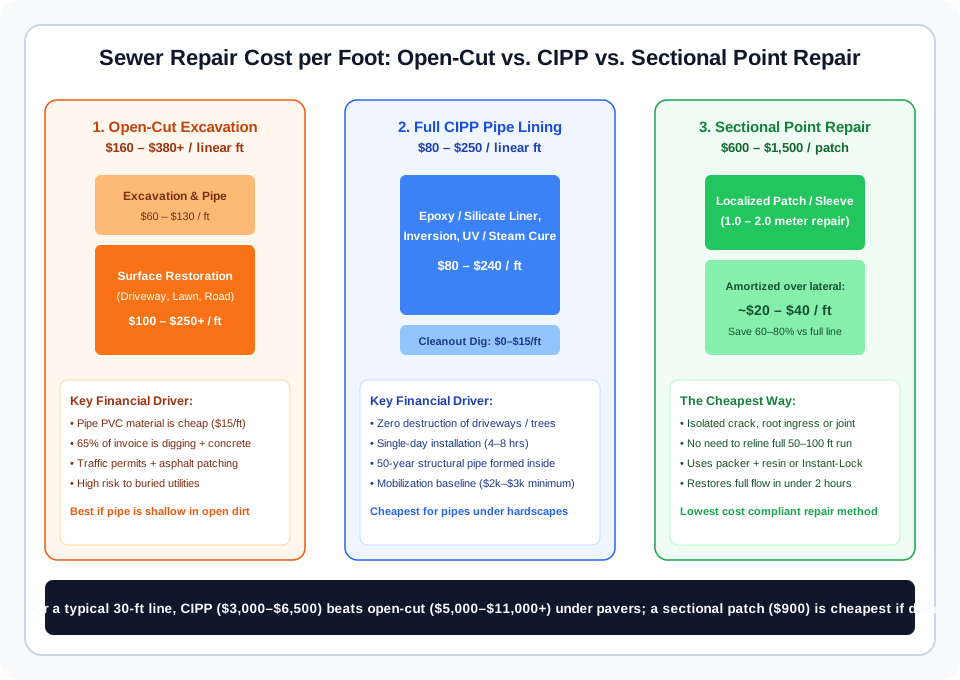
Under Open Dirt or Soft Landscaping: If a shallow pipe (under 4 feet deep) runs across an open lawn with no mature trees, sidewalks, or paved structures, open-cut replacement is often slightly cheaper or price-competitive ($60 to $120 per foot total).
Under Driveways, Concrete Patios, or Roadways: When the sewer line runs beneath a concrete driveway, paver walkway, house foundation slab, or public street, open excavation triggers massive secondary expenses. Demolishing and repaving concrete adds $10 to $25 per square foot; roadway asphalt trench restoration with municipal compaction testing adds $2,500 to $6,000. In these scenarios, trenchless CIPP is 30% to 50% cheaper in total out-of-pocket cost, while completing in hours instead of days.
According to the US EPA CIPP Rehabilitation Fact Sheet, eliminating collateral surface disruption is the single largest economic driver favoring trenchless methods over traditional open trenches.
How much does it cost to replace 30 feet of sewer line?
Replacing 30 feet of sewer lateral is one of the most common residential scopes. Here is how real project invoices compare across rehabilitation pathways:
Open-Cut Excavation (30 Feet): $4,500 to $11,500+. The excavation and pipe installation account for approximately $3,000, while trench backfill, concrete driveway reconstruction, and landscaping restoration contribute the remaining $2,500 to $8,500.
Continuous CIPP Inversion (30 Feet): $3,200 to $6,500. Work is conducted entirely through an existing exterior cleanout or a small access pit, leaving hardscapes completely undisturbed.
Sectional Point Repair (Isolated Spot): $700 to $1,400. If the 30-foot pipe run is sound except for a single cracked joint or root ingress point, installing a localized structural sleeve or resin patch repairs the defect permanently without paying to reline the remaining 26 feet of healthy conduit.
What is the cheapest way to replace or repair a sewer line?
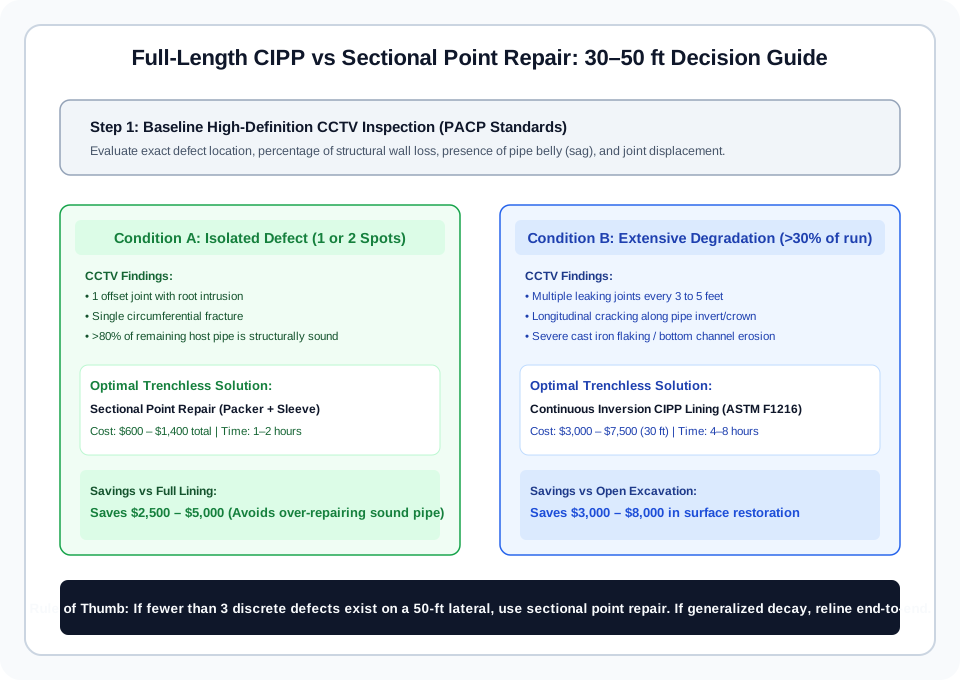
When property owners or municipal asset managers ask for the single lowest-cost compliant method to fix a failing sewer pipe, the answer is sectional point repair.
In many cases, home inspection cameras identify a single cracked bell-and-spigot joint or localized tree root intrusion at 18 feet down a 40-foot sewer line, while the remainder of the cast iron or clay pipe remains structurally stable. Relining the entire 40 feet with continuous CIPP costs $4,000 to $8,000.
The engineered, budget-preserving alternative is deploying a localized sectional point repair:
Precision Placement: A heavy-duty, flow-through Repair Packer wrapped with a pre-cut, resin-impregnated Fiberglass Resin Repair Kit is pushed or pulled to the exact target meterage.
Pneumatic Expansion: The packer is inflated to 1.5–2.5 bar, pressing the multi-axial fiberglass patch firmly against the host pipe walls and bridging across the crack.
Ambient Curing: Within 90 to 120 minutes, the silicate or epoxy matrix hardens into a tight structural sleeve matching ASTM F1216 standards.
Mechanical Alternative: Where resin curing is impractical due to high groundwater flow, an Instant-Lock Mechanical Sleeve made of 316L stainless steel and EPDM rubber expands mechanically in minutes, providing permanent structural support with zero chemical curing time.
By treating only the defective zone, a sectional point repair delivers an ASTM-certified 50-year structural repair for $600 to $1,400, saving property owners and utilities between $2,500 and $6,000 per intervention.
Key parameters to verify before approving a quotation
Before signing any sewer repair or relining proposal, ensure your contractor provides:
Complete CCTV Video with Distance Overlay: Verify whether defects are generalized across the entire run or confined to 1 or 2 discrete joints.
Itemized Restoration Clauses: In open-cut quotes, ensure pavement, sod, and concrete restoration are explicitly written into the contract scope rather than excluded as "owner responsibility".
Lining Specification & Wall Thickness: Confirm that CIPP proposals calculate design thickness according to fully deteriorated or partially deteriorated host pipe conditions per ASTM F1216 Appendix X1.
For detailed engineering guidance on equipment selection, review our guide on How to Choose a Pipe Repair Packer, compare Sectional Point Repair vs Full-Length CIPP, or request contractor equipment quotations through our Technical Repair Equipment Portal.
References and source documents
Further reading
Article
Disadvantages of Trenchless Pipe Lining: Limits, Failures, and DIY Risks
Article
Sewer Line Replacement: Permits, Insurance Coverage, and Lifespan
Article
Reading a 40°C Pipe Repair Resin Demonstration
Buyer guide
How to Choose a Pipe Repair Packer
Buyer guide
Sectional Point Repair vs Full-Length CIPP Lining