
Pipe Repair Resin: Working Time, Setting Time and Cure Time
By Reliance Trenchless Technology
Working time, setting time and cure time describe different milestones in a resin data sheet. Compare the formulation, temperature, test sample and starting point before using any timing value to plan a repair.
This guide explains how to read published resin timing information. It is not a mixing recipe, temperature conversion, fixed removal time or permission to restore flow, apply pressure or accept a repair.
This guide is available in English. Choosing another language opens that language’s resource library.

1. What each time describes
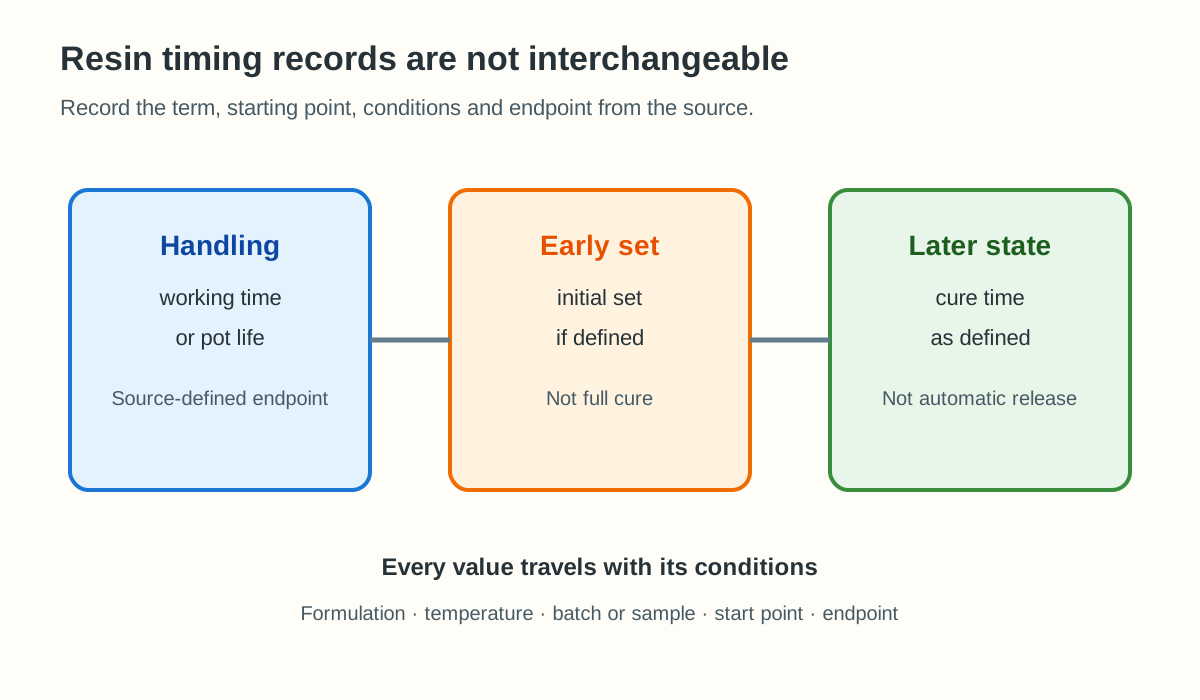
A resin timing value is useful only when its meaning and test conditions are clear. Working time, setting time and cure time describe different milestones; they should not be treated as interchangeable deadlines.
Working time or operation time commonly describes the interval in which a mixed material can be handled or applied. Pot life may describe a similar handling limit, but the source must define its endpoint. Initial set describes a change in the material state, while cure time describes the source-defined period to a later cured condition. The terms are not automatically equivalent across manufacturers.
Read the wording exactly as printed. If a document says operation time and curing time, do not silently relabel them as working time and full cure.
| Term as printed | Meaning stated by the source | Starting point | Temperature and other conditions | What it does not establish |
|---|---|---|---|---|
| Working time / operation time | Handling or application milestone as defined by the source | The source-defined mix or preparation point | Record the formulation, temperature and sample conditions | Not automatically pot life, initial set or release to service |
| Pot life | Usable life in the container when that term is defined | The source-defined mixing point | Record batch size, temperature and test method if stated | Not a universal application or cure deadline |
| Initial set | Early set milestone when the source defines one | The source-defined start of setting | Record the test temperature and endpoint | Not full cure or finished-repair acceptance |
| Cure time | Later cured-state milestone as defined by the source | The source-defined mix, placement or set point | Record formulation, temperature and test conditions | Not permission to remove equipment, restore flow or apply pressure |
Sources and supporting product information
Reliance fiberglass and resin: published formulations, timing records and source notes2. Compare the test conditions before comparing minutes
Write the formulation, test temperature, sample or batch description and timing start point beside every published value. A number without those conditions is an incomplete record.
The Reliance fiberglass-and-resin material record separates seasonal operation and curing times from a spreadsheet that reports initial-setting and curing times at 25°C. Those entries describe different published conditions. They are not one continuous test series and should not be averaged, converted or ranked in this guide.
If the source does not state a temperature, batch size, sample geometry or endpoint, preserve the omission as unknown. Do not fill it with a standard assumption.
Sources and supporting product information
Reliance fiberglass and resin: published formulations, timing records and source notes3. Read the Reliance tables as source-specific records
The Reliance product page keeps the resin and fiberglass material information with its source notes and tables. The page records seasonal operation and curing values separately from the 25°C spreadsheet timing entry. Keep the original table title and units when copying a value into a project comparison.
A table can help a buyer see that two timing records are different without deciding which one governs a proposed order. The applicable formulation, revision and project conditions still need to be identified for the system under review.
The same rule applies to any external technical data sheet: its timing belongs to the named formulation and test conditions. It does not become a Reliance compatibility or performance statement merely because the terminology looks familiar.
Sources and supporting product information
Reliance fiberglass and resin: published formulations, timing records and source notes4. Cure is not an automatic release decision
A published cure-time value is not, by itself, permission to remove a packer, restore flow, introduce pressure or accept the finished repair. Those decisions depend on the specified system, site conditions, instructions and project acceptance requirements.
Do not turn a brochure minute value into a safety threshold. This article intentionally does not provide a fixed removal time, temperature adjustment, catalyst recommendation or pressure procedure.
Sources and supporting product information
Reliance fiberglass and resin: published formulations, timing records and source notesReliance repair packers: equipment used in localized repair5. Build a comparison record you can audit
Use the blank record below when comparing two resin data sheets. Copy the value and wording from the source, not from a remembered conversion. Keep a separate note for every unresolved condition.
This is an illustrative worksheet, not a laboratory result or a recommendation. A project file should identify the product document and revision used by the technical reviewer.
| Record field | Formulation A | Formulation B | Source location / unresolved condition |
|---|---|---|---|
| Product and formulation | Blank | Blank | Blank |
| Term as printed | Blank | Blank | Blank |
| Value and unit | Blank | Blank | Blank |
| Starting point | Blank | Blank | Blank |
| Temperature / batch / test conditions | Blank | Blank | Blank |
| Endpoint definition | Blank | Blank | Blank |
| What decision it may inform | Blank | Blank | Blank |
Sources and supporting product information
Reliance fiberglass and resin: published formulations, timing records and source notes6. Follow the specified system
For a resin-and-fiberglass point repair, keep the resin formulation, reinforcement, packer arrangement and application conditions together in the review package. The fiberglass and resin product guide supplies the published material context, while the repair packer selection guide explains why packer dimensions and usable repair length must be confirmed separately.
Before ordering, identify which source document governs, what conditions are known, and which timing or compatibility questions remain unanswered. A complete record is more useful than a single number copied without its definition.
Sources and supporting product information
Reliance fiberglass and resin: published formulations, timing records and source notesReliance repair packers: equipment used in localized repairWhat to include in your enquiry
Send the information you have and identify what still needs measurement or confirmation. A requested delivery date is a requirement to review, not a promised lead time.
Product name, formulation and source document revision.
Timing term exactly as printed, including the stated endpoint.
Starting point for the clock and the unit used.
Temperature, batch or sample conditions and any omitted test information.
Whether the value is operation, set or cure information.
Project decisions that must remain separate from the timing value: equipment removal, flow restoration, pressure and acceptance.
Related product pages
The primary button preselects Fiberglass and Resin as a discussion starting point; it does not select a system or confirm suitability. The contact form opens an email draft for you to review and send. Opening it does not confirm delivery.