Manhole rehabilitation equipment: spin-cast lining
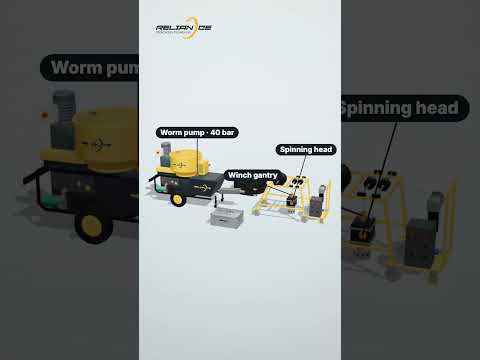
Manhole rehabilitation equipment rebuilds a manhole wall from inside the shaft: a worm pump at 40 bar, a spinning head and a winch.
Application Overview
The throw figures are computed from the published head speed and the shaft radius (a = ω²r). Confirm the pump, head and mortar mix for each project with Reliance.
Chapters
Each chapter opens the video at that point on YouTube. Read the script under each chapter. From the subtitle track delivered with the video. Refer to the video and product documentation for technical details.
- 010:00Why a manhole wall fails under a live road
The wall of a manhole fails where nobody can see it. Manhole rehabilitation equipment rebuilds that wall from inside the shaft. When that wall goes, groundwater gets behind it, and the road above starts to sink. The usual repair is an open cut: excavate the shaft, rebuild the wall, pave it again. On a live street that cut is the expensive part, and the traffic never stops. The set stays at the surface: a worm pump pushes the mortar at forty bar. A spinning head sprays it, and a winch walks it up the shaft.
- 020:33Manhole rehabilitation equipment: what is in the set
The head goes down to the floor of the shaft. Then it starts to turn: three thousand six hundred revolutions a minute. The motor is in the head, and the mortar arrives through the hose.
- 030:45How spin-cast spraying throws mortar onto the wall
The head throws the mortar outward, not down. It leaves the cup as a spray and reaches the wall as a wet coat. Because the throw is even all the way round, the coat lands on every side of the shaft at once. Why does a spinning head throw the mortar sideways instead of letting it fall? The head turns at three thousand six hundred revolutions a minute, which is three hundred and seventy-seven radians a second. Acceleration is omega squared times r. At the wall of a six-hundred-millimetre shaft, r is zero point three metres. So the throw is forty-two thousand six hundred metres per second squared. That is about four thousand three hundred times gravity. The mortar is thrown, not dropped. Now the winch raises the head at zero point one metres a second, which is six metres a minute. The lining is left behind it, from the floor to the rim. A twelve-metre shaft is one pass in about two minutes. The shaft itself is a precast base, shaft rings and a cone. The same head covers shafts from six hundred to eighteen hundred millimetres. At the wall of an eighteen-hundred-millimetre shaft, it throws at about thirteen thousand times gravity. The same mortar can go on by hand gun, and on a short repair that is enough. A whole shaft is a different job: every pass is aimed by an operator working in a confined space. The spinning head aims nothing, and it does not get tired on the way up. The road above was never opened. One shaft, one set, one pass from the floor to the rim. The surface is left exactly as it was found.
- 042:19Choosing a worm pump and a spinning head
Two choices decide the order. The pump: the P60/120 at twenty to forty litres a minute, or the P90/160 at thirty to sixty. Both deliver at forty bar, and both reach forty metres up and sixty metres along. Then the head: the RSS-HT hollow feed, or the RSS-SP side feed. Both spray six hundred to eighteen hundred millimetres. Send us your manhole size, and we will match the pump and the head.
Resources
Product videos
Explainer videos and short demonstrations from Reliance’s official YouTube channels. Browse every published video by topic and follow each one to its reviewed watch page or official YouTube source.