
One-Piece vs Segmented Expansion Bands in Internal Seals
Compare one-piece and segmented expansion bands for internal pipe joint seals. Shaft access clearances, diameter thresholds, and torque locking methods.
By Reliance Trenchless Technology5 min read
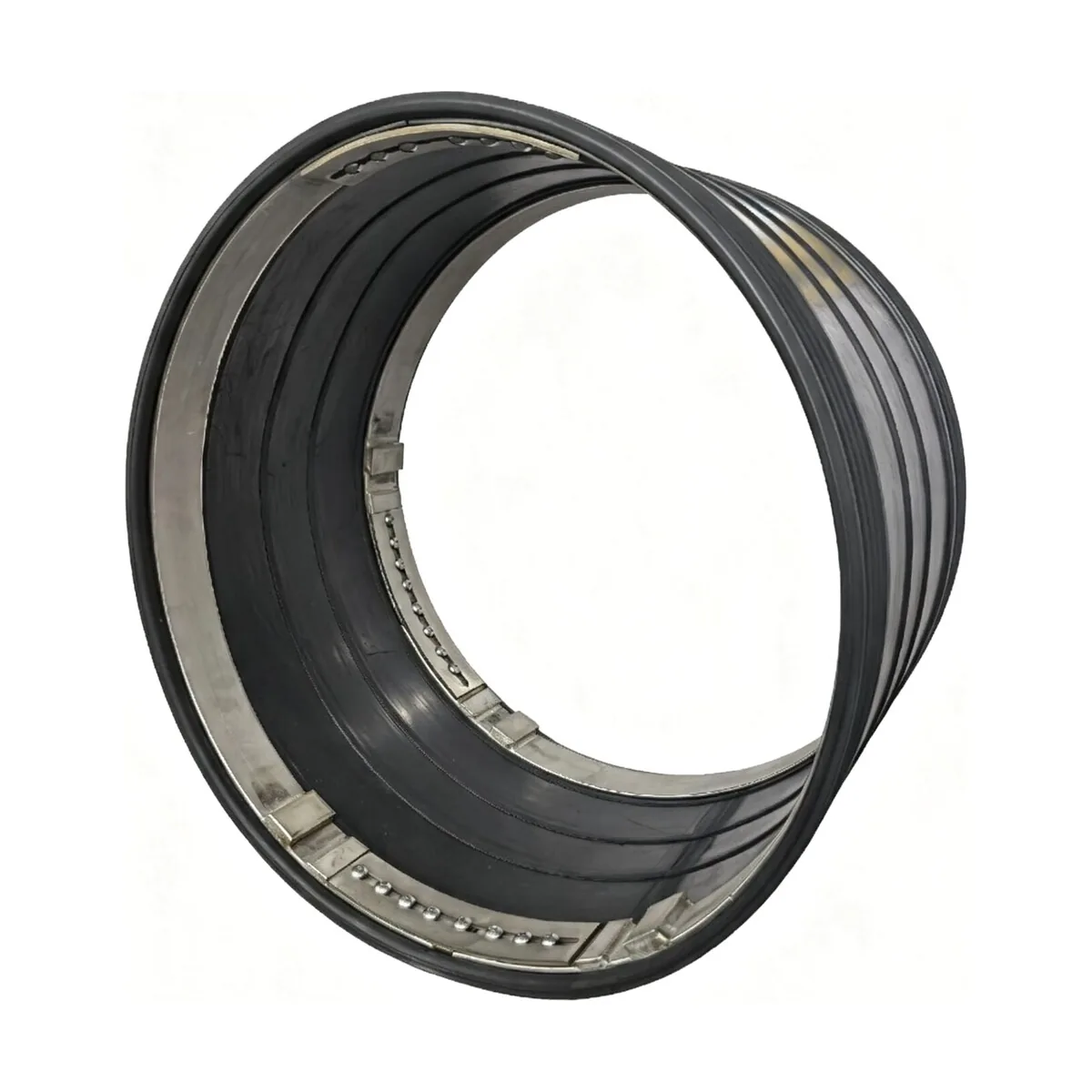
When specifying internal mechanical joint seals for leaking storm sewers, culverts, or potable water mains, engineers often focus entirely on the elastomer profile while overlooking the retaining mechanism. A high-grade EPDM rubber sleeve cannot stop infiltration or exfiltration unless its stainless steel expansion bands exert continuous, uniform radial compression against the host pipe wall.
The Reliance Internal Pipe Joint Seal and Internal Pipe End Seal utilize precision roll-formed stainless steel bands engineered in either one-piece continuous or multi-piece segmented configurations. As emphasized in our technical video on the Reliance Internal Joint & End Seal YouTube Feature, matching the band architecture to pipe diameter and shaft access is essential: one-piece rings suit remote installation in non-man-entry lines (DN150–DN600), while segmented bands allow workers to transport heavy structural retaining rings through standard 600 mm manhole openings to seal massive culverts up to DN4000.
Mechanical kinematics: One-piece vs segmented band architecture
The internal pipe seal works by compressing an elastomeric sleeve across the circumferential gap of a failing joint or CIPP liner termination. The radial pressure required to energize the rubber ribs is delivered by expanding internal metal bands outward against the pipe crown, invert, and springlines.
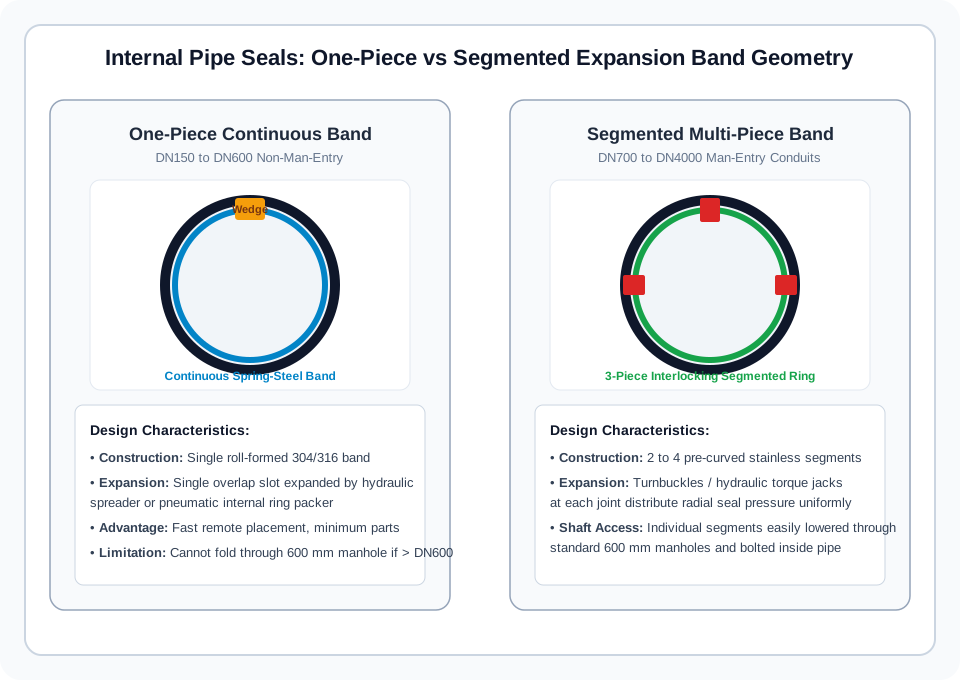
1. One-piece continuous expansion bands (DN150 to DN600)
For non-man-entry and small utility lines, the expansion band is manufactured from a single piece of high-tensile 304L or 316L stainless steel strip.
Expansion Mechanism: Incorporates an overlapping slot with pre-punched indexing teeth and a locking wedge pin. A specialized internal pneumatic or hydraulic expansion packer centers the sleeve over the joint and expands the band outward until the target radial seating torque is achieved.
Operational Advantage: Allows fully remote installation from surface manholes using winch cables and CCTV navigation, requiring zero manned entry inside confined pipes.
Physical Boundary: Above DN600, a rigid one-piece circular band cannot be maneuvered through standard roadway manhole covers.
2. Segmented multi-piece expansion bands (DN700 to DN4000)
For man-entry storm sewers, irrigation tunnels, and potable water conduits, the retaining band is divided into two, three, or four articulated circular arcs.
Expansion Mechanism: Adjacent arc segments are connected by precision turnbuckles, mechanical scissor jacks, or threaded torque bolts with serrated locking plates.
Radial Load Uniformity: In large diameters ($>DN1000$), expanding a single joint creates uneven friction distribution around the circumference. Multiple expansion points distributed at 120° (for 3-piece) or 90° (for 4-piece) ensure that every sector of the EPDM sleeve receives equal sealing pressure, preventing localized wrinkling.
Solving the shaft access bottleneck: Passing through a standard 600 mm frame
In congested urban infrastructure, excavating new access pits to lower large steel rings into a sewer costs tens of thousands of dollars and disrupts roadway traffic. Segmented band engineering eliminates the need for shaft excavation.
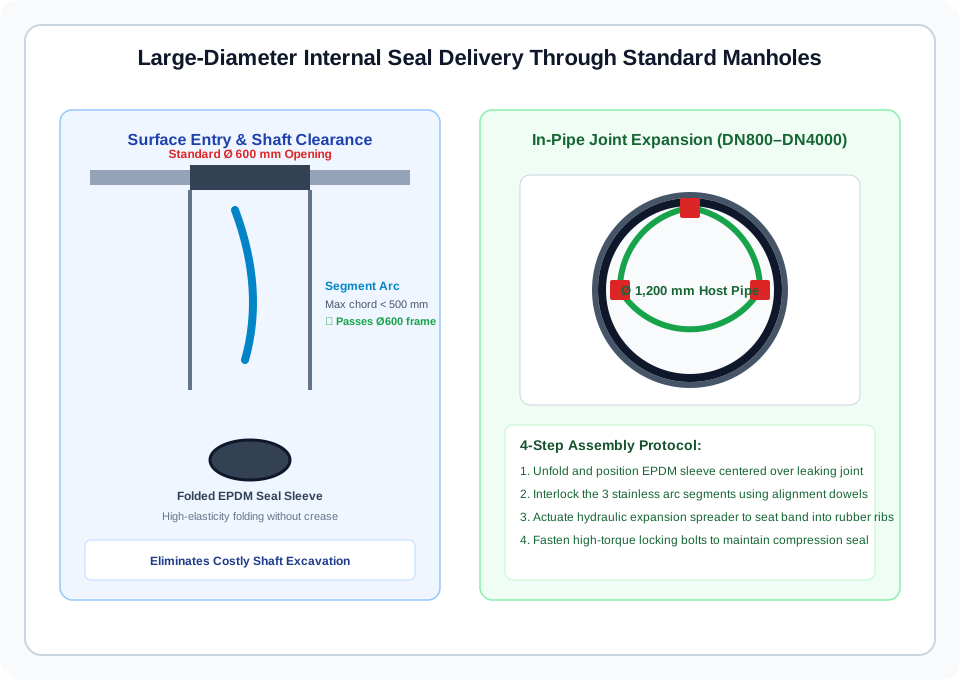
As illustrated in the shaft delivery diagram, a rigid DN1500 steel ring has a diameter 2.5 times larger than a standard 600 mm cast-iron manhole cover. Segmented engineering resolves this constraint through a straightforward protocol:
Flexible Elastomer Folding: The heavy-duty EPDM or NBR rubber sleeve possesses high elastic recovery conforming to BS EN 681-1. Workers roll and fold the sleeve longitudinally into a narrow oval bundle ($<400\text{ mm}$ width) and lower it safely down the vertical manhole shaft.
Segmented Arc Delivery: A DN1500 3-piece band has an arc circumference of approximately 1.57 meters, but its straight geometric chord length is less than 480 mm. Each individual stainless steel segment slides through the 600 mm manhole frame with generous clearance.
In-Pipe Assembly: Inside the pipe invert, certified confined-space technicians interlock the segment alignment pins, position the rubber sleeve across the joint, and apply calibrated torque wrenches to expand the band into the elastomer sealing grooves.
Engineering standards and materials specification
Selecting expansion band metallurgy and torque ratings depends on media chemistry and hydrostatic head:
Corrosive Wastewater vs Potable Water: Standard municipal sewer and stormwater installations utilize Grade 304L stainless steel. For saline estuarine environments, industrial effluents, or high-chloride coastal lines, specify Grade 316L (EN 1.4404) to resist pitting and crevice corrosion under continuous submersion.
Potable Water Compliance: For municipal drinking water mains and CIPP liner end seals, all elastomer formulations must meet drinking-water certification standards, and metal retaining components must satisfy NSF/ANSI 61 and ASTM C923 resilient connector requirements.
Hydrodynamic Retention: In accordance with ASCE Manual of Practice 145, mechanical expansion bands must be sized to withstand internal operating pressure (typically rated up to 1.6 bar for standard joint seals and up to 2.5–3.0 bar for potable water end seals) without relying on chemical adhesives or grouting.
Preparing the internal seal project inquiry
To obtain certified general arrangement drawings and project quotations for internal joint or end seals, provide the following site parameters:
Exact Internal Pipe Geometry: True internal diameter (ID), pipe material (reinforced concrete, ductile iron, steel, or CIPP relined), and wall surface roughness.
Joint Dislocation Profile: Measured joint gap width, vertical offset step, and longitudinal deflection angle.
Operating Pressure Requirements: Maximum internal service pressure and external groundwater head acting against the joint.
Smallest Entry Access Point: Clear dimensions of manhole frames, drop shafts, or portals along the insertion route.
Download complete dimensional tables in the Reliance Internal Pipe Seal Brochure, read our Internal Pipe Joint Seals Measurement Guide, or submit your pipeline repair data through our Internal Joint Seal Project Form.
References and source documents
Further reading
Article
Disadvantages of Trenchless Pipe Lining: Limits, Failures, and DIY Risks
Article
Sewer Line Replacement: Permits, Insurance Coverage, and Lifespan
Article
Trenchless Sewer Repair Cost per Foot: CIPP, Epoxy, and Point Repairs
Buyer guide
Joint Guide: Measuring Internal Pipe Joint Seals