
Internal Pipe Joint Seals: What to Measure Before Ordering
By Reliance Trenchless Technology
Prepare an internal pipe joint seal enquiry around the actual joint: the bore on each side, visible joint condition, available seating areas, access and known service conditions. Keep nominal pipe size separate from measured dimensions, and send the evidence behind the measurements. This information supports a configuration review; it does not by itself establish that a seal will fit or achieve the required result.
Use existing inspection records, drawings or measurements obtained by appropriately qualified personnel under the applicable site procedures. This guide is not an instruction to enter a pipe or manhole, install a seal or conduct a pressure test.
This guide is available in English. Choosing another language opens that language’s resource library.

1. Identify the joint and the task
Reliance’s internal pipe joint seal information describes an assembly using stainless steel components, a rubber sealing element and installation accessories to address leakage at the joint between pipe sections.
Start by identifying that joint in the inspection record. Describe what has been observed, where the water movement is reported and whether the proposed task concerns the joint itself or additional damage nearby. A general statement such as “the pipe leaks” does not show which area needs to be assessed.
Include dated images or the relevant inspection reference where available. Do not infer that a joint-sealing product is automatically suitable for unrelated cracks, deformation or a wider structural problem.
Sources and supporting product information
Reliance internal pipe seal: guide, assembly terms and accessoriesReliance internal joint sealing systems2. Record actual bore information separately from nominal size
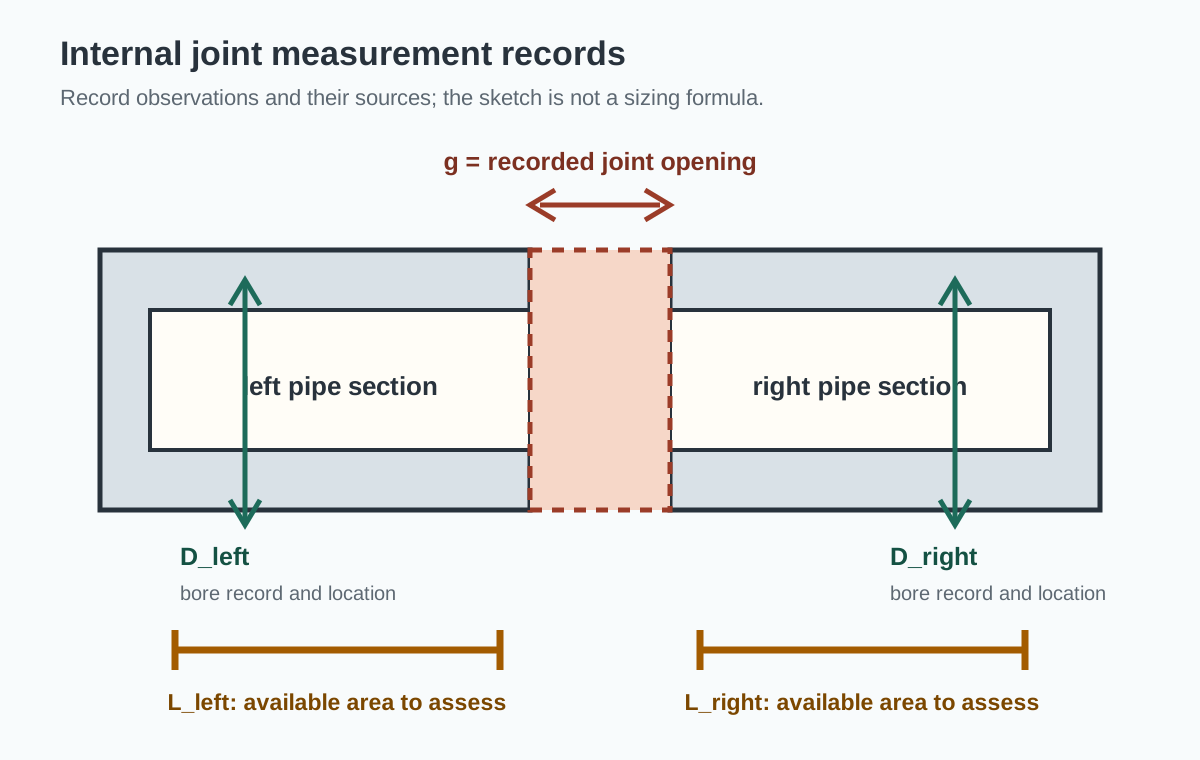
State the nominal pipe designation for identification, then provide the actual bore information available at the proposed location. Identify where each measurement was taken and whether it came from a drawing, an inspection record or a site measurement.
Where records show different dimensions, an irregular bore or uncertainty about the measurement location, preserve that information. Do not reduce it to a single convenient number or derive an exact bore from the product model name.
The conceptual diagram names information to collect on the two sides of the joint. It is not to scale and contains no permitted fit range, minimum seating length or automatic sizing formula.
Sources and supporting product information
Reliance internal pipe seal: guide, assembly terms and accessoriesReliance internal pipe seal: published technical specifications3. Describe the joint opening, alignment and nearby surface
Provide the recorded joint opening and any visible offset or change in alignment, together with images showing where those observations apply. If no reliable measurement is available, describe it as unmeasured rather than assigning an estimated value.
Identify visible deposits, lining changes, protrusions or other conditions near the intended location. These observations give the technical reviewer context; they do not establish an allowable tolerance or prescribe how the surface should be prepared.
A dimensioned sketch should distinguish what was measured from what was drawn only for illustration. Avoid presenting a not-to-scale sketch as a manufacturing or installation drawing.
Sources and supporting product information
Reliance internal pipe seal: guide, assembly terms and accessories4. Keep seating information and access information separate
Describe the areas on each side of the joint that are available for assessment, and identify nearby connections, obstacles or changes in the pipe. The total width of a rubber component is not, on its own, a statement of the usable contact area or minimum installation requirement.
Access is a separate part of the enquiry. Provide the available information about the entry route and space for the proposed assembly and installation equipment. Reliance’s brochure illustrates ring configurations and hydraulic installation equipment, but the proposed configuration still needs to be matched to the actual location.
Do not transfer dimensions or procedures from an apparently similar product without checking which arrangement is being proposed.
Sources and supporting product information
Reliance internal pipe seal: guide, assembly terms and accessoriesReliance internal pipe seal: published technical specifications5. Provide service information without guessing material compatibility
Identify the conveyed medium and the known operating conditions relevant to the project. Keep the units, source and date with any pressure or temperature information, and state whether it is a measured value, a project requirement or information still awaiting confirmation.
The term “rubber seal” does not establish compatibility with every medium or temperature. Similarly, a broad application list does not prove certification for a particular service. The quotation and material documents should identify the configuration proposed for the stated conditions.
Where a source document contains an unclear material designation, request clarification instead of silently substituting another grade.
Sources and supporting product information
Reliance internal pipe seal: guide, assembly terms and accessoriesReliance quality and project-document information6. Use a review table instead of an incomplete model request
This table makes the evidence behind the request visible. It also separates facts that help a supplier review a configuration from conclusions that require product and project confirmation.
| Information | What to send | What it does not prove by itself |
|---|---|---|
| Nominal size | The pipe designation used in the project records. | The exact internal diameter at the joint. |
| Bore information | Measurements or records with their locations and sources. | That a catalogue model is approved for the condition. |
| Joint condition | Opening, visible offset and supporting images where available. | An acceptable installation tolerance. |
| Areas beside the joint | Available information about surfaces, lining and nearby obstacles. | A minimum contact or seating requirement. |
| Access | Entry and positioning information for the proposed assembly and tools. | Permission or a safe procedure for personnel to enter. |
| Service conditions | Medium, known conditions, units and the source of the information. | Material compatibility or a pressure rating. |
| Project documents | The drawings, required records and acceptance criteria. | That every requested document is already available. |
7. An enquiry example
“We need a configuration review for leakage at a recorded pipe joint. We have the inspection images, the available bore information on each side, observations of the joint opening and surrounding area, and the known service conditions. Please identify the additional information required to review the seal, material configuration, installation equipment and project documentation.”
This is an enquiry example, not a completed survey or an approved installation. Attach only the records that actually exist; mark missing information as unknown.
What to include in your enquiry
Send the information you have and identify what still needs measurement or confirmation. A requested delivery date is a requirement to review, not a promised lead time.
Joint identification and the reported leakage task.
Nominal designation and actual bore information, kept separate.
Measurement locations, record sources and known uncertainties.
Joint opening, visible alignment conditions and available images.
Information about the areas beside the joint and nearby obstacles.
Access and installation-equipment positioning constraints.
Medium and known service conditions, with units and sources.
Candidate product documents, requested quantity and destination.
Required material, inspection and project-acceptance documentation.
Related product pages
The primary button preselects Internal Pipe Joint Seals as a discussion starting point; it does not select a system or confirm suitability. The contact form opens an email draft for you to review and send. Opening it does not confirm delivery.