Matching Installation Packers to Sleeves and Resin Patches
Can one packer install an Instant-Lock sleeve and a resin patch? Compare tool records, interfaces and the confirmation needed.
By Reliance Trenchless Technology6 min read
Share this article
Can the same packer install an Instant-Lock sleeve and a resin-and-fiberglass patch? The published Reliance equipment records do not support a default “yes.” They describe two different installation duties, two different tool references and two different records to keep with the order.
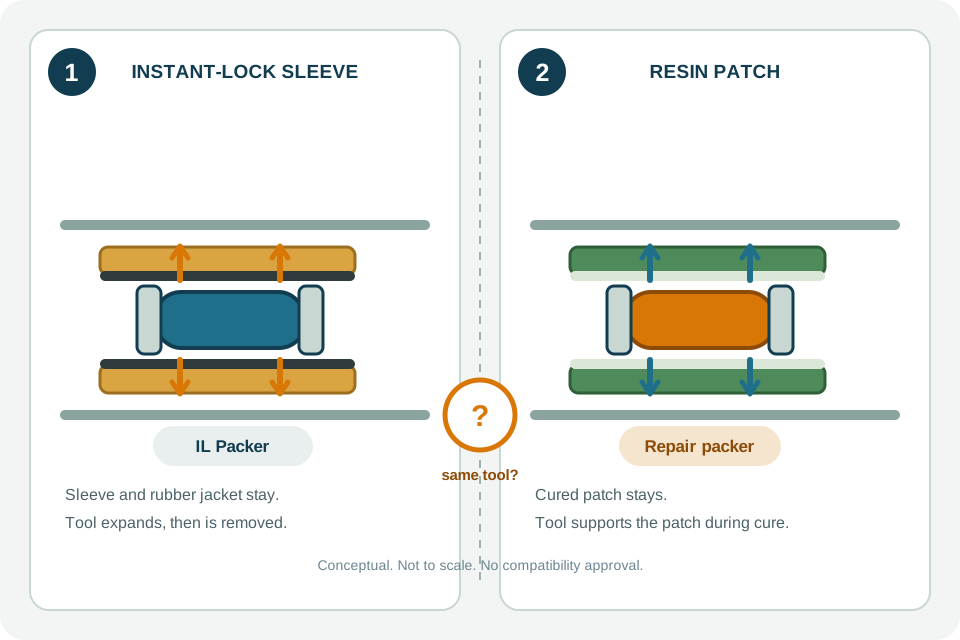
A Reliance repair packer is a tool used to position and support a localized resin-and-fiberglass patch while it cures; the packer is removed afterwards. An Instant-Lock sleeve is a mechanical repair that remains in the pipe after expansion. The Small installation column names an “IL Packer” for the sleeve, the Large rows say “Installation Tools,” while the repair-packer table lists RP and RPBP models. A shared nominal pipe size is not a compatibility approval.
Start with the repair that remains in the pipe
The two routes leave different things behind. An Instant-Lock repair leaves a stainless steel sleeve and an EPDM rubber jacket compressed against the host pipe. NASSCO’s general description of mechanical seals likewise separates the sleeve and rubber gasket from resin mixing, and notes that some systems use flow-through packers for installation. That industry description explains the method; it does not identify which Reliance tool is approved for a particular sleeve.
A resin-and-fiberglass repair leaves a cured composite patch. The packer holds the uncured material against the pipe wall, and the tool is retrieved after the required cure. NASSCO’s description of a CIPP spot repair also places a resin-impregnated liner around an inflatable packer. Reliance’s resin-and-fiberglass system should not be treated as identical to every CIPP liner; the comparison is useful only to show why the installation tool belongs to the repair system being installed.
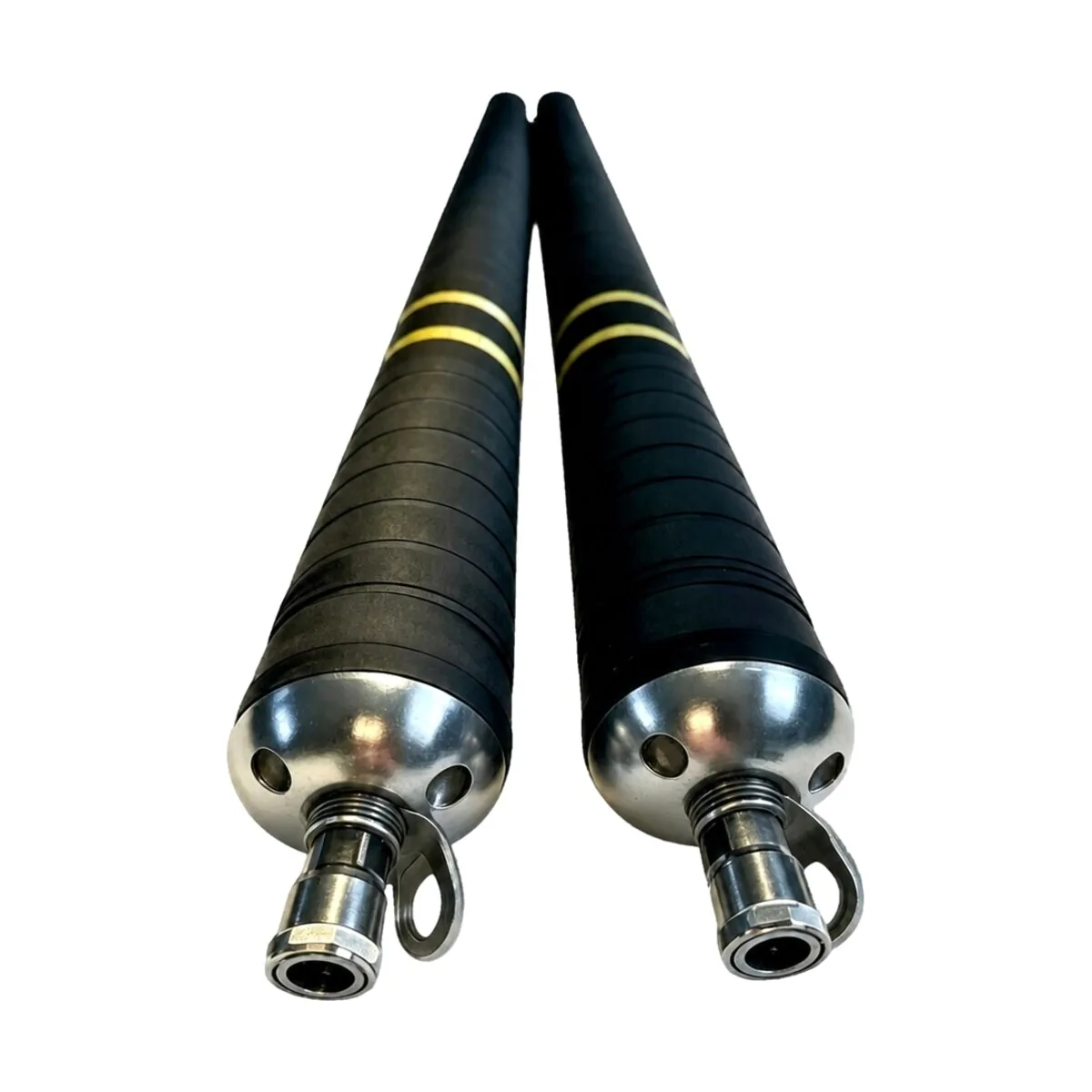
Reliance’s Plugs brochure lists standard, bypass, long-lateral and wheeled repair packers. The Plugs & Packers spreadsheet gives the RP rows’ suitable pipe range, minimum inner diameter, deflated length, maximum inflation pressure, weight and inflation thread. Those fields describe a repair packer. They do not state that the same model expands an Instant-Lock sleeve or that the sleeve’s locking mechanism has been checked with it.
The distinction is visible in the Instant-locks spreadsheet. Its Small installation column names a 150 IL Packer, a 200-300 IL Packer, a 300-400 IL Packer and a 500-600 IL Packer across the sleeve rows; one DN300 row lists “200-300/300-400 IL Packer,” preserving the source wording. The brochure’s page 1 uses the same installation column, and its page 2 is headed for Instant-Lock Small. The Large rows instead say “Installation Tools.” These are separate published references, not one universal tool list.
Read the installation column before the DN range
Overlapping numbers are easy to misread. A DN200 sleeve entry and an RP 100-200 repair packer both mention 200, but the records answer different questions. The sleeve entry asks which IL Packer or installation tool belongs to that sleeve designation. The RP row asks which pipe range, deflated length and inflation limit belong to that repair packer.
| Review item | Instant-Lock sleeve route | Resin-and-fiberglass patch route |
|---|---|---|
| What remains in the pipe | Stainless steel sleeve and rubber jacket | Cured resin-and-fiberglass repair |
| Published tool reference | “IL Packer” for Small; “Installation Tools” for Large | RP or RPBP repair packer |
| Tool’s task | Expand and lock the sleeve | Hold the patch against the wall during cure |
| Records to keep | Sleeve table, tool identification, applicable instructions | Packer table, resin and reinforcement records, applicable procedure |
| Default interchange? | Not established by the reviewed records | Not established by the reviewed records |
The custom packer video below shows a repair-packer configuration with bypass and wheels; it is a brand demonstration, not a sleeve installation approval. The sleeve video shows a sleeve carried on an inflatable packer, but it does not identify that packer as an RP model. Use the documents, not the similar word “packer,” to decide what is being reviewed.
Build a compatibility file
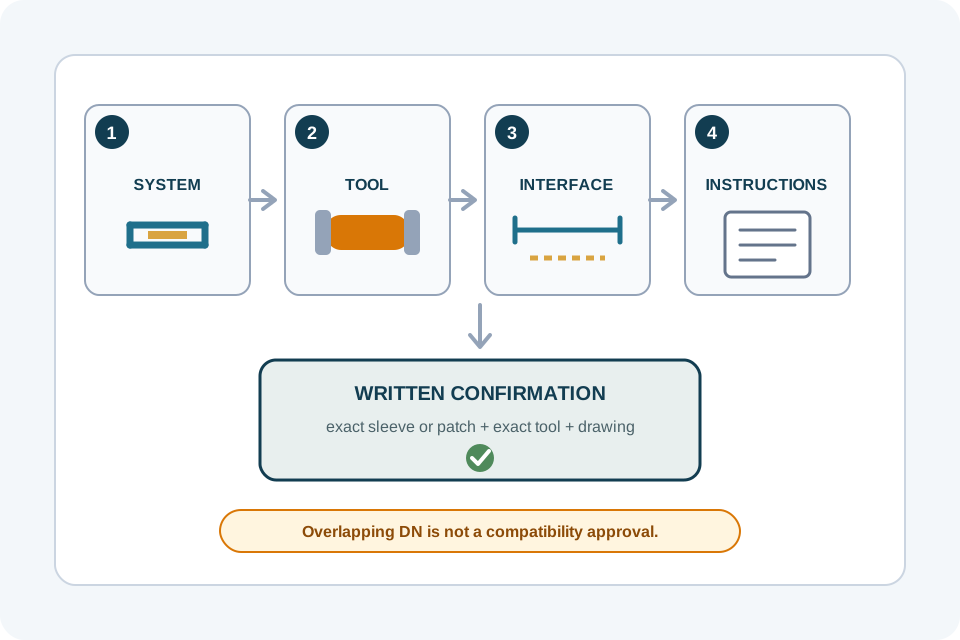
A useful review connects five records:
Repair system: the sleeve designation, or the resin formulation and fiberglass reinforcement.
Tool identity: the IL Packer label or the RP/RPBP model, including any custom drawing or revision.
Physical interface: sleeve or patch dimensions, packer working area, deflated assembly envelope, connections, wheels and any central flow path.
Process: the applicable expansion or inflation sequence, cure conditions, flow management and the manufacturer’s limits for that configuration.
Supply and documents: included accessories, instructions, maintenance information and the quotation’s stated scope.
The UK HSE PUWER overview provides a useful review framework: equipment should be suitable for its intended use, account for workplace conditions and be supplied with adequate information and training. These are UK requirements, not a Reliance approval or a global legal standard. HSE maintenance guidance also calls for maintenance logs where they exist, competent maintenance and action on damaged equipment. A maintenance record describes condition; it does not establish compatibility with another repair system.
For the resin route, keep the resin and fiberglass records with the packer record. The brochure describes mixing and reinforcement steps, while the material spreadsheet separates mixing ratio, working-time fields and fiberglass codes. Those details belong to the material system; they cannot be inferred from a packer model name.
Resolve document differences before matching equipment
There is a concrete reason to keep each source attached to its value. For the Small DN150 sleeve, the brochure’s page 1 lists a pipe-fit window of 120–150 mm, while the Small spreadsheet lists 140–152 mm. Both name a 150 IL Packer. Agreement on the tool label does not resolve the difference in sleeve-fit data.
Send the measured internal diameter and both document references for confirmation. Do not choose the wider range because it is more convenient, and do not treat this article as a fit approval. The same rule applies to a packer quotation: retain the table row, revision and drawing that were actually reviewed.
What to send with the enquiry
For a sleeve route, send the sleeve family and designation, measured bore, defect record, existing tool identification and photographs, access constraints, flow conditions and the applicable instruction document. For a patch route, send the same route information plus the proposed resin formulation, fiberglass reinforcement, required repair length and cure conditions. If an existing tool is being reused, include its maintenance history and any reported faults.
Ask for one written answer: “Which exact tool is confirmed for this exact sleeve or patch system, what accessories are included, and which drawing and procedure apply?” Link the answer to the quotation. A demonstration, a catalogue family name or “we always use this packer” is not the same as a configuration review.
Use the point-repair equipment checklist to separate supplied items from project support. Compare mechanical sleeves and resin-and-fiberglass patches if the repair method is still open, and review packer access and packer length versus repair coverage before confirming the tool envelope. Then send the records through the repair packer enquiry or the sleeve enquiry.
References and source documents
Reliance Instant-locks spreadsheet — Small installation entries and IS Packer fields
Reliance Resin Glassfiber brochure — page 1 resin records and page 2 mixing and reinforcement steps
Reliance Resin & FiberGlass spreadsheet — mixing ratio, working-time fields and fiberglass codes
Reliance YouTube — DN700 Instant-Lock Repair Sleeve: Point Repair from Inside the Pipe
Reliance YouTube — Custom DN250–300 Repair Packer with Bypass and Wheels
Further reading
Article
Can a Repair Packer Reach the Defect? Reviewing the Route
Article
CIPP Liner Ends: What to Measure Before Specifying an End Seal
Article
Disadvantages of Trenchless Pipe Lining: Limits, Failures, and DIY Risks
Buyer guide
How to Choose a Pipe Repair Packer
Buyer guide
Stainless Steel Pipe Repair Sleeves vs Resin-and-Fiberglass Patches
Buyer guide
Point Repair Equipment Checklist