
How to Read a Pipe Plug Factory Test Report
A factory test report should trace the exact plug, test conditions and result to your order. Check these fields before accepting delivery.
By Reliance Trenchless Technology13 min read
Continue with AI
Bring this article into your own conversation.
Preferred Sources
Keep up with Reliance Trenchless on Google.
Availability depends on your account and region.
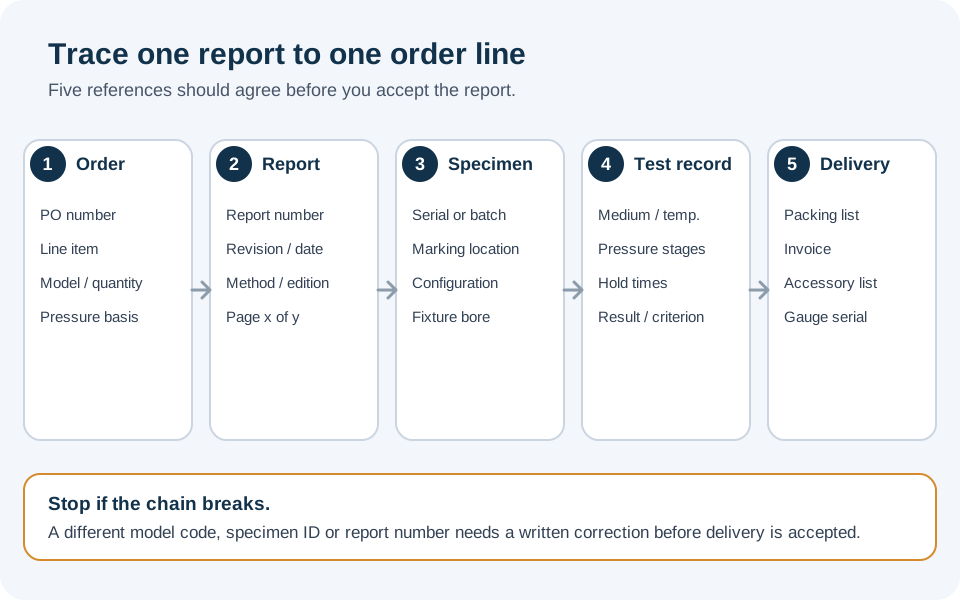
A factory test report for a Reliance pipe plug is only useful if it lets you trace one tested specimen to one order line. It should identify the exact model and configuration, a unique report number and specimen or batch number, the test method and its revision, the test medium, the instruments used, the pressure stages and hold times, the acceptance criterion, the measured result, and who tested and approved it. The same report should also name the purchase order, invoice or packing list it belongs to. If any of those links is missing, you have a test record, but not yet evidence that the plug delivered to site is the plug that was tested.
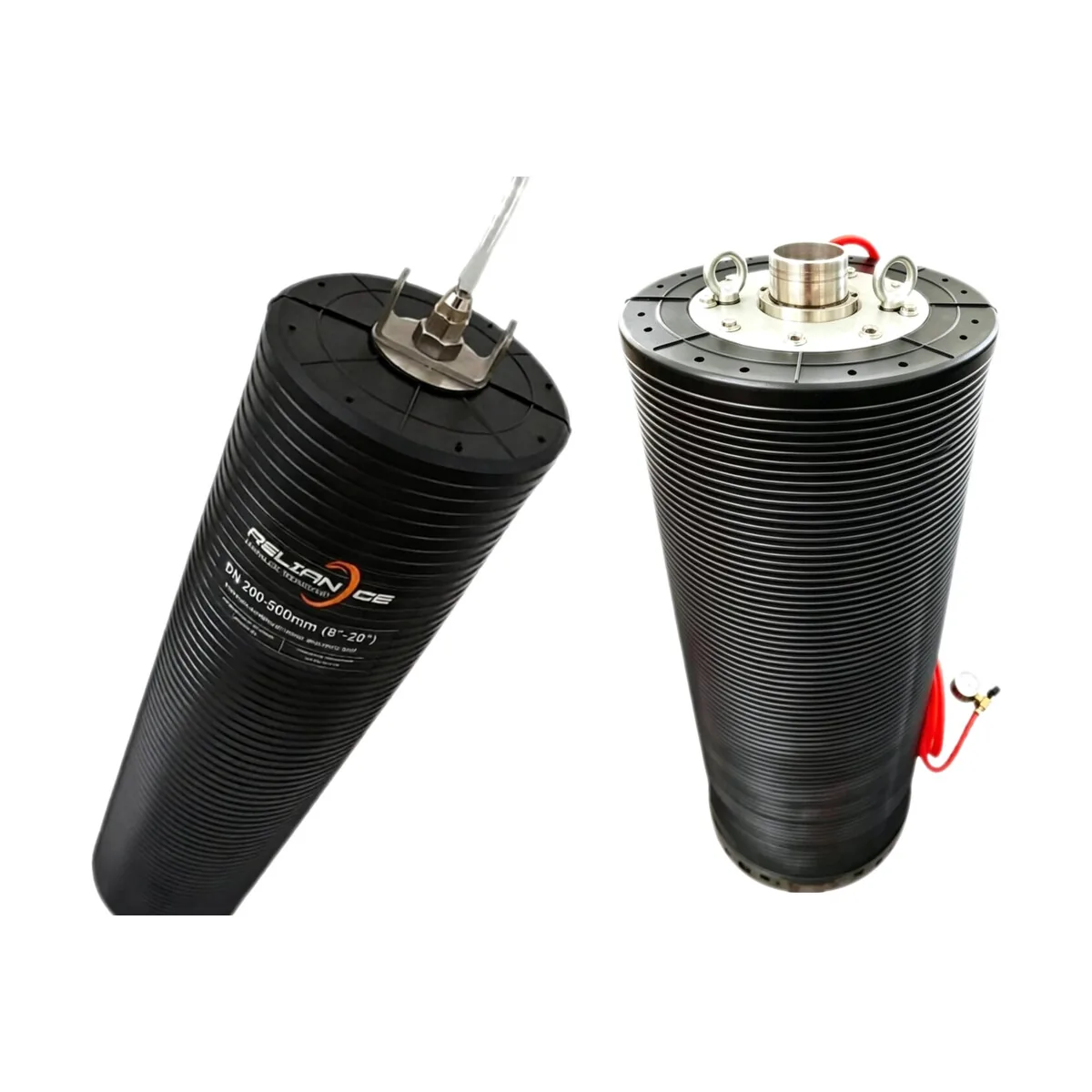
Reliance's multi-size family is the practical example. The multi-size pipe plug guide separates MS isolation plugs from the MSBP bypass family and publishes a model range from MS 50-100 through MS 800-1500. The brochure, page 2 prints each MS model with maximum inflating (working) pressure, maximum back (sliding) pressure, product diameter, total length and net weight, and lists a pressure gauge and 10 m air hose as included accessories. Those are the fields a report should echo before you compare the result with the order.
Match the report to the plug
Start with identity before the pass stamp. The report should repeat the model code exactly as ordered, state the configuration (MS isolation or MSBP bypass), and identify the individual specimen by serial number, batch or lot, or another unique mark that also appears on the plug or its packaging. A report that says only "MS plug" or "DN 500" cannot be matched to a specific order line.
| Report field | What it should contain | Where to check it |
|---|---|---|
| Model and configuration | Exact code, such as MS 500-1000; MS isolation or MSBP bypass | Purchase order, product table, brochure page 2 |
| Specimen identity | Serial, batch or lot number, manufacture date if stated, and marking location | Plug label, packing list, inspection record |
| Sample scope | One unit, batch sample or 100% test; number tested | Report header and order line |
| Report identity | Unique report number, revision, date, test location, method and edition, page x of y | Document control or supplier |
| Order reference | PO number, line item, quantity and invoice or packing list | Your PO and shipping documents |
| Approval | Test date, tester and approver | Report footer or approval block |
A report for one specimen cannot be extrapolated to a batch unless the report states the sampling basis. If the order is for twenty plugs and the report covers one, ask whether that is the agreed sample or whether the other units have separate records. Record the answer in the order file.
The model code is not a fit range. MS 500-1000 is a catalogue interval, not a measurement of the pipe you will seal. The report should also state the test fixture or chamber diameter and how the plug was positioned, so you can see whether the test conditions resemble your application. The selection guide already separates nominal size, measured bore and access. The report should not collapse them into one number.
Reliance's two published MS documents are not identical. The brochure lists eleven MS rows, including MS 50-100, MS 70-150, MS 600-1200 and MS 800-1500. The spreadsheet lists only MS 100-200 through MS 500-1000. If your order is for a model absent from the spreadsheet, the report should cite the brochure or the model drawing, not a spreadsheet row that does not exist. The spreadsheet also labels its diameter column "Min. Inner Dia.", while the brochure labels the same area "Product Diameter". Do not treat those headings as interchangeable without written confirmation.
The pressure columns need the same care. The brochure separates "Max. Inflating (Working) Pressure" from "Max. Back (Sliding) Pressure". They are different conditions. One is the pressure inside the plug. The other is the pressure from the pipe contents acting to push the plug along the pipe. A report that gives one number without naming which pressure it is cannot be compared with either column.
| Model | Brochure: max. inflation / max. back pressure | Spreadsheet: max. inflation / max. back pressure | Other fields that differ |
|---|---|---|---|
| MS 100-200 | 2.0 / 1.0 bar | 2 / 0.8 bar | Diameter 95 vs 96 mm; weight 1.5 vs 3 kg |
| MS 300-600 | 1.5 / 0.5 bar | 2 / 0.8 bar | Weight 13 vs 12 kg |
| MS 400-800 | 1.5 / 0.5 bar | 2 / 0.6 bar | Weight 20 vs 18 kg |
| MS 500-1000 | 1.5 / 0.5 bar | 1.5 / 0.5 bar | Weight 29 vs 28 kg |
Where the documents differ, do not choose the more convenient number. Make the report identify its source. The technical table on the multi-size product page follows the brochure values for these MS rows. The spreadsheet is a separate document with different rows. If the report cites neither, ask for the governing specification in writing before you accept the delivery.
For a single-size order, use the single-size product table and do not carry an MS pressure pair across to an SS model. The report logic is the same, but the model row and the pressure basis are different.
Identify the test conditions and instruments
A pressure number has no meaning without the conditions that produced it. The report should name the test medium (water, air or another fluid), the test fixture or chamber, the pressure at each stage and how long it was held, the temperature, and the instrument used for each reading. It should identify the gauge by serial number and calibration date, and state the acceptance criterion before the result.
UK HSE GS4, paragraphs 5-6 and 13 frames the same questions: the size of the assembly under test, its test pressure, the test medium, and which part of the assembly is being tested. Paragraphs 29-35 add how the assembly is energised, monitored and evacuated, and require hose and connectors rated for the test pressure and medium. Paragraphs 39-45 describe venting, staged pressure increases, leak detection and the temperature differential that may need technical review. A report that omits the medium, the instrument or the stage duration cannot answer those questions.
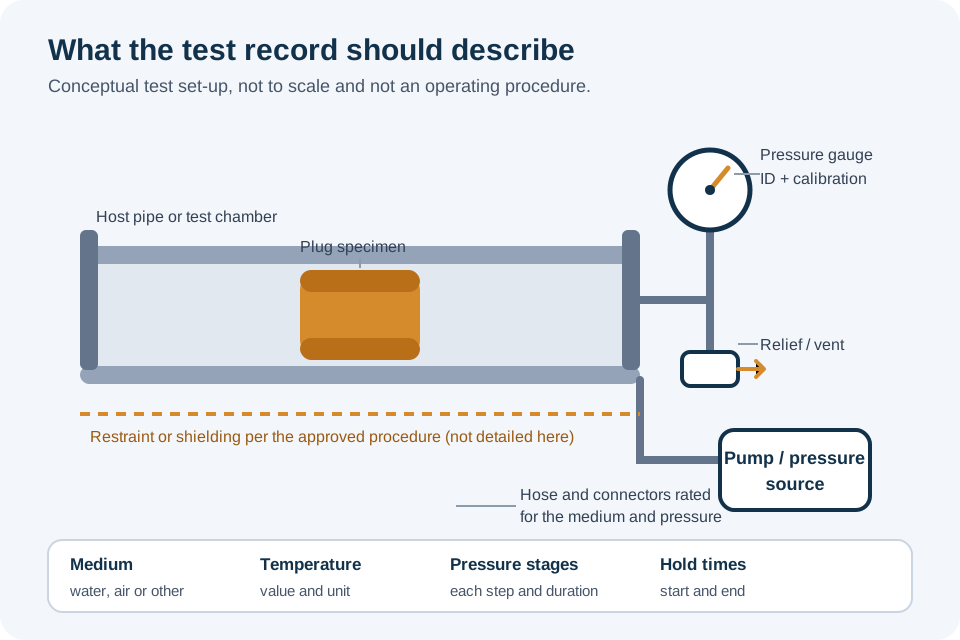
GS4 paragraph 15 prefers water or another fluid over gas where possible, to reduce stored energy. A water test is not automatically correct for every case. The report still has to state which medium was used. A water test and an air test are different evidence, even if both end with the word "passed".
Use a numbered review rather than a glance at the pass/fail box:
Read the report header and confirm the report number, revision, date and page count.
Match the model code and configuration to the purchase-order line.
Match the specimen number or batch mark to the plug and the packing list.
Confirm the test method and edition, and whether the report is a proof test, a leak test or a functional test.
Check the medium, fixture, pressure stages, hold times, temperature and instrument IDs.
Compare the measured result with the stated acceptance criterion, in the stated units.
Confirm the tester and approver, then file the report with the order documents.
GS4 paragraph 1 defines pressure testing as applying stored energy to verify strength, integrity and/or functionality. Ask the report to say which of those it addresses. "Passed" without a criterion cannot be audited. A criterion without a measured value is not a result either.
Instrument identity has a practical purpose. If the gauge is not identified, the same number could have come from any gauge on the bench. If the calibration date is missing, you cannot tell whether the reading was traceable at the time of test. The report can leave out the calibration certificate itself. It should still give the gauge or certificate ID so you can ask for it.
Separate test results from service approval
A factory test pass is evidence about one specimen under the report's conditions. It is not a service approval, a site acceptance test, or a guarantee that the plug will hold a given back pressure in a particular pipe. Keep three questions separate: what was tested, what the project requires, and who approved the installation.
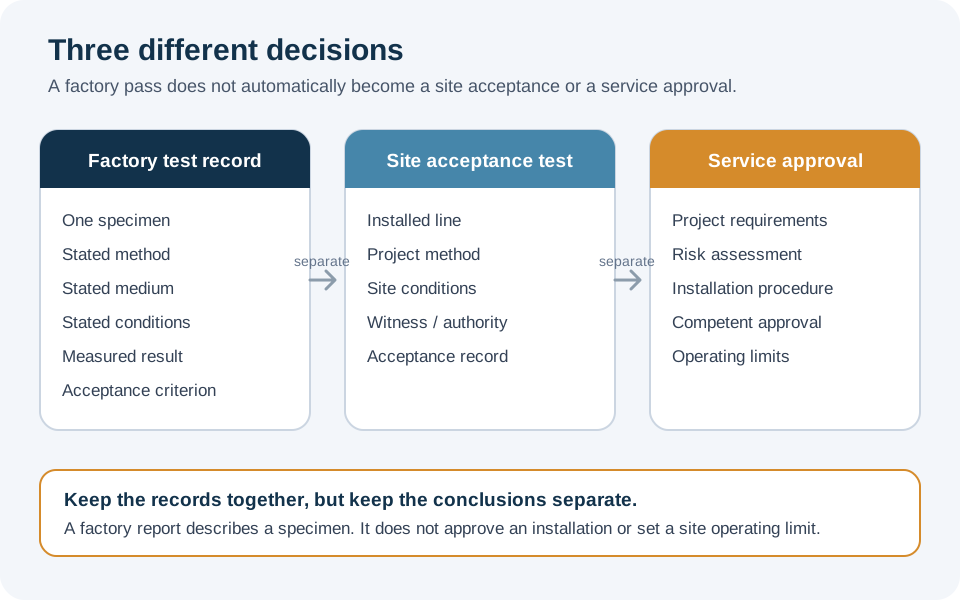
ASTM F1417-25 is a useful comparison because its public scope covers low-pressure air testing of non-pressure plastic sewer lines, not a factory test of a plug. Its Significance and Use 4.2 says air loss must not be used as a quantitative measure of service infiltration or exfiltration. The standard is a field acceptance practice with its own method and limits. A factory report and a site test answer different questions, and neither one automatically becomes the other.
A report can be technically valid and still not close the purchase. Check the acceptance criterion against the order. If the order specifies a maximum back pressure, the report should state the pressure and duration at which the plug was tested and whether the result is a proof test, a leak test or a functional test. Those are different claims. The report should also state the test fixture diameter and the plug's position, because a plug tested in a small rigid chamber is not the same evidence as a plug tested in a larger pipe or a flexible host.
Do not accept a report that only says "passed" without the criterion. A pass compares the measured value with the limit. If the report gives a measured pressure but no acceptance limit, or a limit but no measured value, you cannot audit the decision. Ask for the missing field or a corrected report before you release the delivery.
If a third-party laboratory is named, check that the report identifies the laboratory and the method, and confirm the laboratory's scope for that specific test. A laboratory name or logo is not a product approval, and it does not replace the project's acceptance decision. If the contract requires a certificate or declaration, ask for that separate document and check its scope. Do not treat a test report as a substitute.
Keep the report with the order documents
File the report with the purchase order, invoice, packing list and any accessory or material certificates, using the same report and specimen IDs. The report is only retrievable if the next person can find it from the order number or the plug's serial or batch mark. Keep the original file and a read-only copy. Do not rely on a photograph of a screen.
UK HSE's inspection guidance says inspection records should be kept at least until the next inspection, and that equipment leaving an undertaking should be accompanied by physical evidence of the last inspection, such as a report or tag. That is work-equipment inspection guidance, not a factory test rule. It supports the same document-control principle. The record must travel with the item and be available to the next user.
A simple document pack contains:
The purchase-order line with model, configuration and quantity.
The factory test report with report ID, specimen ID, method, conditions, result and approval.
The packing list or invoice with the same model and serial or batch mark.
The accessory list, including the pressure gauge and 10 m air hose the brochure lists with each plug.
Any calibration certificate or material certificate the order requires.
A short transmittal note listing what was received and what is still missing.
If the report and packing list use different model codes, stop and ask for a written correction before accepting delivery. Do not translate the code yourself, and do not assume that a similar model number covers the same configuration.
To get a report that matches your order, send the purchase-order line, the exact model code, the measured bore and required back pressure, the test method and edition, the medium, the acceptance criterion and the destination. Reliance's multi-size guide lists the project data it needs: measured inner diameter, medium, working conditions including inflation and back pressure, quantity, destination and freight preference. Use the multi-size pipe plug enquiry and attach the order line and any report you have been given. If the order is for a single-size plug, use the single-size enquiry instead.
FAQ: Pipe Plug Factory Test Reports
What is the minimum identity information on a pipe plug factory test report?
At minimum, the report should identify the report number and revision, the exact model and configuration, the specimen serial or batch number, the purchase order or line item, the test date, and the tester and approver. If the model code, specimen ID or order reference is missing, you cannot trace the result to the plug you received. Ask for a corrected report before accepting delivery.
Does a factory test report prove the plug will hold the project back pressure?
No. It records what one specimen did under the report's method and conditions. It does not prove performance in your pipe, with your installation, restraint, medium and temperature. Use the report as evidence for the specimen, then check the project conditions and the current model limits separately. A site acceptance test or a competent project approval is a different decision.
Which pressure should I compare: inflation pressure or back pressure?
Compare the pressure the report measured with the matching column in the current model table. Reliance's brochure, page 2 prints "Max. Inflating (Working) Pressure" and "Max. Back (Sliding) Pressure" separately. One is the pressure inside the plug. The other is the pressure from the pipe contents acting to push the plug along the pipe. Do not substitute one for the other.
What if the brochure and spreadsheet give different values for my model?
Do not pick the more convenient value. Ask which revision governs the order and require the report to state its source. For example, the brochure gives MS 300-600 as 1.5 bar maximum inflation and 0.5 bar maximum back pressure, while the spreadsheet gives 2 bar and 0.8 bar. Keep both documents in the order file until the supplier confirms the applicable specification in writing.
Can I accept a report that only says "passed"?
Only if the report also gives the measured value, the acceptance criterion, the method, the medium and the test conditions. A pass needs a measured value and a stated limit. If any of those fields is missing, ask for the missing record or a corrected report. The selection guide and the inspection and storage guide cover the wider enquiry and equipment records.
References and source documents
Further reading
Article
How a Pipe Plug Holds Back Sewer Head: Pressure, Area and Friction
Article
Pipe Leak and Break Repair: Joint Seal, Sleeve, Patch or CIPP?
Article
Inflatable Pipe Plug Names: A Quotation Checklist
Buyer guide
How to Choose an Inflatable Pipe Plug
Buyer guide
Inflatable Pipe Plug Inspection, Cleaning and Storage