
Pipe Plug Accessories: Hoses, Gauges and Connectors
How to specify the hose, gauge and connectors in a pipe plug order: match the model, read the pressure markings, and define the supply boundary before quoting.
By Reliance Trenchless Technology6 min read
Share this article
A pipe plug order is more than a rubber body. The hose, gauge, connectors and any bypass fittings decide whether the plug can be inflated, monitored and removed as one controlled assembly. A quotation that names only the plug model leaves the buyer to guess what will arrive and whether the parts match.
The Reliance plug brochure lists a pressure gauge and a 10 m air hose as included accessories for the multi-size and bypass plug tables. That is a useful starting point, not a universal packing list. Accessories vary by model and order, so the review has to connect the plug, the accessory set and the job.
What belongs in a pipe plug accessory review?
Start with the plug model and its task. A plug used for temporary isolation has different connection needs from a bypass plug that must pass flow, or a test plug connected to a pressure source. The accessory review should identify four things: the plug, the hose, the gauge and every connector between them. If a bypass or drain connection is part of the assembly, include it in the same list.
The review is not a substitute for the manufacturer's instructions or a site risk assessment. It is a way to make the quotation and the delivered assembly describe the same equipment.
1. Match every accessory to the plug model
Record the full model, the pipe range and the configuration. Then ask which accessories are supplied with that model, which are optional and which the project must provide. Do not carry an accessory list from one model to another.
The brochure presents multi-size plugs, bypass plugs and testing plugs in separate tables. That separation matters. A gauge that is included with one family is not proof that the same gauge, hose length or connector is included with another. The quotation should state the accessory content model by model.
For a bypass plug, add the bypass connection size and the intended use to the list. A connection that is adequate for draining a line is not automatically adequate for the flow the project intends to pass. The safe position is to record the proposed connection and ask for written confirmation of its intended service.
2. Read hose and gauge markings as a set
The hose and gauge are part of the pressure boundary. HSE's guidance for pressure testing says to verify that hoses and connectors are rated for the test pressure and the test medium, and to keep the manufacturer's data accessible. It also warns that hose-fitting components from different manufacturers are not usually compatible and should not be assembled together unless compatibility is confirmed.
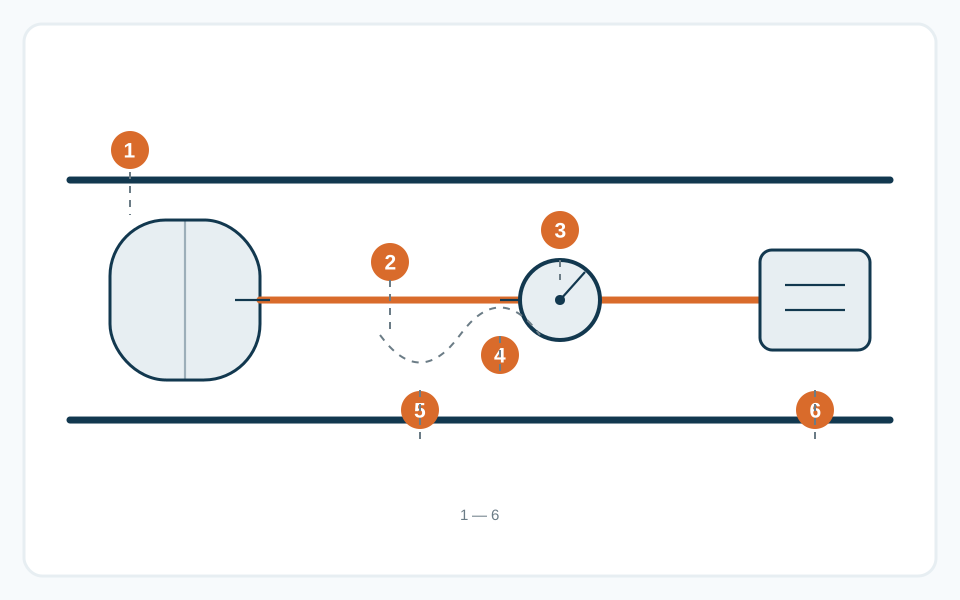
Apply that to a plug order in three steps. First, read the markings on the hose, gauge and connectors and record them. Second, compare the marked rating with the maximum pressure the job can produce, not only the pressure the operator intends to apply. Third, confirm that the gauge range makes the working pressure readable rather than crowding it at the end of the scale.
HSE also describes hose restraint, such as whip-check cables, where a flexible hose could move if a connection fails. The need for restraint and shielding belongs in the job plan; it is not created by the plug alone.
3. Separate supplied, optional and project-supplied items
A short table prevents most order disputes. List each item, its source and the document that confirms it.
| Item | Record | What the record does not prove |
|---|---|---|
| Plug body | Model, pipe range and configuration | That the accessory set matches another model |
| Air hose | Length, pressure marking, end connections | That the hose is suitable for every medium or site |
| Pressure gauge | Range, unit, connection and marking | That the gauge has a current calibration certificate |
| Connectors | Type, size, material and manufacturer | That parts from different makers are compatible |
| Bypass or drain fittings | Connection size and intended service | That the connection passes the required flow |
| Restraint and shielding | Project decision and responsible person | That the site procedure is adequate |
The table also shows what the seller cannot confirm. A catalogue entry can identify a supplied hose; it does not establish that the hose has been inspected after delivery, that the gauge is calibrated for the project, or that the site has a safe pressure-test procedure.
4. Put the connection boundary in the quotation
The clearest quotation states where the supplier's scope ends and the project's scope begins. Does the supplied hose end in a connector that matches the site air supply? Is a reducing adapter needed? Who supplies the restraint? Is a spare gauge or hose required? These are commercial questions, but they decide whether the assembly can be used on arrival.
Ask for a line-item accessory list with the plug model, not a general statement that accessories are included. If the answer is a photograph, ask for the model number and the marking on each item as well. A photograph shows what was on the bench; it does not show the pressure rating or the connection standard.
For inspection, cleaning and storage after delivery, the plug inspection guide sets out records that belong with the equipment. The multi-size plug product page and the plug selection guide provide the starting fields. Neither replaces the model-specific accessory list in the quotation.
FAQ: Pipe plug hoses, gauges and connectors
Does every Reliance pipe plug include a gauge and hose?
Do not assume that from this article. The brochure lists a pressure gauge and a 10 m air hose as included accessories for the multi-size and bypass plug tables shown, but the packing list can vary by model and order. Ask for the accessory content of the exact model in the quotation.
Can I replace the supplied hose with a longer one?
Only after confirming the pressure rating, medium compatibility, connector type and restraint. A longer hose changes the assembly and may change the pressure drop or the safe layout. HSE guidance says hoses and connectors should be rated for the test pressure and medium, with manufacturer data available.
Is the gauge range the same as the plug's maximum pressure?
No. The gauge range is a measurement range; the plug's maximum inflation or back pressure is a separate limit from the product data. A gauge that reads high enough does not raise the plug limit, and a gauge with a very wide range may make the working pressure hard to read.
What should the quotation state about connectors?
It should state the connector type, size, thread or coupling standard, material and who supplies each mating part. If the site air supply uses a different connector, ask for the adapter in the same line item rather than assuming it will be available on site.
References and source documents
Reliance — Repair Packers & Plugs brochure: plug tables, included gauge and 10 m air hose
UK Health and Safety Executive — GS4: Safety requirements for pressure testing
UK Health and Safety Executive — Maintenance of work equipment
Reliance — How to choose an inflatable pipe plug: task, size, pressure terms and accessories
Further reading
Article
RCP Stormwater Joints: Evidence Needed for Internal Sealing
Article
What Is Trenchless Drain Lining? Methods, Materials, and Bends
Article
What Is Trenchless Sewer Repair? Methods, Limits, and Selection
Buyer guide
How to Choose an Inflatable Pipe Plug
Buyer guide
Inflatable Pipe Plug Inspection, Cleaning and Storage