What Is Trenchless Drain Lining? Methods, Materials, and Bends
Learn what trenchless drain lining is, how CIPP and sectional patches rehabilitate drain pipes, navigate bends, and when point repair is the better choice.
By Reliance Trenchless Technology7 min read
Share this article
Trenchless drain lining is a non-destructive pipeline rehabilitation method that repairs damaged subterranean drain lines from within, eliminating the need to excavate trenches across residential lawns, driveways, or commercial floors. By inserting a flexible fabric tube saturated with thermosetting resin into the existing conduit and curing it in place, contractors create a seamless, jointless "pipe within a pipe" that restores structural integrity, stops groundwater infiltration, and seals off tree roots.
For property managers and drainage contractors evaluating internal repairs, Reliance supplies the specialized equipment and consumable systems required for small-to-medium diameter drains (DN50 to DN225 / 2" to 9"). Our Fiberglass Resin Repair System pairs with flexible, bend-capable Point Repair Packers to deliver durable structural patches conforming to ASTM F1216 standards without disturbing surrounding structures.
How trenchless drain lining works: Inversion vs pull-in-place
Trenchless drain lining relies on the proven principles of Cured-in-Place Pipe (CIPP). Rather than digging up a deteriorated host pipe made of vitrified clay, cast iron, or PVC, installers access the drain via existing cleanouts, roof vents, or small inspection chambers.
As documented in industry standards from ASTM F1216 and NASSCO Pipe Rehabilitation, two primary deployment mechanics are used for drain runs:
Air or Water Inversion: A resin-impregnated needlefelt or composite liner tube is loaded into an inversion drum. Compressed air or a column of water turns the tube inside-out as it travels into the host pipe. This inversion forces the resin-coated face directly against the inner host pipe wall while keeping the calibration layer on the interior lumen.
Pull-in-Place (PIP): The saturated liner assembly is pulled into position using a winch or pull cable connected through upstream and downstream access points. Once positioned over the target span, an internal calibration bladder is inflated with compressed air (typically 0.5 to 1.5 bar) to press the liner against the host pipe perimeter until curing completes.
Continuous drain relining vs sectional patch lining
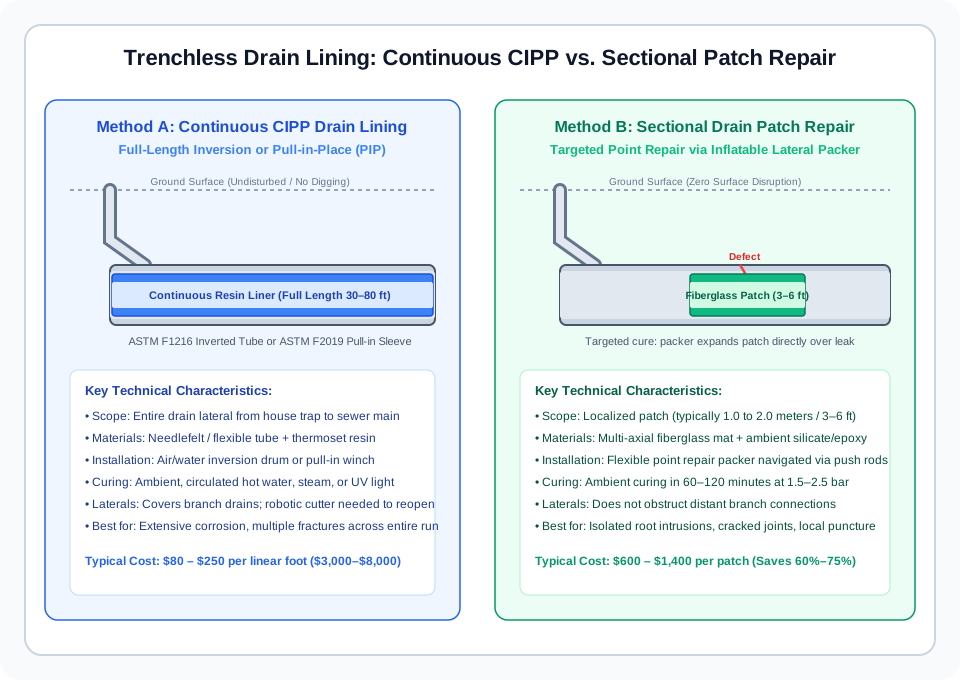
A critical engineering decision is whether to line the entire drain run or install a localized sectional patch:
| Technical Parameter | Continuous CIPP Drain Lining | Sectional Packer Patch Repair |
|---|---|---|
| Typical Length | 30 to 80+ linear feet (full lateral) | 3 to 6 feet (1.0 to 2.0 meters) |
| Access Requirement | Cleanout or boundary trap | Single cleanout or inspection manhole |
| Material Structure | Needlefelt / woven fleece + resin | Multi-axial E-CR fiberglass mat + silicate/epoxy |
| Cure Duration | 2 to 6 hours (ambient / steam / hot water) | 60 to 120 minutes (ambient temperature) |
| Branch Laterals | Covers branch junctions; robotic cut needed | Positioned between junctions; zero cutting required |
| Average Cost | $3,000 – $8,000 ($80–$250/ft) | $600 – $1,400 per patch |
| Best Scenario | Continuous longitudinal cracking or acid corrosion | Isolated joint leak, localized fracture, root entry |
When closed-circuit television (CCTV) inspection identifies only one or two localized joint leaks on an otherwise stable drain, installing continuous CIPP overpays for undamaged footage. Deploying a localized patch using an inflatable Point Repair Packer and Fiberglass Resin Repair Kit repairs only the defect zone, cutting mobilization time and project costs by 60% to 75%.
Resins and fabrics: Choosing the right composite system
The mechanical strength and chemical resilience of a lined drain depend on the polymer resin matrix and reinforcement fabric specified:
Silicate Resins (Organomineral): Formulated with liquid sodium silicate and polymeric isocyanate components. Silicate systems feature low exotherm temperatures, virtually zero shrinkage (), and high water tolerance. They cure reliably in damp underground conduits within 60 to 120 minutes at ambient ground temperatures (12°C to 20°C).
Epoxy Resin Systems: Two-part amine-cured epoxies deliver exceptional chemical resistance and flexural modulus ( per ASTM F1216). Epoxy emits negligible odor and volatile organic compounds (VOCs), making it ideal for interior residential drains and commercial kitchen stacks.
Reinforcement Fabrics: While continuous municipal liners often use needlefelt, high-performance sectional patches utilize chopped strand mat (CSM) combined with multi-axial woven fiberglass. Fiberglass provides superior tensile hoop strength at thinner wall profiles (3 mm to 5 mm), preserving maximum hydraulic flow diameter.
Navigating 45-degree and 90-degree bends
Small-diameter building drains frequently incorporate swept 45-degree and 90-degree elbows, vertical drops, and sanitary junctions. Navigating these turns requires specialized tooling:
Flexible Lateral Packers: Standard rigid wheeled packers cannot negotiate tight sanitary elbows. Reliance manufactures flexible rubber packers with articulated end-cones and rounded bypass fittings that flex through swept 90-degree transitions in DN100 (4") lines without binding.
Specialty Highly Stretchable Liners: When continuous lining must traverse multiple 45° or 90° bends, installers specify woven fleece tubes engineered with lateral elasticity. These tubes stretch along the outer radius and compress along the inner radius to prevent thick, flow-restricting wrinkles.
Hard Limit: Sharp sanitary tee connections (mitred 90-degree corners) cannot be traversed by inflatable packers or heavy inversion tubes. Access must be established downstream or through a cleanout branch.
The 4 critical stages of a successful drain lining installation
A structurally sound drain lining installation follows a rigorous four-stage engineering sequence:
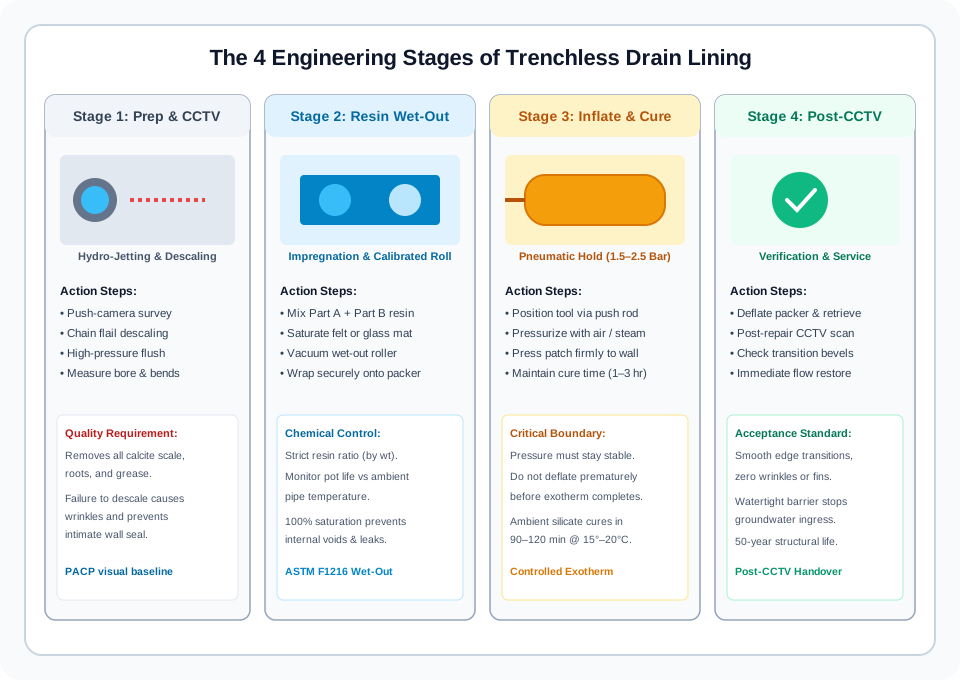
Mechanical Descaling & CCTV Inspection: High-speed chain flails or milling tools strip out calcite encrustations, grease, and root masses. A pre-lining push-camera survey verifies the measured bore, defect distances, and lateral clock positions per WRc Drain Repair Guidance.
Controlled Resin Wet-Out: The resin components are measured by weight according to technical data sheets. The resin is poured onto the fiberglass mat or felt tube and passed through calibrated mechanical pinch rollers under vacuum assistance to eliminate air pockets.
Packer Positioning & Pneumatic Hold: The wet patch is wrapped around the deflated packer and secured with degradable silicone straps. The packer is pushed to the defect location under camera monitoring and inflated to 1.5–2.5 bar, pressing the patch firmly against the host pipe.
Cure & Post-Repair Handover: Once the chemical exotherm is complete, the packer is deflated and withdrawn. A final CCTV inspection verifies smooth transition bevels, complete defect coverage, and unobstructed flow.
What project details to submit for an equipment quote
Before ordering drain lining consumables or equipment, ensure you have gathered the following parameters:
Internal Pipe Diameter: Nominal size and actual measured internal bore (e.g., DN100 cast iron often has a different actual bore than DN100 PVC).
Defect Location and Extent: Distance from access point and total length of the damaged zone.
Pipe Geometry: Number and radius of bends (swept vs sharp) between the cleanout and the defect.
Ambient Pipe Temperature: Ground temperature dictates resin formulation and required curing duration.
For technical guidance on matching flexible packers and resin kits to your project geometry, review our Sectional Point Repair vs Full-Length CIPP guide or contact our team via the Reliance Engineering Consultation Portal.
FAQ: Trenchless drain lining questions
Can trenchless drain lining fix pipes with 90-degree bends?
Yes, provided the elbows are swept drainage bends rather than sharp, mitred sanitary tees. Installers must use specialized flexible lateral packers or high-stretch woven liner tubes designed to expand evenly without creating heavy internal wrinkles.
How long does trenchless drain lining take to cure?
Ambient-curing silicate and epoxy resins typically cure in 60 to 180 minutes at normal underground temperatures (15°C to 20°C). Accelerated continuous CIPP installations using circulating hot water, steam, or UV light can achieve complete cure in 45 to 90 minutes.
Does drain lining reduce pipe water flow capacity?
Although drain lining reduces the host pipe's internal diameter by approximately 3 mm to 6 mm (5% to 10%), the resulting epoxy or silicate composite surface is significantly smoother than degraded cast iron or clay. The lower Manning's roughness coefficient ( compared to –) generally maintains or improves total hydraulic flow velocity.
Can a collapsed or back-pitched drain pipe be lined?
No. Trenchless lining requires an intact host pipe pathway to guide the liner. If a drain line has suffered structural collapse exceeding 10% cross-sectional deflection or has developed a reverse-grade belly that pools water, trenchless lining will only conform to the existing sag. The sunken section must be excavated and re-graded.
References and source documents
YouTube Explainer: What Is Trenchless Drain Lining? A New Pipe Inside the Old One
Reliance Watch Page: Trenchless Drain Lining Video & Transcript
NASSCO — Pipe Rehabilitation: CIPP, sectional patch repairs, and lateral connections
WRc — Drain Repair Book & Sewerage Risk Management Guidance for Small-Diameter Conduits
Further reading
Article
What Is Trenchless Sewer Repair? Methods, Limits, and Selection
Article
Matching Installation Packers to Sleeves and Resin Patches
Article
Can a Repair Packer Reach the Defect? Reviewing the Route
Buyer guide
How to Choose a Pipe Repair Packer
Buyer guide
Sectional Point Repair vs Full-Length CIPP Lining
Buyer guide
What CCTV Inspection Information Is Needed Before Pipe Point Repair?