What Is Trenchless Sewer Repair? Methods, Limits, and Selection
Discover what trenchless sewer repair is, compare CIPP lining, pipe bursting, and mechanical sleeves, and learn how CCTV inspection determines the right method.
By Reliance Trenchless Technology7 min read
Share this article
Trenchless sewer repair is an umbrella term encompassing advanced subterranean pipeline rehabilitation technologies that repair, renew, or replace buried sewer mains and building laterals without digging an open, continuous trench along the pipe's path. By accessing underground conduits through existing manholes, property cleanouts, or compact launch pits, trenchless methods preserve ground surfaces—such as asphalt roadways, concrete driveways, landscaping, and foundation slabs—while restoring structural integrity and stopping groundwater infiltration.
For civil engineers, municipal operators, and piping contractors, understanding trenchless sewer repair means knowing when to deploy localized spot repairs versus full-length pipeline renewal. Reliance manufactures specialized installation equipment for trenchless contractors, including pneumatic Repair Packers, stainless steel Instant-Lock Repair Sleeves, and rubber Internal Pipe Joint Seals designed to resolve pipeline defects without disruptive open-cut excavation.
The 4 major trenchless sewer repair methods explained
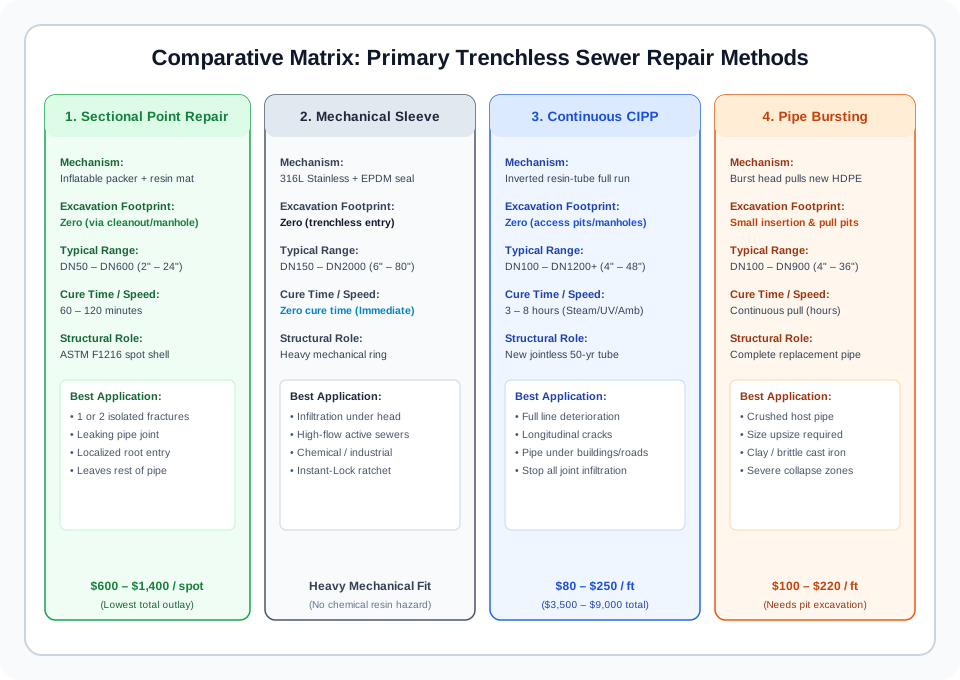
Rather than representing a single proprietary process, trenchless sewer repair consists of four distinct engineering methodologies codified by NASSCO Pipe Rehabilitation and ASCE MOP 145:
1. Sectional point repair (packer-placed patches)
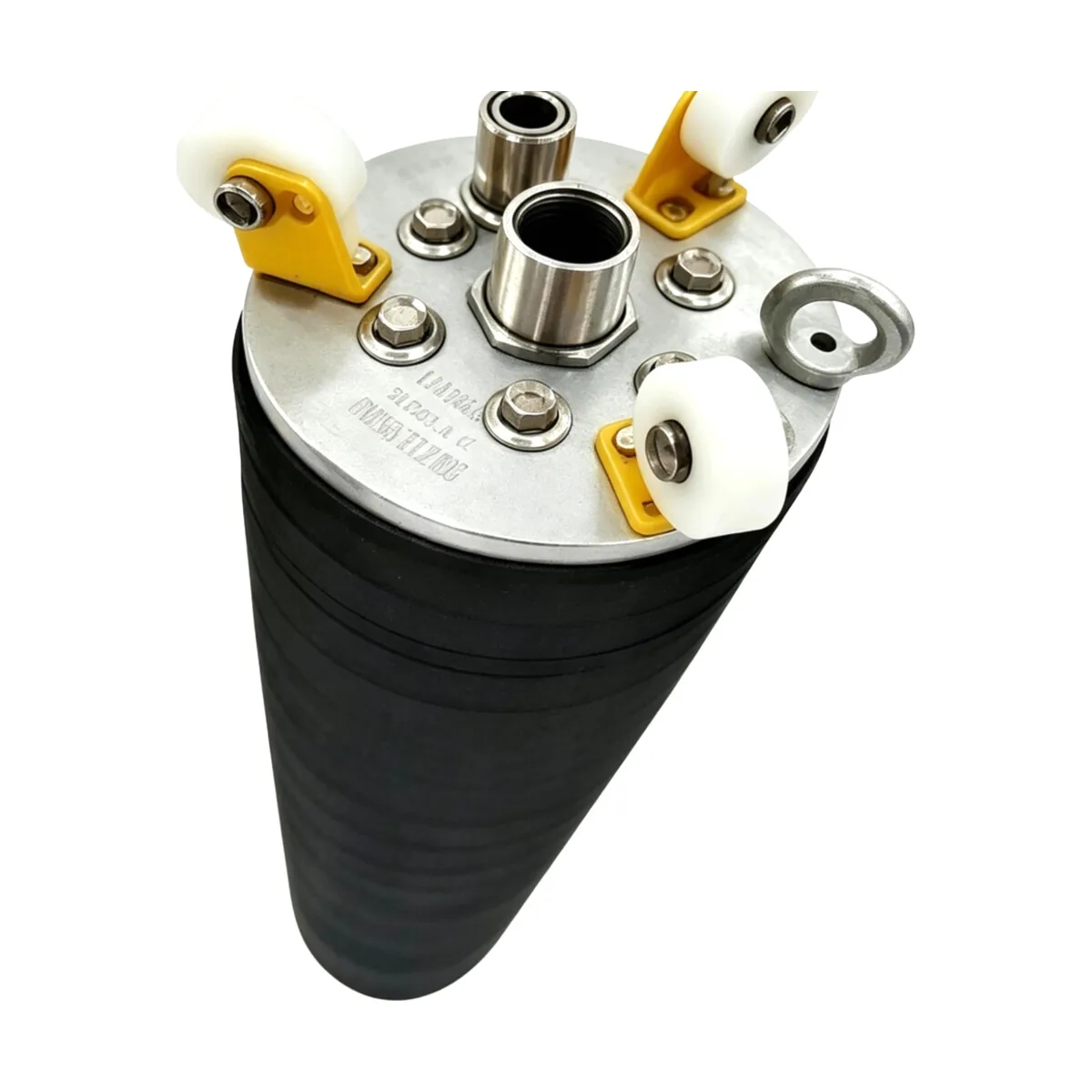
When pipeline defects are confined to discrete locations—such as an isolated root intrusion, cracked bell-and-spigot joint, or localized wall puncture—rehabilitating the entire line is financially unnecessary. An inflatable, wheeled Repair Packer wrapped with a resin-saturated fiberglass mat is navigated to the defect via CCTV guidance. The packer inflates to 1.5–2.5 bar, pressing the composite patch firmly against the host pipe. Within 60 to 120 minutes, the resin cures into an independent structural sleeve spanning 1.0 to 2.0 meters, permanently sealing the defect.
2. Mechanical stainless steel repair sleeves (Instant-Lock)
For pipelines carrying active wastewater flows where resin curing is impractical or where zero chemical wait-time is required, mechanical sleeves provide immediate structural restoration. The Instant-Lock Repair Sleeve consists of an austenitic 316L stainless steel shell encased in a profiled EPDM elastomeric compression gasket. A placement packer mechanically ratchets the sleeve open until its internal teeth lock permanently against the host pipe bore. The repair provides immediate structural reinforcement and hydraulic sealing without any resin or curing time.
3. Continuous Cured-in-Place Pipe (CIPP) lining
For sewers with continuous deterioration, multiple fractures, or heavy acid etching across their entire length, continuous CIPP relining rehabilitates the conduit from manhole to manhole. A resin-saturated needlefelt or glassfiber tube is inverted or pulled through the line and expanded using compressed air or water pressure per ASTM F1216. Heat (steam or hot water) or UV light initiates polymerization, forming a smooth, seamless composite pipe within the host barrel designed for a 50-year service life.
4. Pipe bursting
When a sewer pipe has suffered severe structural collapse, has lost its circular cross-section, or needs an increase in hydraulic capacity (upsizing), pipe lining cannot be used. Pipe bursting uses a high-tonnage pneumatic or hydraulic expanding head pulled through the host conduit. The bursting head fractures the brittle existing pipe (vitrified clay, cast iron, or unreinforced concrete) outward into the surrounding soil while simultaneously pulling a new, continuous High-Density Polyethylene (HDPE) or fusable PVC pipe string behind it per ASTM F585.
Technical and economic comparison across methods
| Method | Access Requirement | Diameter Range | Installation Time | Structural Rating | Average Cost Range |
|---|---|---|---|---|---|
| Traditional Open-Cut | Full continuous trench | All diameters | 2 to 5 days | Full new pipe | $160 – $380+ / ft (excavation-heavy) |
| Sectional Point Repair | Single cleanout / manhole | DN50 – DN600 (2"–24") | 1 to 2 hours | ASTM F1216 spot shell | $600 – $1,400 per patch |
| Mechanical Sleeve | Single cleanout / manhole | DN150 – DN2000 (6"–80") | 30 to 45 minutes | Heavy mechanical ring | $800 – $2,200 per sleeve |
| Continuous CIPP | Manhole-to-manhole | DN100 – DN1200+ (4"–48") | 4 to 8 hours | 50-year structural tube | $80 – $250 / ft |
| Pipe Bursting | Launch and exit pits | DN100 – DN900 (4"–36") | 1 to 2 days | Seamless new HDPE line | $100 – $220 / ft + pit digging |
As demonstrated in technical evaluations by the US EPA Sewer Rehabilitation Guide, traditional open-cut replacement carries lower pipe material costs ($15–$30/ft for standard PVC), but demolition, trench shoring, traffic control, and hardscape reconstruction drive the total project cost to $160–$380+ per linear foot. Trenchless methods absorb slightly higher specialized tooling costs while eliminating surface reconstruction expenses, yielding 30% to 50% net project savings.
Engineering decision framework: How to select the right method
Selecting the correct trenchless technique requires matching pipeline condition data from CCTV surveys against the mechanical capabilities of each method:
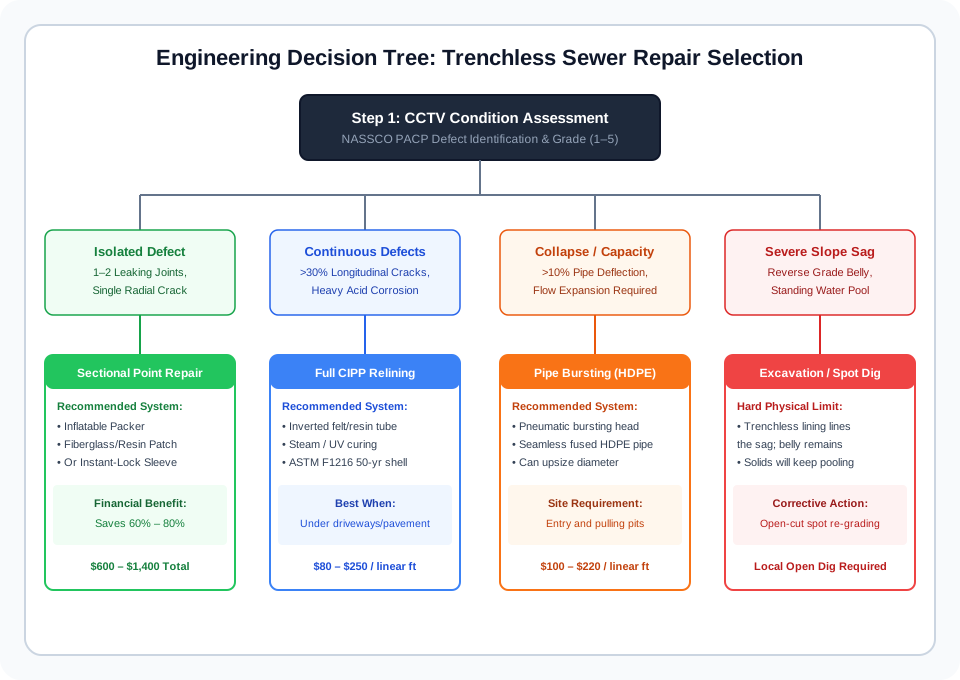
Isolated Joint or Crack (1–2 defects on a 50-ft lateral): Choose Sectional Point Repair or Instant-Lock Sleeves. Relining an entire 50-foot line to fix a single 2-foot root intrusion wastes thousands of dollars. Localized packer repairs address the root intrusion at a fraction of the cost.
Continuous Longitudinal Cracking (>30% of total run): Choose Continuous CIPP Inversion. When the structural integrity of the entire barrel is compromised, continuous lining eliminates all joints and provides complete structural hoop strength.
Severe Structural Collapse (>10% cross-sectional deformation): Choose Pipe Bursting or Open-Cut Spot Replacement. CIPP liners conform to host pipe geometry and cannot expand a crushed, flattened pipe back into a circle.
Hydraulic Capacity Upgrade Required: Choose Pipe Bursting. Bursting allows an existing 4-inch (DN100) clay line to be upsized to a 6-inch (DN150) HDPE sewer main in the same alignment.
Physical limitations: When trenchless repair cannot be used
Trenchless sewer repair is powerful, but professional engineers must recognize its physical limits:
Sewer Bellies and Reverse Slope: A sag in the pipe (belly) where wastewater pools cannot be leveled by trenchless lining. Liners simply line the dip, leaving the hydraulic trap intact. Bellies require physical re-grading via open-cut spot excavation.
Severe Pipe Deflection: If the host pipe has collapsed or deflected by more than 10% of its original internal diameter, lining will create severe wrinkles or fail to pass installation packers.
Unbonded Annular Infiltration: Thermoset resins shrink slightly ( to ) upon curing and do not bond molecularly to contaminated host pipe walls. In high-water-table applications, mechanical rubber end seals must be installed at pipe terminations to prevent water from tracking behind the liner.
Submitting project data for equipment and packer selection
Contractors and municipal utilities specifying repair equipment should gather the following technical parameters:
CCTV Video & PACP Defect Log: Exact defect distance from access manholes and defect severity rating.
Accurate Measured Pipe Bore: Measured internal diameter (ID) and host material (clay, cast iron, concrete, PVC).
Active Inflow Conditions: Groundwater hydrostatic head and whether wastewater bypass pumping is needed.
Access Route Constraints: Manhole depth, access hatch dimensions, and any 45° or 90° bends between entry and defect.
To evaluate equipment configurations for upcoming projects, review our guide on How to Choose a Pipe Repair Packer, read What Is Trenchless Pipe Repair, or contact our engineering specialists directly via the Trenchless Equipment Consultation Form.
FAQ: Trenchless sewer repair questions
Is trenchless sewer repair as durable as traditional pipe replacement?
Yes. CIPP lining and pipe bursting systems installed to ASTM standards (such as ASTM F1216 and ASTM F585) provide a 50-year structural design life. The finished composite liner or continuous HDPE pipe is fully resistant to root intrusion, chemical corrosion, and joint leakage.
What is the primary difference between pipe lining and pipe bursting?
Pipe lining (CIPP) creates a new composite pipe inside the existing host conduit, reducing internal diameter by 5% to 10% while preserving the original pipe structure. Pipe bursting physically breaks and displaces the old host pipe into the surrounding ground while drawing in an entirely new, often larger-diameter HDPE pipe.
Can trenchless sewer repair fix bellies or back-pitched lines?
No. Trenchless lining follows the existing grade of the host pipe. If a sewer lateral has settled and created a belly where solids accumulate, lining will simply follow the depression without correcting the slope. Correcting a reverse grade requires targeted open-cut excavation to re-grade the pipe bedding.
How much excavation is actually required for trenchless sewer repair?
Point repairs and CIPP inversion lining require zero open trenching, accessing the pipe through existing manholes or surface cleanouts. Pipe bursting requires two small pits: an equipment insertion pit and a winch pulling pit. Overall surface excavation is reduced by 85% to 95% compared to traditional open trenching.
References and source documents
Further reading
Article
What Is Trenchless Drain Lining? Methods, Materials, and Bends
Article
Matching Installation Packers to Sleeves and Resin Patches
Article
Can a Repair Packer Reach the Defect? Reviewing the Route
Buyer guide
How to Choose a Pipe Repair Packer
Buyer guide
Sectional Point Repair vs Full-Length CIPP Lining
Buyer guide
What Is Trenchless Pipe Repair? Methods and Limits