
Sewer Line Insurance: Service Line vs Water Backup
A water backup endorsement pays for sewage inside the house; a service line endorsement covers the buried lateral. Compare what each policy part pays.
By Reliance Trenchless Technology8 min read
Many HO-3 homeowners policies exclude a sewer lateral that failed from age, corrosion or roots. A water backup endorsement pays for sewage damage inside the house. A service line endorsement is the part that can name the buried lateral. Read the declarations page before you file, because the endorsement decides which loss is insured.
This guide separates the two endorsements and lists the records an adjuster will ask for. It is a documentation guide, not a coverage opinion. The policy wording, the endorsements printed on your declarations page and the adjuster's decision govern the claim.
What does standard HO-3 insurance cover on a sewer line?
An HO-3 policy covers direct physical loss to the dwelling unless the form excludes it. In practice, a buried sewer lateral is treated as maintenance until an endorsement adds it. The policy form decides, not the plumber's diagnosis. Read the exclusions for wear, deterioration, roots and faulty workmanship before assuming the pipe is covered.
| Policy part | What it responds to | What it usually does not pay |
|---|---|---|
| HO-3 base policy | Direct physical loss to covered dwelling property, subject to the form's exclusions | Gradual wear, corrosion, root intrusion or maintenance |
| Water backup endorsement | Sewage that backs up into the dwelling, plus cleanup and damaged interior finishes | Repair of the buried pipe outside the building |
| Service line endorsement | Direct physical loss to the buried service line, subject to its limit and deductible | The utility main, or a loss the endorsement excludes |
| Utility main | The public main in the street, usually owned by the utility | The private lateral on the property |
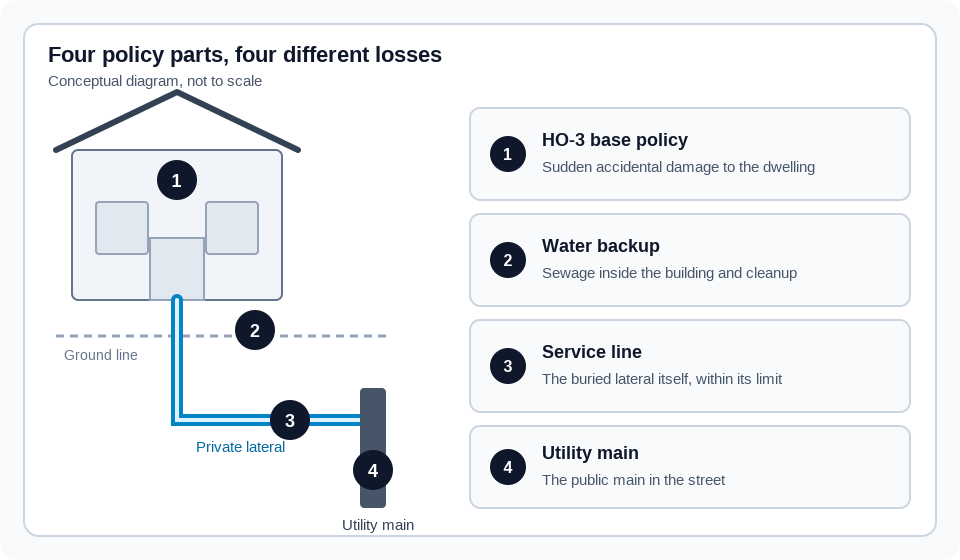
The base policy is not a maintenance contract. If the inspection shows years of joint wear, root intrusion or a repaired section that failed again, the loss may fall under an exclusion even though the repair is urgent. The endorsement is the part that responds to the buried line itself, and its limit may be lower than a full replacement quote.
Service line endorsement vs water backup endorsement: which one pays?
The two endorsements answer different losses. Water backup responds when sewage reverses into the basement or crawl space. Service line responds when the buried lateral is damaged. A single event can trigger both, but the adjuster needs the interior damage and the pipe failure separated on the record.
Ask three questions before you call:
Did sewage enter the building? That points to the water backup endorsement and the interior cleanup record.
Did the buried lateral itself fail? That points to the service line endorsement and the CCTV record.
Is the failed section on the property or in the street? The utility main and the private lateral can have different owners.
A water backup endorsement does not turn into service line coverage because the backup started in a cracked pipe. Likewise, service line coverage does not pay to clean sewage out of a finished basement unless the endorsement also includes that damage. Read both the coverage grant and the exclusions.
What evidence should you collect before calling the insurer?
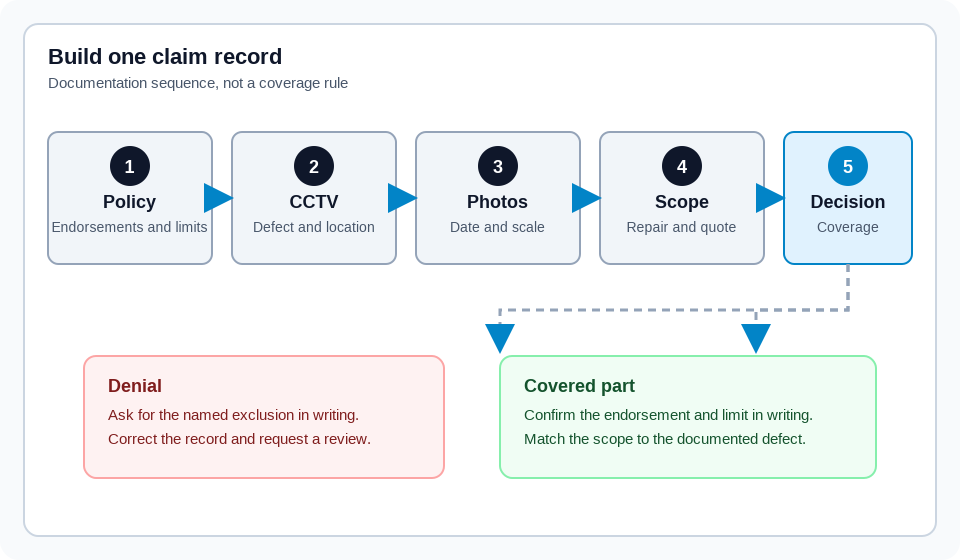
Collect the policy declarations, the CCTV record, the defect location, the cause and the repair scope before the first call. The adjuster decides from documents, not from the word "collapse". Keep every file dated and tied to the same address and loss date.
| Record | What it establishes | What it does not prove |
|---|---|---|
| Policy declarations | Active endorsements, limits and deductible | That this loss is covered |
| CCTV inspection | Defect type, location and before-condition | The cause or the date of failure |
| Photos and video | Visible backup, collapse or damaged interior | Hidden pipe condition |
| Contractor scope and quote | Repair method, quantities and cost | Insurance acceptance |
| Maintenance and repair history | Prior condition and earlier work | Who is legally responsible |
| Utility or municipal records | Main location and ownership boundary | Coverage under your policy |
Do not describe a gradual failure as sudden because the repair is expensive. The maintenance history and the CCTV images will contradict it, and an inaccurate description weakens the whole claim. Describe what happened in time order: the first sign, the date, the response and the inspection result.
How do you separate a covered event from a maintenance exclusion?
A covered event has a date, a cause and a sudden loss. A maintenance exclusion has a history: corrosion, roots, joint wear or repeated patches. The same pipe can show both. Separate the event from the condition before you write the claim summary.
| Scenario | What the record should show | Which policy part may respond |
|---|---|---|
| Sewage backed up after a storm | Inflow path, interior damage and cleaning invoice | Water backup endorsement |
| Lateral collapsed after a sudden load | Pre-event condition, collapse date and CCTV | Service line endorsement, if active |
| Roots found during routine cleaning | Maintenance history and repeated blockage | Often excluded as maintenance |
| Joint leak found during a CCTV survey | Defect location and repair scope | Service line endorsement, subject to exclusions |
If the only evidence is a blockage and a root cut, the file looks like maintenance. If the pipe collapsed under a known event and the pre-event condition was sound, the file looks like a sudden loss. The difference is the record, not the vocabulary.
What should you send to the adjuster?
Send one indexed file with the policy number, loss date, address, CCTV video and stills, defect log, contractor scope, quote and photos. Ask the adjuster to confirm the endorsement and its limit in writing. Keep a copy of everything you upload.
A usable claim pack contains:
The declarations page and the endorsement wording, with the policy number visible.
CCTV video with the inspection date, the address and the distance from the access point.
Stills of the defect, the surrounding pipe and the access point.
A defect log that names the defect type and location.
Photos of the backup, the damaged interior or the collapsed section.
The contractor's scope, quantity and quote, separated into excavation, lining, point repair and reinstatement.
Maintenance and repair records for the same address.
A short timeline that separates the event from the pre-existing condition.
If the repair is a localised joint defect rather than a failed run, the quote may include a mechanical sleeve or an internal joint seal. The CCTV inspection guide lists the records a contractor should capture, and the sectional repair guide explains how a point repair is scoped. Those records help the adjuster see the boundary between the defect and the rest of the line.
What if the claim is denied or the limit is too low?
A denial should name the policy exclusion and the evidence used. Ask for that clause in writing, correct factual errors, and request a review. If the buried lateral is not insured, compare a focused point repair with a full replacement and get a scope that matches the defect.
The next step depends on the defect, not on the claim outcome. A single leaking joint, a short cracked section and a collapsed run are different repairs. The Instant-Lock Small sleeve page gives the measured-bore range for a localised structural repair, and the point repair systems page separates sleeves, packers and resin patches. Send the CCTV record and the measured bore to the point repair enquiry if the insurer pays only for a local repair.
The technical check for this guide was the Reliance point-repair catalogue reviewed on 2026-11-26. It is not an insurance coverage opinion, a legal opinion or a promise that a particular loss is covered.
FAQ: Sewer line insurance and endorsements
Does homeowners insurance cover sewer line replacement?
Usually not under an HO-3 policy when the cause is age, corrosion or roots. A service line endorsement may pay for a sudden accidental loss to the lateral, up to its limit and after the deductible. Water backup coverage pays for sewage damage inside the home, not the pipe in the yard.
Is a water backup endorsement the same as service line coverage?
No. Water backup responds to sewage that reverses into the dwelling. Service line coverage responds to damage to the buried service line itself. The declarations page lists each endorsement and its limit; one does not replace the other.
Who owns the sewer lateral, the homeowner or the city?
Ownership varies. Many utilities own the main in the street and the homeowner owns the lateral to the connection point, but the boundary can sit at the property line, the curb or the main. Check the local sewer ordinance or utility map before assuming who pays.
What documents should I collect before filing a sewer claim?
CCTV video with location and date, stills of the defect, the inspection log, photos of the backup or collapse, the contractor's scope and quote, maintenance records and the policy declarations. Keep the files indexed by address and loss date.
References and source documents
Share this article
Continue with AI
Bring this article into your own conversation.
Preferred Sources
Keep up with Reliance Trenchless on Google.
Availability depends on your account and region.
Further reading
Article
Repair Packer Delivery Inspection: Order vs Equipment
Article
Specifying Trenchless Pipe Rehabilitation: ASTM vs GCC Requirements
Article
Internal Pipe Repair Sleeves: Defect Coverage vs Sleeve Length
Buyer guide
Sectional Point Repair vs Full-Length CIPP Lining
Buyer guide
What CCTV Inspection Information Is Needed Before Pipe Point Repair?