Sectional point repair: joint seal, sleeve, patch or CIPP?
A sectional point repair starts with the survey: the defect picks joint seal, sleeve, patch or liner, and the defect count decides the reach.
Application Overview
Chapters
Each chapter opens the video at that point on YouTube. Read the script under each chapter. From the subtitle track delivered with the video. Refer to the video and product documentation for technical details.
- 010:00How to read a sewer defect before choosing a repair
A sectional point repair is not one product. It is four different answers to the same leak. Under a live street, a sewer joint has been leaking for months. A camera crawler finds it in one run. But a leaking pipe is not a specification. Where it sits, how far it runs, and whether the wall around it is still sound.
- 020:21Internal joint seal, repair sleeve or resin patch: how each one works
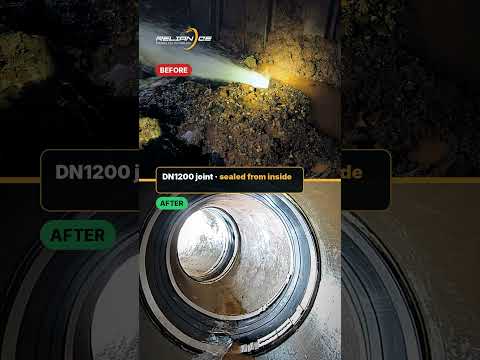
Route one is an internal joint seal. Two stainless bands press a rubber sleeve across the joint. The rubber takes the water, and the steel holds the rubber. Inside, the water pressure pushes the rubber onto the wall. Outside, groundwater pushes in from behind. The stainless bands keep the rubber compressed against the wall. Route two is a mechanical repair sleeve. A rolled stainless shell in a rubber jacket rides in on a packer. It unrolls to the wall, and a ratchet locks it open. No resin, and no cure time. Nine sizes, from DN150 to DN600. Route three is a resin and fiberglass patch. A packer carries the wet patch to the crack and presses it onto the wall. The pressure squeezes the air out and holds it while the resin cures. Twenty minutes to work, forty to cure, in summer. Route four is not a point repair at all. A resin-soaked liner is inverted through the whole reach and cured in place. That is CIPP, and Reliance does not supply the liner. So the question is not which product, but how much pipe.
- 031:25Sectional point repair or full-length CIPP lining
Now count the defects on the reach. Three or fewer, and the pipe has kept its shape. Sectional repairs cut life-cycle cost by forty to sixty percent. Under three defects, spot repairs hold. Over four, line the reach. That is the break-even a survey gives you. Past four failures on one reach, every mobilisation compounds. Then a liner through the whole run is the lower-risk choice. The street above never closed.
- 041:52What to send a supplier for a point repair quote
So the survey is the product decision. Send four things. Where the defect sits, how far it runs, whether the wall is sound. And how many defects are on the reach. Send the survey, and we will quote the route, not the product.
Resources
Product videos
Explainer videos and short demonstrations from Reliance’s official YouTube channels. Browse every published video by topic and follow each one to its reviewed watch page or official YouTube source.