
Video · English
Trenchless Sewer Repair: How Do You Prove It Holds?
A trenchless sewer repair is only accepted when a pressure test proves the repaired section holds: both ends sealed, the medium chosen and the gauge read.
Application Overview
Illustration: the test section, plug and gauge are drawn by the engine; no job footage was used. TP-DN150 is described as 100 mm / 4 in and the brochure does not call that a pipe-fit range.
Chapters
Each chapter opens the video at that point on YouTube. Read the script under each chapter. From the subtitle track delivered with the video. Refer to the video and product documentation for technical details.
- 0:00
Trenchless sewer repair: how do you prove it holds?
Trenchless sewer repair is only finished when it holds pressure. Not when the camera shows a clean patch. Under this road, a repair is finished and the street is still closed. Before the traffic comes back, someone has to prove the repair holds.
- 0:14
What a pressure test has to prove
A pressure test closes the repaired section at both ends. An inflatable test plug seals the bore, and a hose brings the test medium in. Then the section is filled and brought up to test pressure. The plug holds the ends of the section. The gauge shows whether the pressure stays.
- 0:33
Water test or air test: stored energy
The test puts stored energy into the repair. Air compresses, so a small volume of air stores a large amount of energy. Water is nearly incompressible, so at the same pressure and volume it stores far less. That is why the guidance prefers water or another fluid where it can. So an air test and a water test are different evidence. Read which medium the project's test method requires, and keep that method on the record.
- 1:00
Test plugs: sealing both ends of the repair
The published pair is in the table: four inside and three behind, or six inside and five behind. That is the plug's rating, not your project's test pressure. The plug goes down the manhole, not through the road. It travels to the end of the repaired section and inflates against the wall. The other end is closed the same way. Then the section is filled, held, and read. The road above never opens. Choose a test plug by measurement, not by the model name. TP-DN150 is described as 100 millimetres, and the brochure does not call that a pipe-fit range. The published rows give a 4 bar series and a 6 bar series. And a testing plug is a separate family from a blocking plug.
- 1:44
Hold the pressure, record it, and order the plug
Now the hold. The section is full, the plugs are sealed, and the gauge is read at test pressure. A gauge that falls is a leak, not a reading. So the test is run before the surface reopens. Then the record. It names the plug, its configuration and its serial number. Then the medium, the pressure at each stage, and how long it was held. And the gauge that read it, with the result. To order the right plug, send four things. The measured inner diameter, not the nominal size. The medium, and the pressure the plug has to hold. Quantity, and where it ships. Then we can quote the plug. Send us the measured bore and the test pressure, and we will match the test plug.
Resources
Product videos
Explainer videos and short demonstrations from Reliance’s official YouTube channels. Browse every published video by topic and follow each one to its reviewed watch page or official YouTube source.
 0:48
Short demonstrations ·
Trenchless Sewer Repair: Proved by Pressure Test #Shorts
 0:35
Short demonstrations ·
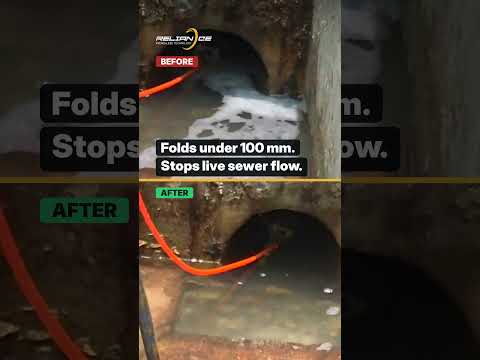
Custom Pipe Plug Folds Under 100 mm, Stops Live Sewer Flow | DN150–DN300
 3:16
Explainer videos ·
Pipe Plug Test Report: What Must It Prove?