
Can One Repair Packer Serve Several Pipe Diameters?
Read a repair packer diameter range correctly: separate the sealing range from the minimum inner diameter, and check where the Reliance documents differ.
By Reliance Trenchless Technology9 min read
Share this article
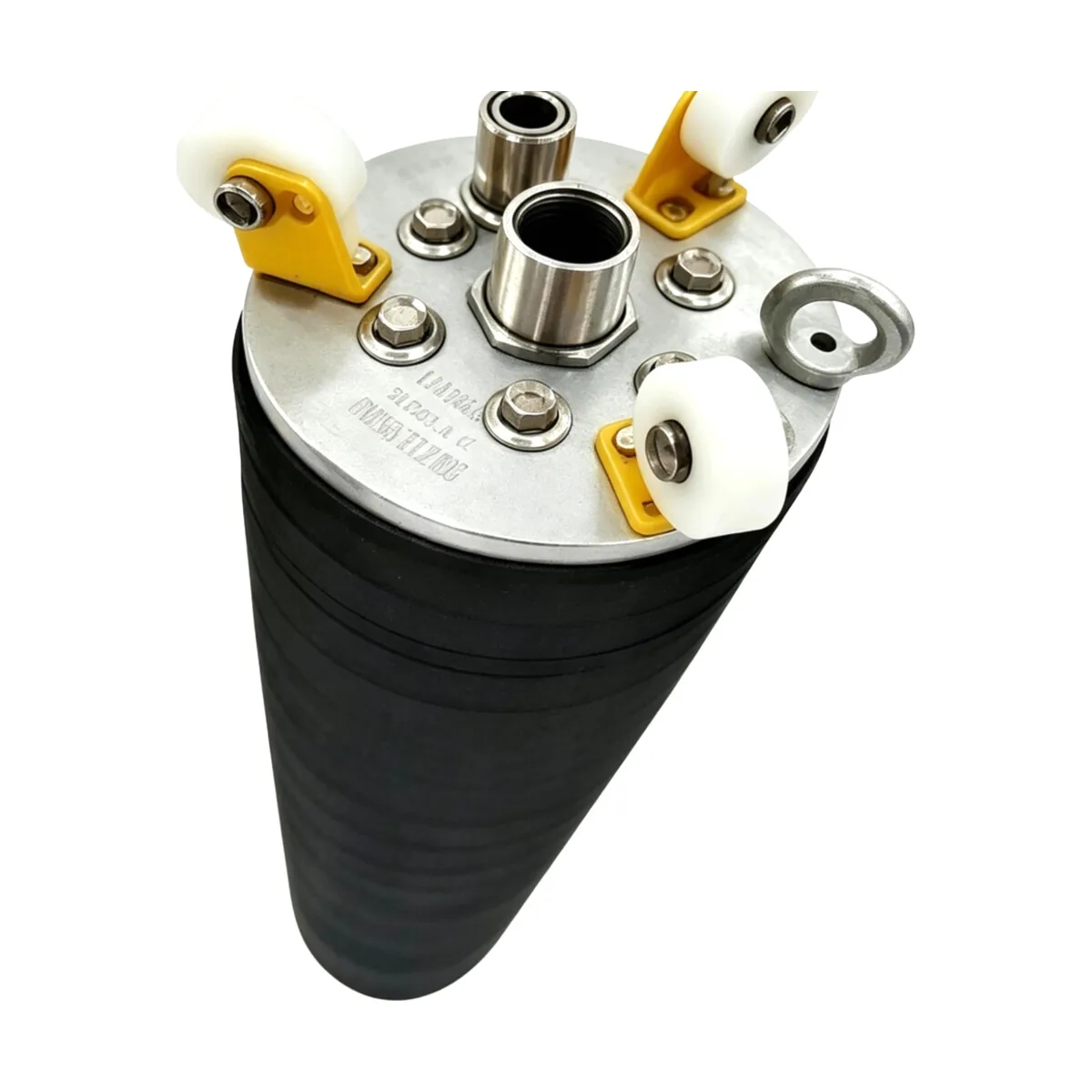
A repair packer can serve more than one pipe diameter, but not every diameter in its model name. The Reliance RP 800-1400 is listed for a 800–1400 mm pipe range, while the same specification table gives it a Min. Inner Dia. of 560 mm. Those two numbers describe different jobs: one is the bore range the inflated body is meant to seal, and the other is the smallest bore the deflated tool can be brought through.
That distinction decides whether one packer covers a mixed-diameter programme or whether you need two models. Reliance publishes a wheeled repair packer family with overlapping nominal ranges, and the current documents do not agree on every model. This article shows how to read the fields, where the documents conflict, and what to put in writing before ordering.
One model name, two diameter questions
A model such as RP 300-400 carries two numbers, but neither is a measurement of your pipe. The pair names a suitable pipe range. The row also carries a separate Min. Inner Dia. value, which the spreadsheet prints as 210 mm for that model.
| What the number describes | RP 300-400 | What it does not tell you |
|---|---|---|
| Suitable pipe range (model name) | 300–400 mm | The bore at your specific defect |
| Min. Inner Dia. (spreadsheet) | 210 mm | The bore the inflated body will seal |
| Deflated length (spreadsheet) | 950 mm | The usable repair coverage |
| Inflation pressure (max) | 2 bar / 30 psi | A site setting without the model instructions |
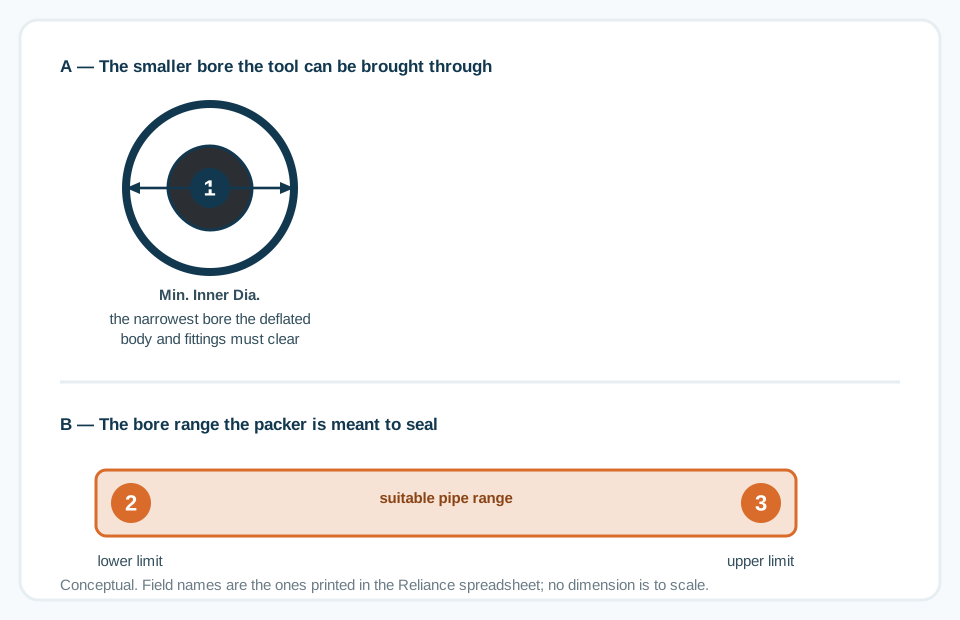
The gap between the model's lower number and its Min. Inner Dia. is not a rounding difference. It runs from 2 mm at RP 100-200 to 320 mm at RP 800-1000, then narrows to 240 mm on the two larger 800-series models. On the Reliance spreadsheet, RP 300-400 lists 210 mm against a 300 mm lower bound, RP 800-1000 lists 480 mm against 800 mm, and RP 800-1400 lists 560 mm against 800 mm.
Read those figures as printed, not as an allowance you can rely on. The spreadsheet gives a single minimum value per model and does not explain how it was derived, whether it includes wheels and end fittings, or what clearance remains once the tool is inside. Those are questions for the supplier, not values to infer.
Read the deflated body separately from the sealing range
The Min. Inner Dia. column sits beside Deflated Length in the spreadsheet, which is a hint about its role: it belongs with the tool's physical envelope, not with the sealing duty. A deflated packer has to travel from the access point to the repair, and the tightest point on that route may be smaller than the pipe at the defect.
NASSCO's assessment guidance describes laser and sonar profiling that quantifies absolute diameters, ovality and offsets, and notes that equipment calibration and operator training affect confidence in that data. That is the measurement side. It does not supply a packer fit value, and no profiling accuracy turns a nominal label into a bore.
The practical consequence is that a single packer can plausibly serve a project with mixed diameters only when both conditions hold for every position: the deflated assembly passes the narrowest point on the route, and the bore at each repair sits inside the suitable range. Where a project has one 350 mm section and one 900 mm section, one model cannot satisfy both, whatever the model name suggests.
Compare the three Reliance documents before choosing
The brochure, the spreadsheet and the product page do not list the same models, and where they overlap the values sometimes differ. This is the finding that most affects a purchase decision, so it is worth stating plainly.
| Model | Plugs brochure, page 1 | Spreadsheet | Site product page | Difference found |
|---|---|---|---|---|
| RP 70-150 | Listed | Not listed | Listed | Brochure and site only |
| RP 100-200 | Listed | 98 mm min, 530 mm length | 98 mm min, 550 mm length | Deflated length differs by 20 mm |
| RP 150-250 | Listed | 120 mm min, 820 mm length | 120 mm min, 820 mm length | None |
| RP 200-300 | Listed | 150 mm min, 760 mm length | 150 mm min, 760 mm length | None |
| RP 300-400 | Listed | 210 mm min | 220 mm min | Min. Inner Dia. differs by 10 mm |
| RP 300-500 | Listed | Not listed | Listed | Brochure and site only |
| RP 400-500 | Listed | Not listed | Listed | Brochure and site only |
| RP 400-600 | Listed | Not listed | Listed | Brochure and site only |
| RP 600-800 | Listed | 420 mm min, 1300 mm length | 420 mm min, 1300 mm length | None |
| RP 800-1000 | Listed | 480 mm min, 1550 mm length | 470 mm min, 1500 mm length | Min. Inner Dia. and length differ |
| RP 800-1200 | Listed | 560 mm min, 1770 mm length | 560 mm min, 1770 mm length | None |
| RP 800-1400 | Listed | 560 mm min, 2000 mm length | 560 mm min, 2000 mm length | None |
| RP 1000-1500 | Listed | Not listed | Listed | Brochure and site only |
Two further models, RP-L 200-300 and RP-T 800-1200, appear in the spreadsheet and on the product page but not in the brochure's wheeled list. The spreadsheet also carries RP 50-90, RP 70-120 and RP 500-600, which appear in neither the brochure list nor the current product table.
None of these differences should be resolved by picking the number that looks more conservative. A 10 mm difference in a minimum bore and a 50 mm difference in deflated length can both change whether a tool passes an entry or seats correctly. Report the difference and ask which figure applies to the configuration being quoted.
Check what the video does and does not establish
The custom DN250–300 repair packer video shows a build with wheels and a central bypass. Its public description gives a size range, a lead time and the fitting arrangement.
That is a first-party example of a configuration, not a fit table. The video does not state a minimum inner diameter, a deflated length or a pressure rating, and the article does not use it as a measurement source. Its value is narrower: it confirms that the range in a model name can be customised, which is exactly why the confirmed drawing matters more than the catalogue row.
Put the diameter decision in writing
Before ordering, ask for a written statement that ties together the model, the configuration and the measured bore. The useful version is specific.
The exact model and any suffix, such as RP, RP-L or RP-T.
The suitable pipe range and the minimum inner diameter, as they apply to that configuration.
Whether the minimum inner diameter accounts for wheels, end fittings and hose connections.
The deflated length and outside dimensions of the complete assembly.
The maximum inflation pressure for that model, with the instruction revision it came from.
The repair packer selection guide covers the wider enquiry, including repair length and bypass. This article covers only the diameter question, which is the one the documents disagree on most often.
For the sealing side of the same decision, the packer length and repair coverage article separates overall length from usable contact length, and the packer route review article covers whether the tool can reach the defect at all. A packer that fits the bore but cannot reach it, or reaches it but covers too little of the defect, is not a usable selection.
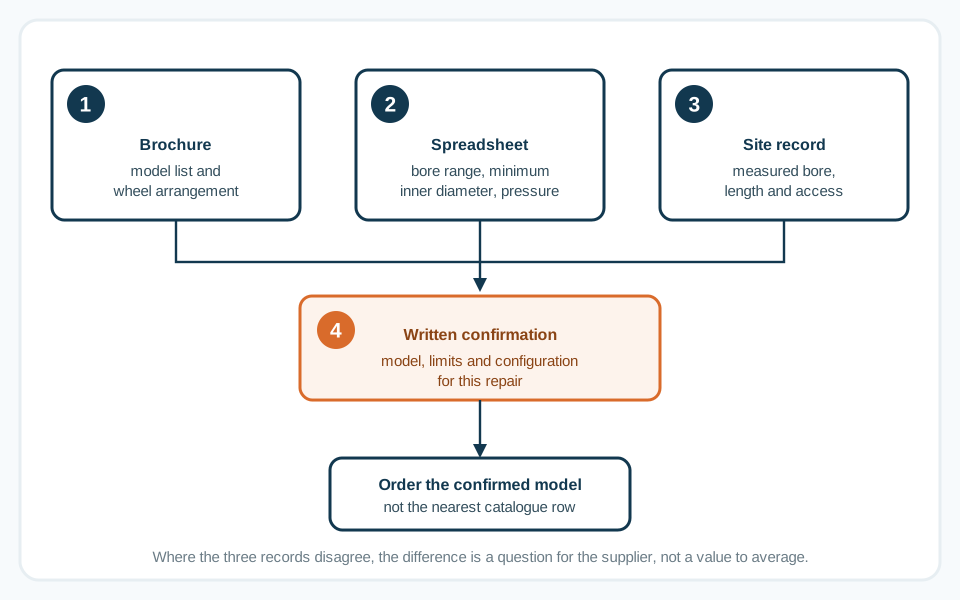
Send the measured bore at each repair position, the tightest restriction on the route, the repair length and the access opening through the repair packer enquiry. Where a model appears in one Reliance document but not another, say so in the enquiry. That is faster than discovering the difference after the tool has been built.
FAQ: Repair packer diameter ranges
Can one repair packer serve several pipe diameters?
It can serve a range of diameters, not any diameter. Each model is published against a suitable pipe range, and the tool also has a separate minimum inner diameter that governs whether it can be brought to the repair. A model listed for 800–1400 mm is not a tool for every bore between those figures at every position in a project.
Why is the Min. Inner Dia. smaller than the model's lower number?
The two fields answer different questions. The model name gives the pipe range the packer is intended to seal, while the minimum inner diameter describes the smallest bore the deflated tool can pass through. The Reliance spreadsheet prints a single value per model and does not explain how it was derived, so treat the gap as a question for the supplier rather than as usable clearance.
The brochure and the spreadsheet list different models. Which one applies?
Neither is automatically the controlling document. The brochure page 1 lists wheeled and bypass model names without bore or pressure columns, the spreadsheet carries full specification rows for a partly different set of models, and the product page shows a third combination. Ask which models and values apply to the configuration in your quotation, and keep that written answer with the order.
Do I still need to measure the bore if the model range covers my nominal size?
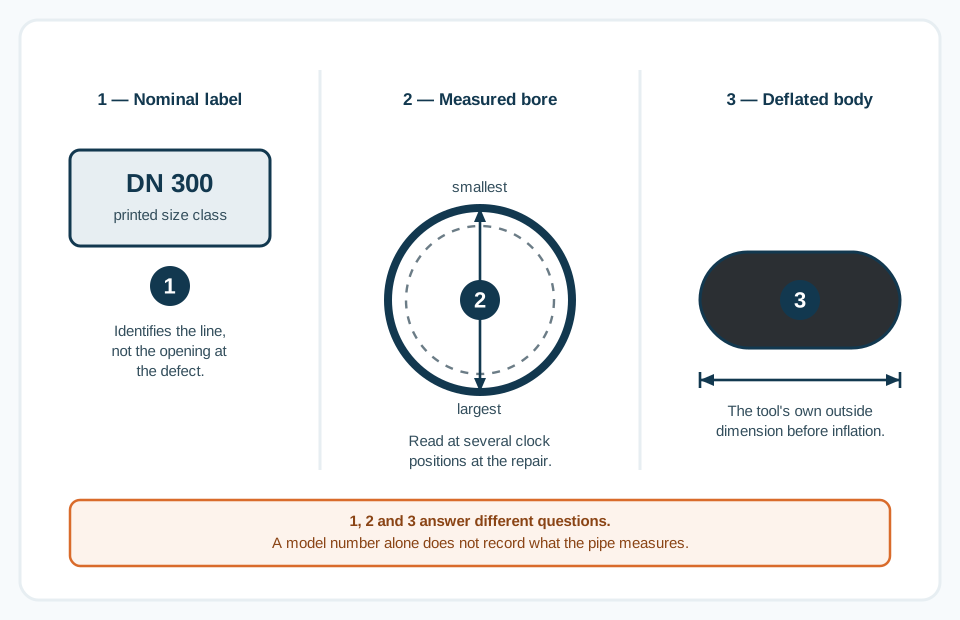
Yes. A nominal designation such as DN300 is a size class, not a measurement of the opening at the defect. Settlement, an offset joint, a lining or a previous repair can all change what the packer meets. NASSCO's assessment guidance describes dimensional inspection that quantifies absolute diameter, ovality and offsets; the recorded values at the repair position are what the fit review needs.
Does a wheeled packer need more clearance than a plain one?
The spreadsheet does not separate the minimum inner diameter by wheel arrangement, so it cannot answer that from the published table alone. Wheels, end plates and hose connections all form part of the assembly that has to pass the tightest point. Ask whether the quoted minimum inner diameter includes those fittings for the exact model and configuration.
References and source documents
Further reading
Article
RCP Stormwater Joints: Evidence Needed for Internal Sealing
Article
What Is Trenchless Drain Lining? Methods, Materials, and Bends
Article
What Is Trenchless Sewer Repair? Methods, Limits, and Selection
Buyer guide
How to Choose a Pipe Repair Packer
Buyer guide
Point Repair Equipment Checklist