
Does Every Joint in a Pipeline Need Sealing? Scoping Joint Repairs from Inspection Records
Why joint-repair scope should follow inspection evidence, what to record for each joint, and when joint-by-joint sealing needs a wider technical review.
By Reliance Trenchless TechnologyPublished 5 min read
Short answer: no. A joint-repair scope should follow what the inspection actually shows, joint by joint. Some joints in a line may show infiltration, exfiltration or displacement while their neighbours look sound. Sealing only the recorded joints can be reasonable when the problem really is limited to those joints. When defects are widespread, mixed with pipe-wall damage, or poorly recorded, the question is no longer "which joints?" but "what repair scope does this line need?", and that calls for a wider technical review.
This article explains how to get from an inspection record to a defensible joint-repair scope. It does not diagnose a particular pipeline or approve a product for it.
Why "seal every joint" is the wrong starting point
Treating every joint the same is tempting because it is simple to specify. It also skips the step that makes a repair scope defensible: linking each proposed repair to an observed condition.
A blanket instruction can put money into joints that show no defect, while missing what the inspection does show between joints, such as cracks or deformation that a joint seal is not designed to address. Reliance's internal pipe seal is described for the joint area between pipe sections where infiltration or exfiltration is present. That description is the reason to identify those joints first, not a reason to install seals everywhere.
The opposite shortcut is just as risky. Sealing only the one joint that is visibly running can leave neighbouring joints with recorded defects unaddressed and the same complaint coming back later.
Start from an inspection record you can trust
A useful scope starts with a record that ties each observation to an identifiable pipe and a location within it. NASSCO describes CCTV assessment and standardised condition records as part of pipeline assessment. Consistent records make it possible to compare one joint with the next instead of relying on a few memorable screenshots.
For each joint you are considering, the record should let a reviewer answer:
Which asset, survey date and direction does the observation come from?
Where is the joint, by distance reference and video timestamp?
What was observed at the joint: water entering, water leaving, an open gap, offset, deposits or roots?
What does the pipe look like on each side of the joint?
What could not be seen because of standing water, debris, fogging or obstruction?
Our guide to the CCTV information needed before point repair covers these fields in more detail, including how to keep measured values separate from visual estimates.
Sort the joints before you choose a product
Once each joint is identified, sorting the line into groups makes the scoping conversation much clearer. The groups below are a way to organise evidence. They are not engineering acceptance criteria.
| Inspection finding | What it suggests reviewing | Related Reliance information |
|---|---|---|
| A recorded joint with infiltration or exfiltration, pipe sound on both sides | Whether an internal joint seal configuration suits that joint's measured bore, seating area and access | Internal pipe seal, joint seal measurement guide |
| A joint defect with cracking or other damage in the adjacent pipe wall | Whether the task is joint sealing, a localised repair of the damaged length, or both | Joint seals vs repair sleeves |
| Several recorded joint and wall defects spread along the same section | Whether repeated local repairs are still the right method or a longer repair scope should be assessed | Sectional point repair vs full-length CIPP |
| A joint that looks sound in the record | Usually no repair is proposed from the record alone; note it as observed rather than assumed | CCTV information guide |
| A joint that could not be seen clearly | Re-inspection or cleaning before scoping, rather than a guess in either direction | CCTV information guide |
Keep joint leaks and pipe-wall defects apart
A leaking joint and a cracked pipe wall can appear in the same section and even in the same video frame. They are different tasks.
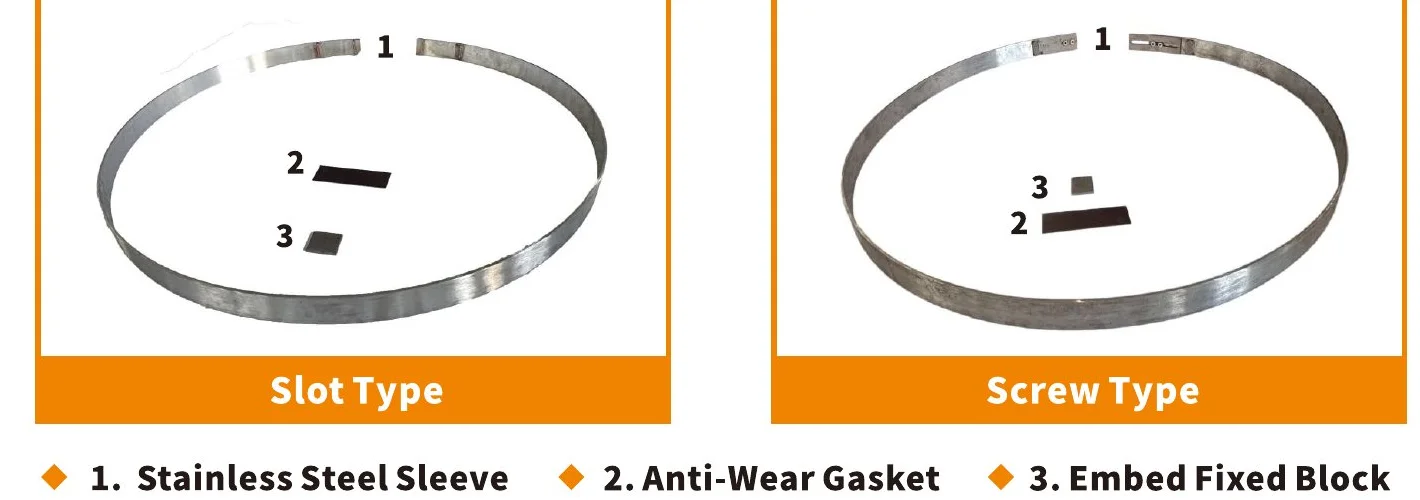
An internal joint seal addresses the joint between two pipe sections. Reliance's brochure describes it as stainless steel sleeves, a rubber sealing element and installation accessories, with slot-type and screw-type ring assemblies and published rubber widths of 270, 350 and 500 mm. Internal repair sleeves such as the Instant-Lock small and large ranges are presented for localised internal rehabilitation and have their own dimensions and installation equipment.
Neither category should be chosen from appearance or from a shared word such as "seal". Record which defect sits where, and let the review decide which task each location needs. The joint seals vs repair sleeves comparison sets out the questions to compare.
When joint-by-joint repair needs a wider review
Joint-by-joint sealing is a scoping choice, not a default. Ask for a wider technical review before committing to it when:
the inspection records defects at many joints in the same section, so the number of individual repairs becomes the main design question;
joint defects are mixed with cracks, deformation or other damage between joints;
the bore changes along the section, or measurements are missing or conflict between records;
access, flow control or the time available for each set-up limits how many individual installations are practical;
the conveyed medium or service conditions have not been confirmed, since a "rubber seal" description does not establish compatibility with every medium or temperature.
This list does not set a number of joints beyond which another method must be used. That judgement depends on the project's records, requirements and constraints, and belongs with the engineer responsible for the work.
What to send for a joint-sealing review
If the evidence points to sealing specific joints, a review is faster when the enquiry identifies those joints clearly. Include:
The asset reference, survey date and original inspection video and report.
A list of the joints proposed for sealing, each with its distance reference, timestamp and observed condition.
The measured internal bore on each side of each joint, where it was measured and how.
Observations of the joint opening, offset and surrounding surface, marked as measured, estimated or unknown.
Access to the joint locations and any constraints on installation equipment.
The conveyed medium and known operating conditions, with units and sources.
The joints you are not proposing to seal, and why, so the reviewer can see the whole section.
Reliance's internal pipe seal brochure lists DN200–3000 and customised sizes, with individually published rows from DN200 to DN1800 in the specification table. Measure the internal diameter before ordering; the configuration, material grade and installation equipment still need to be confirmed for the actual location.
Next step
Prepare the joint list and inspection records, then send a project enquiry. For measurement details, use the internal pipe joint seal measurement guide.
Sources
Further reading
Buyer guide
Internal Pipe Joint Seals: What to Measure Before Ordering
Buyer guide
Internal Pipe Joint Seals vs Repair Sleeves: What Is the Difference?
Buyer guide
Sectional Point Repair vs Full-Length CIPP Lining
Buyer guide
What CCTV Inspection Information Is Needed Before Pipe Point Repair?